3 Infrastructure Checks Before You Automate Content Marketing Strategy

What You Need to Know
- Content demand rose 93% between 2023 and 2024, after a 55% jump the year before. That puts volume at about three times 2022 levels.
- Marketing leaders who automate report 29% more revenue impact from content and are 24% more likely to keep up with demand.
- 47% of organizations now use GenAI to brainstorm content ideas, up from 28% in 2023, and 90% of leaders say content matters more than it used to.
- Among organizations that haven't adopted GenAI for content yet, change management is the most common concern.
Run the Infrastructure Checks Before You Turn Anything On
The part most teams underestimate is what automation copies. When demand climbs this fast, weak spots in your content operation stop being small annoyances and become repeatable defects: inconsistent messaging, missing metadata, fuzzy ownership, and reports that can't show whether extra output did anything.
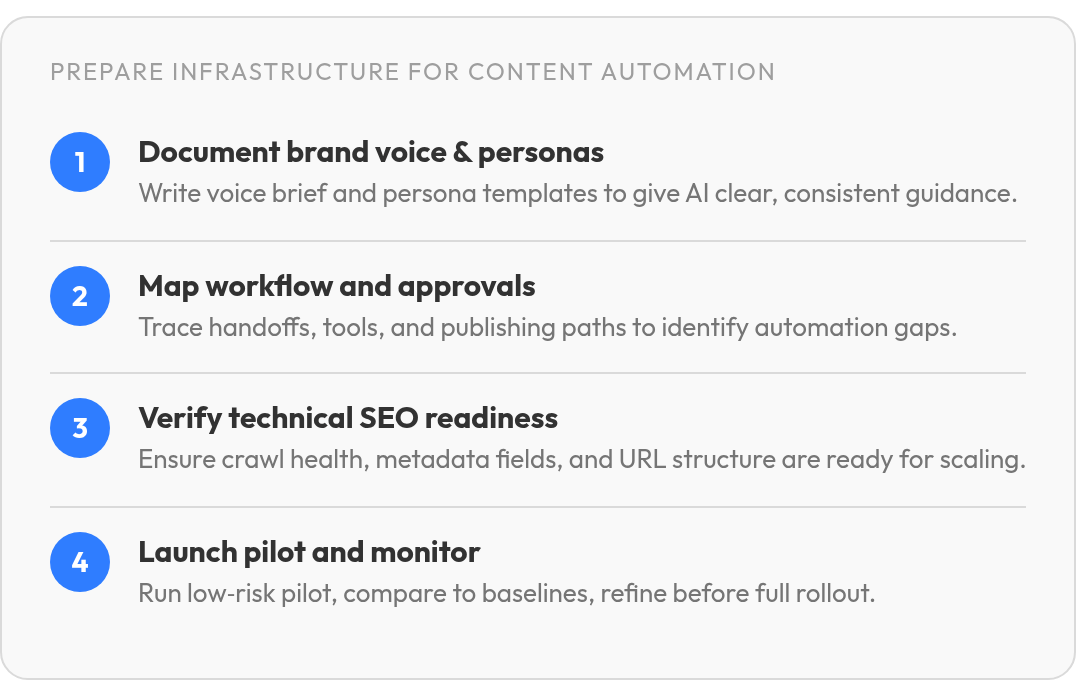
Audit the systems underneath before you automate your content marketing strategy. Automation can raise throughput and make content ops easier to run, but it also strips out the informal safeguards that slower work relies on. A sharp editor, a last-minute SEO pass, or a Slack nudge from the channel owner can catch problems one at a time. At scale, those one-off saves do not keep up.
Automation Enforces Only the Standards You Wrote Down
Automated review checkpoints can raise quality, but only against a standard someone documented. Without a written brand voice, personas, or goals, approval routing moves drafts faster and checks nothing. The infrastructure checks give those checkpoints something to measure against before volume multiplies every gap.
The fan-out makes this worse. One approved piece becomes many channel variants, each with less human review. A tone slip an editor used to catch in a single post can show up in every repurposed version. Tooling is only half the readiness question. Your team also needs a practical way to take on new responsibilities, checkpoints, and review habits before the system produces more than people can comfortably inspect.
Infrastructure check: a review, done before you automate, of the inputs, workflows, governance, and measurement your AI content process depends on.
KPI alignment: lining up content goals, audiences, production workflows, and metrics before anything runs on autopilot.
Three Checks, Sized by Effort and Risk
The checks start with your inputs and work outward to the site itself. The durations below are relative estimates, not benchmarks. If you publish a few pieces a month on one channel, you can skip the full workflow map. A short brand review is enough.
| Check | Purpose | Typical duration | Skill level | Risk mitigated |
|---|---|---|---|---|
| Brand/persona review | Document voice, personas, goals | Shortest | Beginner to intermediate | Off-brand output at scale |
| Workflow mapping | Trace handoffs, approvals, channels | Moderate | Intermediate | Skipped reviews, bottlenecks |
| Technical SEO review | Confirm site and tracking readiness | Longest | Intermediate to advanced | Unmeasurable content |
- Write down voice rules and personas so automated checkpoints have criteria to enforce.
- Map every handoff and approval in your content pipeline to see where automation removes a human reviewer.
- Tie each content goal to one metric so you can see what automation actually changes.
Check #1: Give the AI a Persona and Voice It Can Actually Use
The first thing an AI workflow reads is your audience definition, and plenty of teams have never written one down. Before you automate, confirm that the inputs you hand the tool describe real buyers and one consistent voice. Vague inputs turn into a pile of off-target drafts once output goes up.
We put this check first because the other two depend on it. Deloitte Digital's research ties the surge in content demand to the push for more relevant, personalized customer experiences that drive loyalty and conversion. You cannot personalize at scale without persona notes a machine can act on. If you send one newsletter to one list, a one-page brief is enough and the full persona build can wait.
What Should Your Voice Brief and Persona Template Include?
A voice brief should be short enough to paste into a prompt and specific enough to reject a bad draft. A persona template should record what buyers want, what stops them, and how they talk. Use this test: if a reviewer cannot use a document to approve or reject a piece, the AI cannot use it either.
- Write a voice brief covering tone, vocabulary, point of view, approved claims, banned phrases, and per-channel style notes. Approved claims carry the most weight, because AI tools tend to embellish when they don't have them.
- Build each persona around goals, pain points, buying triggers, preferred language, objections, and favorite content formats. The objections tell the tool which arguments to make.
- Turn both documents into the reusable instructions or prompt fields your AI tool reads. Expect a few drafting cycles before the outputs stop drifting.
How Do You Audit Existing Content Before Automating?
Review what you've already published before the machine learns from it. Older posts often carry stale claims and mixed messages, and automation will repeat them in every new piece unless you fix them first.
- Pull recurring themes and top-performing topics into a pillar list the AI can draw from.
- Flag outdated claims and retire them from your source material.
- Mark content gaps, plus any spots where your messaging misses what the audience was actually searching for.
The audit notes double as a baseline. Once AI drafts start shipping, you can hold them against standards you wrote down instead of a vague sense of "on brand." If your tools are already running without this groundwork, read why marketing automation tools fail without content operations infrastructure.
Checks #2 and #3: Map the Publishing Path and Protect Your SEO Fields
Publishing is where automation saves the most time and fails the most quietly. A draft can clear every review and still lose its meta description, canonical tag, or UTM parameters somewhere between the editor and the CMS. Once that step is automated, each dropped field repeats on every post that follows.
Getting this right pays off in overhead. Cutting manual steps can give your team more room for strategy and ideation. Most of that overhead lives in handoffs: pasting drafts into the CMS, reformatting posts for each social channel, and chasing approvals over email. If you publish one blog post a month to one channel, skip the rules engine. A manual checklist will serve you better.
Where Does Your Content Go After Approval?
Map the whole path before you write a single rule. A gap you can't see on paper becomes a failure nobody notices once a scheduler is running it.
- List every tool in the chain: CMS, social scheduler, email platform, and analytics. Note which ones connect directly and which depend on someone copying and pasting.
- Trace one piece from brief to draft, review, CMS upload, social variants, newsletter copy, and reporting. Every manual step you mark is a candidate for automation.
- Set publishing rules for time zones, approval status, platform formatting, image sizes, and UTM tags. Add a fallback that routes any post with a missing field to a person instead of publishing it.
Which SEO Fields Must Survive the Handoff?
Check site health before you publish AI-assisted pages at scale. A crawl problem that hits ten pages can hit a thousand just as easily.
- Clear crawl errors, confirm indexation, and fix redirect chains. Scaled publishing copies whatever state the site is already in.
- Keep URL structure clean and predictable. Consistent slugs keep scaled content organized, crawlable, and easy to segment in reports.
- Confirm the workflow preserves title tags, meta descriptions, canonical URLs, schema, alt text, slugs, and internal links. Test with a real post, then view the source of the published page to make sure everything arrived.
How to Run Your First Automated Content Pilot
The hardest part of a pilot is often the people, not the software. That fits the change-management concern from the survey data, and a written checklist helps make the change concrete. Everyone can see which standards the automation will copy before you scale up, and each owner can find where their work enters or leaves the process.
Walk through the list with every owner in the room. Treat any unchecked box as a reason to wait.
What to Confirm Before You Automate Content Marketing
These items cover the inputs the AI reads, the path a draft travels, and the numbers you will judge it by.
- Persona notes name real buyer problems and objections. Drafts aimed at "small businesses" in general tend to land with nobody.
- The brand voice guide includes on-voice and off-voice sample sentences. Reviewers need examples to check a draft against.
- Content foundations list your pillars, internal link targets, and approved sources for claims. The tool can't link to pages it doesn't know exist.
- The publishing workflow is mapped from draft to every channel. Unmapped steps become a hidden tax of manual patching.
- SEO metadata fields (title, meta description, canonical tag, UTM parameters) each have an owner and a set format. A field that goes missing once tends to go missing on every later post.
- Approval owners are named for each content type, with a turnaround time. Without a deadline, review queues can swallow whole afternoons.
- Baselines are recorded for production time, review cycles, traffic, engagement, and conversions. Without them you can't tell what the pilot changed.
Your First 30 Days Run on Weekly Reviews
Start with one low-risk pillar: an audience you know well, claims that are easy to verify, and existing posts that give you a direct comparison. Leave regulated topics and launch content out of the pilot, because a factual slip there costs more than the time you save.
Set goals against your own baselines, not an article count borrowed from someone else's blog. Track these in the analytics you already use:
- Indexation and early ranking movement, read as a trend rather than a verdict
- Production time, review cycles, and how many channels each post actually reached
Weight conversions most heavily. A pilot that doubles output while sign-ups and demo requests stay flat has mostly given you more pages to maintain. Compare each pilot post's conversion rate against older posts in the same pillar, and judge the pilot on that. Traffic alone can make a weak pilot look good.
Hold a short weekly review for the first month. Once review cycles and distribution stay steady, move to a monthly optimization cadence and add a second pillar.
Quick Questions, Straight Answers
Do small content teams need all three infrastructure checks?
Not always. Match the audit to the complexity of your operation. A small team with one main channel may only need to document voice, claims, and final publishing steps. Add deeper workflow mapping when more reviewers, platforms, or handoffs enter the process.
Can automated approval routing catch off-brand drafts on its own?
No. Routing moves work through the process; it does not decide what “good” means unless you define the criteria first. Give reviewers clear voice examples, approved claims, and persona notes before you expect automation to enforce consistency.
What should happen when an automated post is missing a required field?
Route it out of the automated path for human review. Required fields should function like gates: if the title tag, tracking parameter, image requirement, or other publishing detail is incomplete, the post should pause until an owner fixes it.
Which topics should you avoid in a first automation pilot?
Avoid topics where the downside of an error is unusually high. Choose a familiar pillar with existing content, straightforward claims, and enough historical data to compare performance after the pilot goes live.