
Why Marketing Automation Tools Fail Without Content Operations Infrastructure

Related Video
Watch: Relay Demo Overview: Content Infrastructure for an Agentic Marketing World by Aampe
Key Takeaways
- Marketing automation is widely adopted, but many teams remain unhappy with the results.
- The gap isn't the software's ability to trigger, score, or route. It's the missing content operations layer that tells the software what to send, when, and to whom.
- Teams build hundreds of disconnected workflows instead of reusable systems, and platform performance stalls.
- Content quality, not send volume, determines whether nurtured leads perform better.
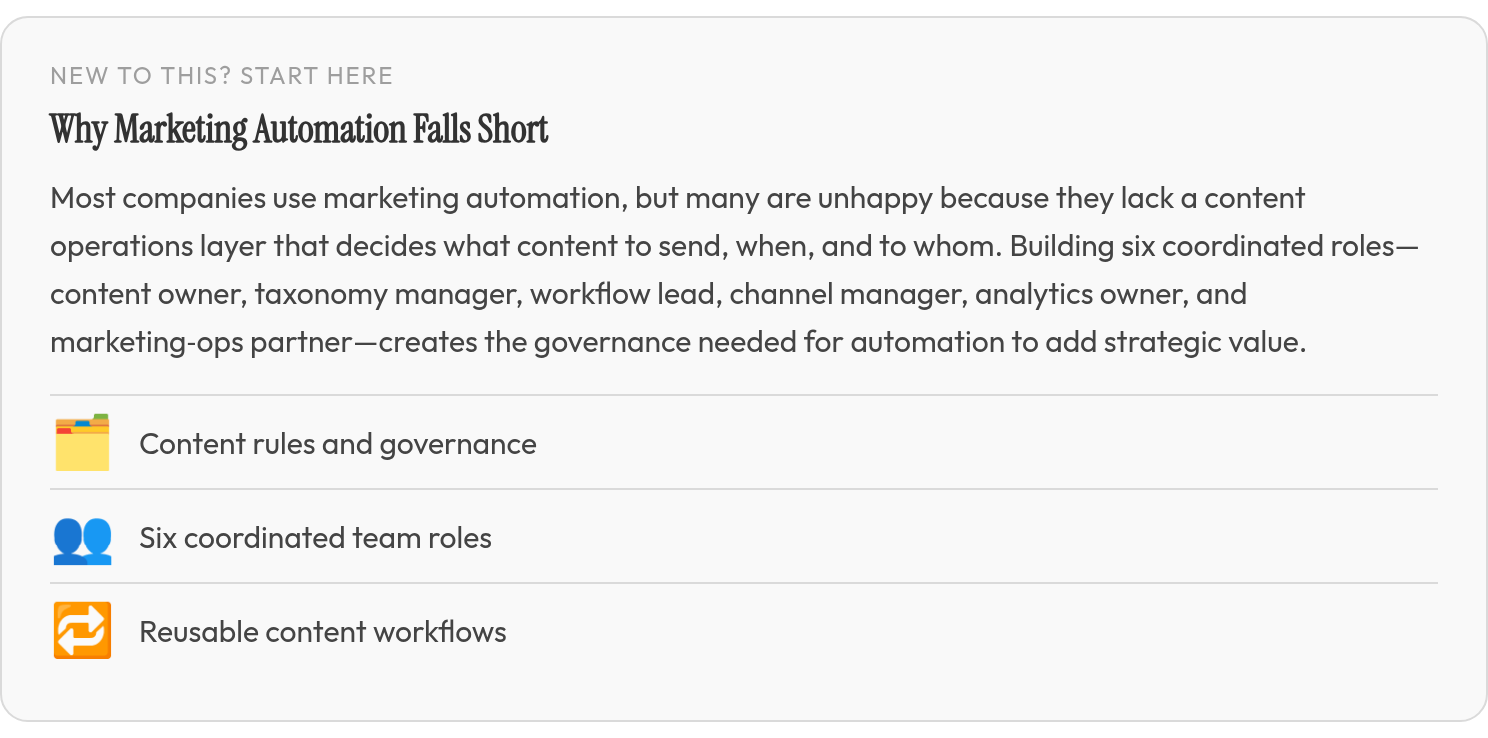
- Six content operations roles need to function as a coordinated system to turn automation from task execution into strategic engine.
What's actually broken
Marketing automation doesn't fail because the platform can't send emails or fire triggers. It fails because most organizations never built the content operations layer that makes automation useful—the taxonomy, governance, and coordination that determine what gets sent, when, and whether it makes sense in context.
The numbers
| Metric | Finding | What it means |
|---|---|---|
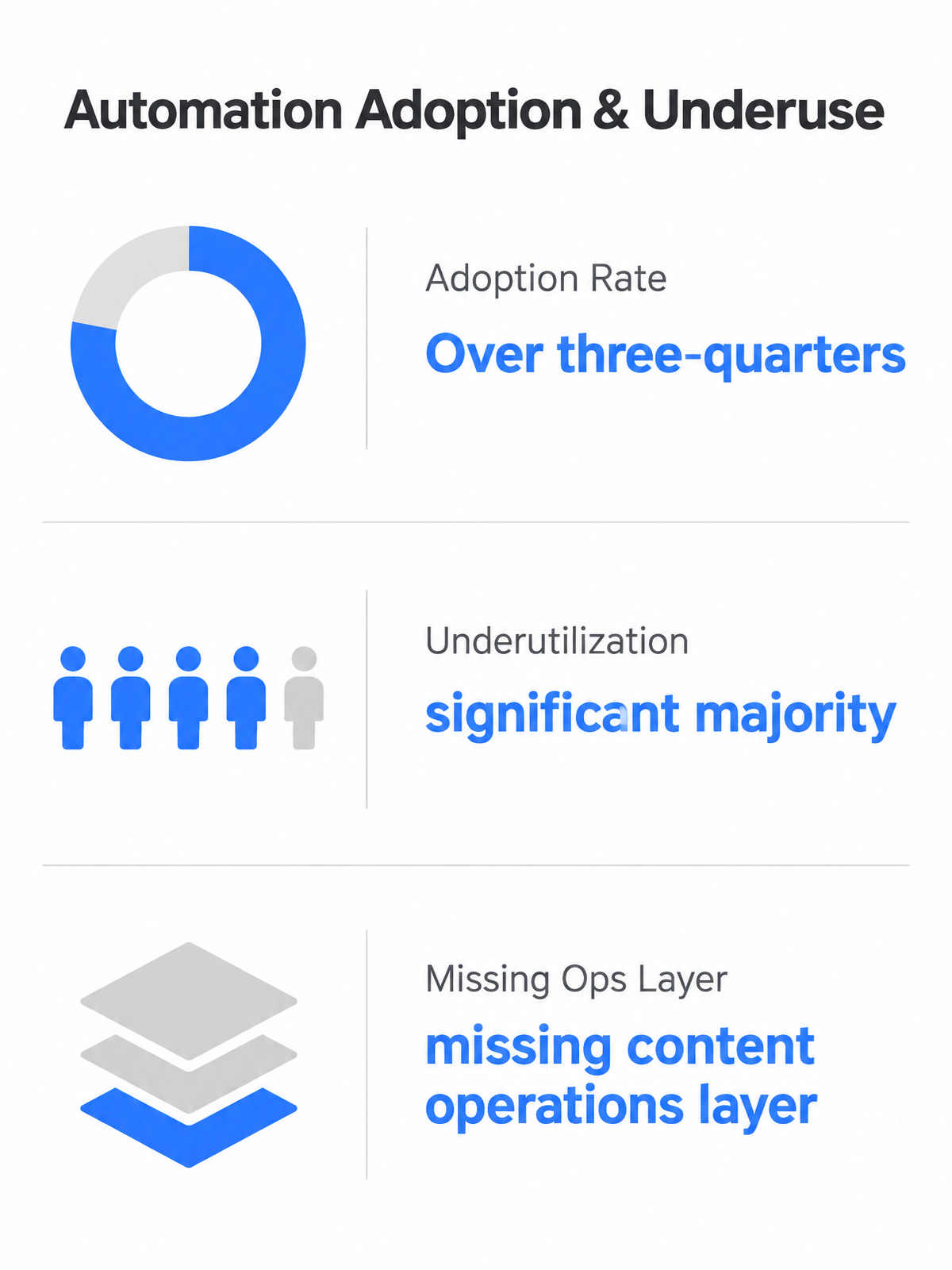
| Adoption rate | Marketing automation is widely used | Adoption doesn't equal execution |
| Dissatisfaction | Many marketers report dissatisfaction | Platforms deliver metrics, not strategic value |
| Underutilization | Most B2B marketers admit they are not using platforms fully | Capability exists; operational reality doesn't |
| ROI potential | Significant returns are possible | Only with proper content infrastructure |
| Qualified lead lift | Nurtured leads can perform better | Depends on content quality, not send volume |
| Platform onboarding | 34 days average (Sprout Social) | Vendor-specific, not an industry standard |
Where the hidden costs are
Poor personalization and broken content flows create costs that don't show up in dashboards. You see the symptoms: duplicate messages across channels, offers that contradict what sales just said, campaigns that ignore support tickets or buying-stage context.
Budget pressure makes the weakness harder to ignore. CMOs keep spending on martech while many lack the resources to execute well. That exposes a measurement problem: teams can track sends and clicks, but they often miss strategic failures in content value delivery.
The six roles that close the gap
- Content owner. Maintains governance over messaging and brand voice across all automated touchpoints.
- Taxonomy manager. Structures content so automation systems can route the right asset to the right context.
- Workflow/QA lead. Catches broken logic before campaigns ship and ensures approval chains function.
- Channel manager. Adapts content formats for each platform without duplicating effort.
- Analytics owner. Translates performance data into content refinements, not just metrics.
- Marketing-ops/IT partner. Bridges technical integration between CMS, CRM, and automation platforms.

When these roles work as a coordinated system instead of isolated functions, automation platforms stop acting like task runners and start supporting a content engine that improves lead quality, conversion economics, and campaign consistency.
Why platforms fail without content infrastructure
Marketing automation platforms promise efficiency at scale. Adoption alone doesn't create performance. The disconnect is rarely the platform. It's the missing content operations layer that determines whether you automate useful content or just accelerate chaos.
Workflow proliferation hides the real problem
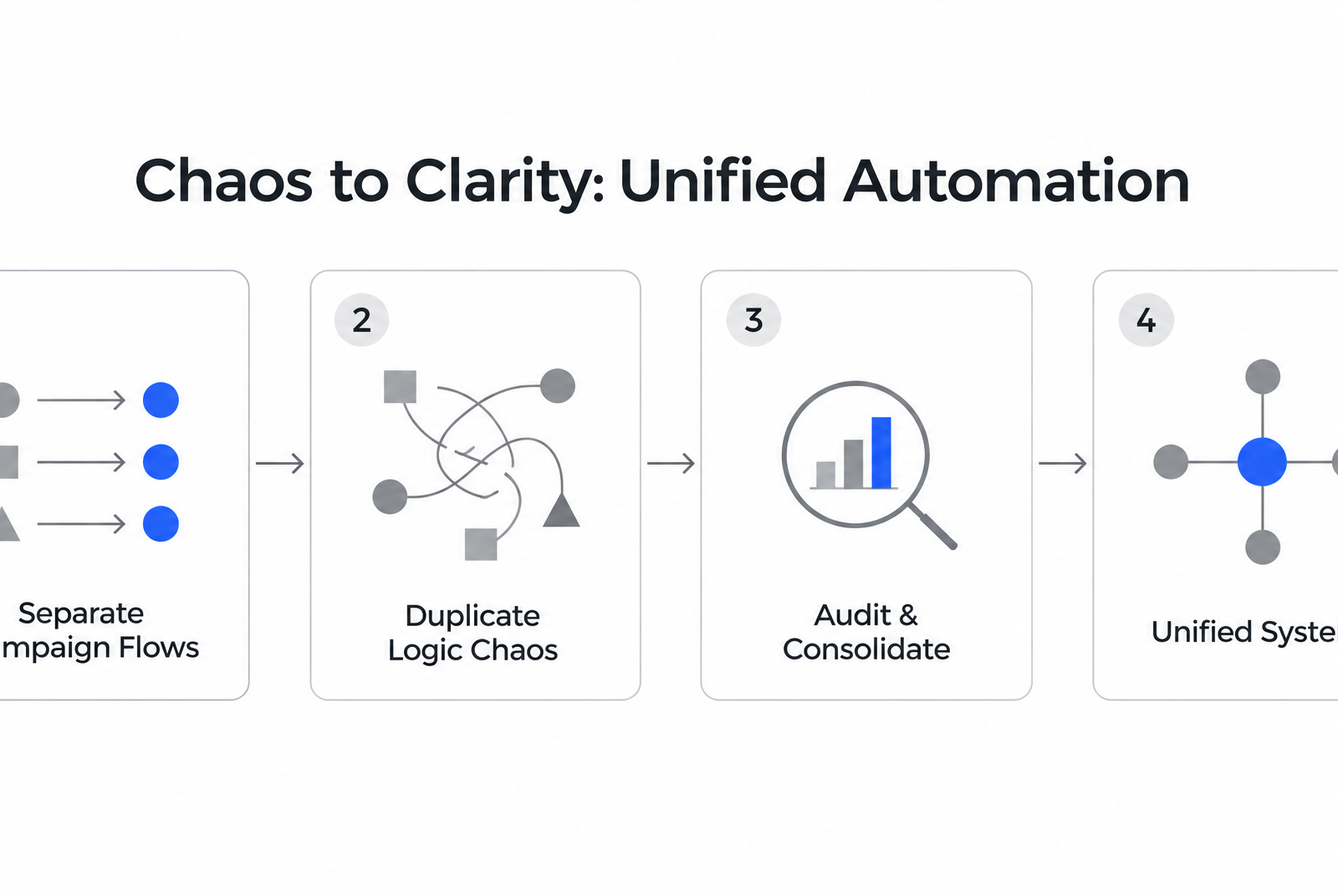
Most teams respond to each new initiative by building another automation path instead of improving the shared system. A product launch gets its own nurture logic. A regional campaign gets separate scoring rules. A webinar follow-up gets a unique suppression list. Over time, the platform fills with overlapping instructions, and launches become stressful because no one can predict dependencies.
The pattern is familiar: platform investment, organic workflow growth, declining visibility, plateauing performance, and frustration with the tool. Switching platforms may clean the slate temporarily, but it doesn't solve the underlying issue. Marketing automation platforms don't fail—organizations fail to use them when they lack the governance, content structure, and operational discipline to make automation repeatable.
Before the fix, teams usually embed data cleanup inside individual campaigns, tag content by keyword alone, and rebuild a new nurture sequence for every initiative. The operating model that scales has three layers working in the background:
- Background hygiene. Data normalization, suppression, and lifecycle rules run continuously outside campaign execution so every workflow receives clean, governed data.
- Semantic content model. Content is classified by value proposition, brand voice, and audience intent, so automation can route meaning instead of matching merge fields.
- Reusable campaign templates. Common sequences—webinar follow-ups, product launches, lead nurture—are built once as shared frameworks, then adapted per campaign without duplicating logic.
Teams often track execution metrics—emails sent, forms triggered—while missing whether the content actually advances the relationship. We see organizations automate workflow stages without the content infrastructure to scale that automation intelligently.

The rework tax compounds
When content operations are weak, every campaign becomes custom work. Marketing teams rebuild nurture sequences, rewrite similar emails, and manually adapt messaging for each channel. This rework tax drains resources that should fund strategy, testing, and optimization. Without structured content that maps to audience segments and journey stages, automation just amplifies inconsistency.
Automation can produce strong returns when the foundation is in place, but that foundation isn't just technical configuration. It includes the people, processes, governance, and systems that make content usable across channels. Without it, you fund tactical automation while leaving strategic value unrealized.
What fragmentation looks like in practice
In our experience, teams rarely name the problem directly. They describe frustrations that sound operational but point to something deeper: missing content infrastructure.
A common sign is uncertainty. Teams hesitate before launching because they can't tell which assets are current, which rules still apply, or whether a new campaign will conflict with an existing one. That hesitation isn't caution. It's evidence that the content pipeline has become too fragmented to trust.
Watch for these signals:
- Inconsistent brand voice across channels. When style guidance, persona definitions, and approval gates are missing, automation amplifies the inconsistency.
- Revision cycles consuming entire afternoons. Content stuck in approval loops or requiring multiple rounds of fixes signals unclear ownership and missing quality gates.
- Duplicate or outdated assets surfacing in campaigns. When taxonomy, metadata standards, and asset retirement rules don't exist, automation pulls from a messy library.
- Broken links and orphaned campaign pages. These appear when no one owns the post-launch audit process.
- Personalization limited to merge fields. Real personalization requires content compiled at runtime based on behavior and intent, not just inserting a first name.
The rework you're already paying for
Teams often embed data cleanup steps inside campaign workflows. One nurture sequence standardizes country values, another adjusts industry classifications. Over time, dozens of workflows contain slightly different data rules, creating inconsistencies that cascade through your automation.
Automating a weak process doesn't repair it. It makes the weakness appear in more places, faster. A messy taxonomy becomes messy routing. Unclear ownership becomes slow approvals. Unmaintained assets become irrelevant recommendations served automatically to the wrong audience.
That gap often reflects the absence of the content operations infrastructure needed to convert platform activity into strategic value.

Building the content operations backbone
In our experience, teams often assume the bottleneck is their automation platform. It's not. The missing piece is a structured content operations backbone that separates reusable systems from campaign execution.
That separation matters because content, data, governance, and campaign logic all age at different speeds. A product message may need editorial review, while a suppression rule needs operational enforcement. A lifecycle definition may require sales alignment, while a landing page requires SEO and conversion testing. If all of that logic lives inside individual campaigns, the system becomes difficult to maintain.
Establish a single source of truth with governed access
Your content repository needs permissions, version history, reusable assets, metadata standards, and search that works across teams. This isn't about storage—it's about making content findable, adaptable, and measurable at scale.
- Build a central repository with role-based access controls. Marketing, sales, and product teams should see the assets they need without stepping on governance rules.
- Tag every asset with structured metadata. Channel readiness, audience segment, lifecycle stage, and SEO keywords should be standard fields, not afterthoughts buried in filenames.
- Connect your repository to analytics platforms and automation tools. API-driven integrations between your CMS, digital asset management system, and distribution platforms eliminate manual handoffs and keep content performance visible.
Compliance, suppression, and data hygiene should be handled by shared operational layers rather than scattered campaign-specific fixes. When opt-outs, internal contacts, competitor exclusions, and field standards are enforced consistently, campaign teams can focus on message strategy instead of rebuilding guardrails.
Design taxonomy and workflow standards that scale
Agents learn on meaning, not words. That shift matters. Your taxonomy has to map content to semantic layers—value propositions, brand voice, audience intent—not just keyword lists. Without that structure, AI-generated content creates noise rather than value.
- Define a content taxonomy that supports both human editing and machine generation. Standardize how you classify topics, tone, format, and distribution channels so new content fits into existing systems instead of creating exceptions.
- Separate campaign workflows from operational systems. Lifecycle management, lead scoring, and data cleanup should be centralized processes that campaign workflows feed into, not logic you rebuild for each initiative.
- Document approval gates, version control, QA checks, and escalation rules. Governance without defined ownership becomes a suggestion, not a system.

Implementing this infrastructure takes upfront investment. One social management platform reports faster onboarding and strong ROI, but those numbers reflect adoption speed, not content-system buildout timelines. Repository setup, taxonomy design, and workflow-engine integration vary widely by organization size and existing technical debt.
What to track and how to keep it running
We work with teams who assume automation success means their workflows finally run without manual intervention. That's execution. The harder question is whether those workflows deliver qualified leads, protect brand standards, and justify the platform investment—and that requires tracking both automation outcomes and content-operations health in the same view.
Track outcomes and system health, not just activity
When teams automate content marketing, they often default to measuring what platforms make easy to see. Those activity indicators confirm the machinery is running, but they don't prove the experience is coherent, persuasive, or useful to sales. A team can celebrate delivery rates while the buying committee receives generic content, outdated positioning, or offers that no longer match account context.
The outcomes worth tracking combine automation performance with content-operations integrity:
- Adoption and use rates across marketing and sales—underutilized features signal training gaps or workflow friction.
- Lead quality and conversion performance—track qualified-lead volume and deal size influenced by nurtured content to confirm automation drives revenue.
- Campaign performance by channel—identify which content types and distribution paths drive engagement versus those that dilute brand voice.
- Publishing speed and approval bottlenecks—measure cycle time from draft to live to catch governance friction before it stalls campaigns.
- Error rates and QA failures—track broken personalization tokens, missing metadata, and failed A/B tests as signals your content model needs repair.
- Brand compliance and taxonomy coverage—audit what percentage of assets follow style guidelines and carry complete metadata.
- Stale-asset counts—flag content sitting unused or outdated in your DAM, which bloats search and confuses teams.
Run recurring audits with cross-functional owners
Automation accelerates approved patterns. It also accelerates unapproved ones if no one checks. We recommend quarterly audits led by marketing ops, with the content lead, analytics owner, channel managers, and IT participating. The checklist covers taxonomy integrity, source-of-truth accuracy, approval-gate effectiveness, QA-failure trends, personalization-rule conflicts, and performance data by segment. Treat this as operations maintenance, not a compliance exercise—the goal is catching drift before it compounds into the workflow proliferation that breaks automation at scale.

FAQ
1. Why do marketing teams report dissatisfaction with automation platforms when adoption rates are so high?
Buying the platform solves distribution, not content readiness. If assets are poorly tagged, ownership is unclear, approvals are inconsistent, and personalization logic relies on thin data, the software will still execute, but the customer experience will feel fragmented. The issue is less about whether the platform has features and more about whether the organization has the operating model to use them well.
2. What's the difference between building workflows for each campaign versus designing reusable systems?
Campaign-specific workflows treat every initiative as a standalone build. Reusable systems treat common rules as shared infrastructure. Instead of hiding qualification logic, suppression rules, and routing decisions inside separate campaign paths, the team maintains them centrally so campaigns can plug into a stable operating layer.
3. How do you separate data normalization from campaign execution in practice?
Create always-on hygiene processes that standardize key fields before campaigns use them. Campaign workflows should receive clean, governed data rather than trying to repair records midstream. That keeps message logic simpler, reduces conflicts across campaigns, and improves the accuracy of segmentation and personalization.
4. What roles need to function as a coordinated system before automation delivers ROI?
The essential functions are editorial stewardship, taxonomy management, workflow quality assurance, channel adaptation, analytics interpretation, and marketing-operations integration. The important point is coordination: each role protects a different part of the system, and automation only becomes strategic when those responsibilities connect rather than operate as isolated handoffs.