Creating a Global AI-Powered Content Factory That Keeps Local Voice

Key Takeaways
- Global AI content operations lose search visibility when localization systems make regional pages too similar.
- AI retrieval can separate passages from their market context, creating mismatches between user location, page intent, and canonical versions.
- Synthetic brand content creates reputational risk when it's accurate in form but wrong in feel.
- Centralized AI workflows work when they combine domain-specific models, market rules, and human review rather than relying on reuse alone.
- Local teams provide signals about culture, belief systems, language, media norms, socioeconomic context, and customer expectations.
- The strongest global content factories increase production speed while preserving the local judgment that makes content usable in each market.
Most Teams Are Building the Wrong Factory
Organizations with multinational content operations often support 30 to 40 markets. For more than 25 years, local marketing teams have repeated the same complaints: "This doesn't sound like us." "Our customers don't ask that question." "That product isn't even sold here." Headquarters usually treated this pushback as resistance to global efficiency rather than a signal about market fit.
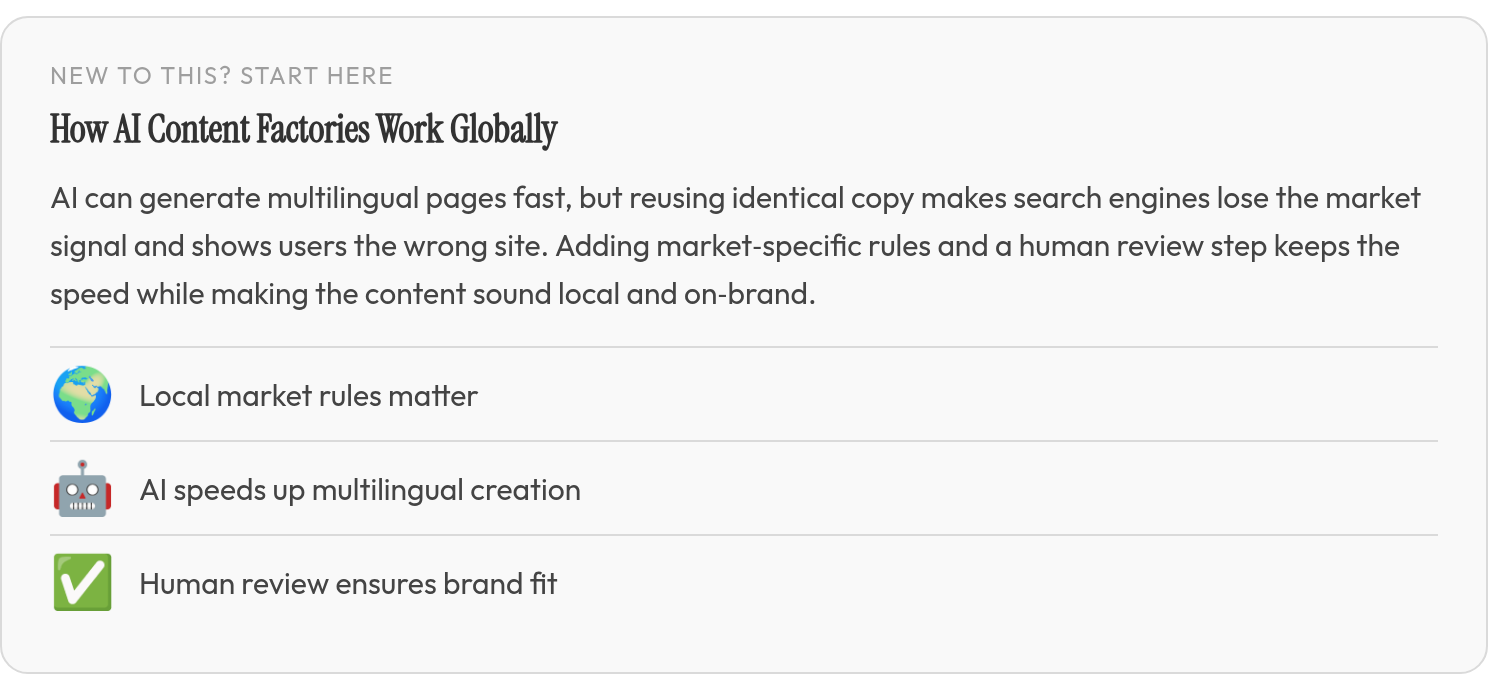
Now automated content creation lets enterprises produce multilingual content faster and more cheaply. The problem is that the traditional efficiency model optimized for something AI search now penalizes: content reuse at scale.
Translation Memory Created an AI Search Problem
Translation memory systems were designed to maximize content reuse. Store an approved sentence once, never translate it twice, and watch cost per word drop. Organizations with high translation memory use rates celebrated their efficiency gains.
AI retrieval systems are designed to discard reuse. When search engines find clusters of pages that are essentially the same across markets, they don't process every version in full. One version becomes the canonical, and the others are treated as alternate names pointing back to it. The passages AI search retrieves come from that canonical version, stripped of the URL indicating which market they belong to. Users land on the wrong market site.
Higher translation memory use can make markets look more alike to AI systems. The efficiency metric global teams optimized for is now causing geo-identification failures across 30 to 40 simultaneous markets. The local teams who complained about copy-paste content were identifying a real market signal that enterprises dismissed as operational friction.
Local Voice Failures Show Up as Brand Risk
In late 2025, a fashion house posted an AI-generated ad video to Instagram. The brand faced criticism not because the content was technically wrong, but because it felt off-brand and low-quality. Synthetic content can damage perception when it ignores the context that makes brand communication work.
Localized tone matters because local teams specifically identify mismatches in voice, customer questions, product availability, and inappropriate market case studies. One enterprise localization platform reports that customers wouldn't have a localization process without their system, and that centralized processes improved time to market and customer satisfaction in new regions. The constraint is not translation speed. It's whether the output passes the filters each market applies: cultural background, religion, national beliefs, political environment, regional languages, media policies, and socioeconomic conditions.
Fast centralized production still fails if it ignores local voice, customer intent, and market context. AI adoption is accelerating across enterprises, but those gains materialize only when AI investment targets the constraint across 30 to 40 markets. For multinationals, overinvesting in global throughput while underinvesting in local responsiveness leaves AI ROI unrealized. Search systems send users to the wrong market site, reviewers keep fixing the same mismatches, and derivative assets scale without a quality gate.
Designing a Scalable AI Content Factory
We centralize three things first: source content, brand and market inputs, and the systems that route everything through review before publication. Most organizations already have source content—product catalogs, campaign briefs, case studies—but it's scattered across departments. The bigger gap is brand and market rules. Local teams have been saying for years that certain wording doesn't work, that customers ask different questions, that a product isn't even sold in their region. Capturing those objections systematically turns resistance into data the content engine can use.
Automated content creation scales when the system knows what to generate and where the boundaries are. The pattern is consistent: systems that account for market differences at scale outperform those optimized only for reuse.

Define Market-Specific Rules Around Actual Failure Modes
Efficiency-driven localization often hides weak market fit until content reaches review, search, or the customer. We define brand-voice rules around the failure modes local teams report: local wording preferences, local customer questions, product availability by region, market-appropriate examples, URL and language and country context, and cultural fit. Capturing those patterns turns them into inputs the system can reference during content creation.
Brand consistency is not uniformity. Context is what separates accurate translation from content that works. Organizations that unify translation memories, terminology, style guides, and quality data into a single context layer create a foundation AI can apply to every market. The result carries the right brand voice, complies with market-specific requirements, and adapts to cultural and channel context without manual intervention for each asset.
Embedding SEO & Local Optimization Into the Factory
When automated content creation produces pages for many regions, those pages can appear in search results with the wrong geography. We've seen this break down in two ways: AI search engines may extract a passage without preserving the market signal attached to it, and highly similar regional pages can be grouped so tightly that only one version is indexed in full.
Local SEO stops being a translation problem and becomes an intent-mapping problem. Local teams push back not because the grammar is wrong but because the content answers questions their customers don't ask or promotes products that aren't sold in their region. A global keyword architecture only works when each market page carries the right language and country context in its URL structure, adapts to local customer questions, and reflects what is actually available to buy there.
Programmatic Templates That Adapt to Market Context
Each market page needs three foundational elements: the correct URL structure with language and country codes, content adapted to local search intent, and product availability checks that prevent promoting items not sold in that region. Companies working across dozens of languages can maintain quality by using domain-specific models that understand product terminology and regional differences. Templates can be localized at scale when the system is built to capture market-specific rules and adapt to regional conventions.
Centralizing keyword research helps maintain consistency, but local insight remains critical. When a search term doesn't match how customers actually talk or when a product category doesn't exist in a given market, that mismatch surfaces quickly in engagement metrics. Organizations have successfully translated critical information into multiple languages while preserving accuracy by building systems that adapt delivery to each language's conventions without losing the core message. Think globally, act locally isn't just a slogan—it's the architectural principle that lets you maintain a unified brand while fitting each market's culture and customer expectations.
Automating Distribution & Repurposing Across Channels
Once you've produced localized core content, automated content creation extends its reach by transforming that material into derivative formats tailored to specific channels. The efficiency gain comes from treating the source article as a reusable asset rather than a one-time deliverable.
Repurposing with Governance, Not Just Speed
The workflow looks straightforward on paper: one source article becomes localized email copy, social snippets or carousel copy, reusable design templates, and video-script outlines. Template-based asset creation can scale when the underlying process is sound. But speed alone doesn't guarantee brand fit. Channels have their own expectations, and a message that works as a landing page may feel too formal, too generic, or visually inconsistent when converted into social or video assets.
We see similar patterns play out in B2B contexts. Cost reduction means nothing if the output erodes trust. The missing layer is review before publication. Treat AI-avatar and synthetic video as governed experiments rather than proven engagement drivers. Route generated assets through local or brand teams who can flag tone mismatches, visual inconsistencies, or cultural missteps before they reach your audience.
Distribution at Scale Without Overclaiming ROI
Large-scale localized distribution shows what's possible when governance is in place. Automated workflows can handle high-stakes, high-volume communication when the underlying content is accurate and the routing logic is sound. That scale doesn't automatically translate to engagement lift or latency reduction in marketing contexts, but it proves the infrastructure can support broad reach without manual bottlenecks.
The key is managing expectations. Repurposing delivers efficiency, not magic. You'll produce more derivative assets faster, but each format still needs a quality gate appropriate to its channel and audience.
What Keeps the Factory Trustworthy After It Scales
Generating the content isn't the hard part. Keeping the factory trustworthy after it scales across markets is. Automated content creation can produce localized pages faster than any human team, but speed without governance creates a different problem: content that sounds generic, references products not sold in that market, or answers questions local customers never ask.
Effective governance routes work by risk level. Content that passes product availability, URL context, and local terminology rules can flow straight through. Content that depends on local tone, regional examples, or customer-question fit goes to local reviewers. Visual and video assets, or anything with brand or reputational exposure, go through a synthetic-content review layer before publication. When a market reviewer flags "This doesn't sound like us," that's not resistance—it's a signal the content failed a voice test. When they ask "Why are we publishing a U.S. case study on the Japanese site?" that is a geo-relevance failure. When they say "Our customers don't ask that question," the content missed intent alignment. These qualitative indicators become the monitoring checklist. Local reviewers check whether content sounds local, answers the right customer questions, uses appropriate regional examples, and only references products actually available in their market.
Synthetic-Content Risk and Brand Backlash
AI-generated brand assets can trigger backlash faster than written content. Luxury fashion brands posting AI-generated ad videos on social media have faced criticism, with audiences calling the visuals "cheap," "lazy," and "disturbing." The technology worked; the video rendered; but it violated the brand's core values of craftsmanship and exclusivity. Research analyzing content management practices across major luxury brands shows this tension isn't unique. AI's large-scale, automated generation logic conflicts with brands built on scarcity and heritage.
Before any AI-generated visual or video asset publishes, a human reviewer checks whether it upholds brand standards. That review is not about technical quality; it is about whether the asset feels authentic to what the brand represents. As generative AI has become widely available, enterprises are still learning which brand elements can be automated and which require human oversight.
Feed Corrections Back Into the System
Reviewer feedback should retrain the routing rules, not just correct one asset. When a local reviewer changes wording, flags a geo-mismatch, or identifies a recurring complaint, that input updates the brand and localization rules the factory uses. The goal isn't to eliminate local review—it's to reduce how often the same mistakes repeat. Performance signals matter too: if pages in one market consistently underperform, the system needs to revisit what that market's content is optimized for. Continuous improvement means treating local pushback as data rather than friction.
Frequently Asked Questions
1. Why do AI search engines treat my localized content as duplicates even when it's translated correctly?
Because correct translation and distinct market relevance are not the same thing. If regional pages preserve the same structure, claims, examples, and phrasing, search systems may see them as near-identical variants rather than separate answers for separate audiences. The fix is to build market-specific intent, availability, terminology, and URL context into the content before it publishes.
2. How do I know if my centralized content factory is actually keeping local voice or just translating faster?
Look at the review patterns, not only production speed. A healthy system should reduce repeated edits over time because local corrections are being captured and reused as rules. If reviewers keep fixing tone, examples, product references, or customer questions manually, the factory is accelerating output without learning from the market.
3. What's the biggest governance mistake teams make when automating visual or video content across markets?
They treat visual generation as a production task instead of a brand judgment task. A market reviewer needs to evaluate whether the asset feels credible for the audience, fits the channel, and reflects the brand’s standards before it goes live. This is especially important when automation touches formats where emotion, style, and perceived authenticity matter as much as factual accuracy.