Turn One Blog Post Into Six Assets Without Diluting Domain Authority

Before we get into it, the short version:
- A six-asset repurposing model gives the original post one job: act as the authority hub. The six assets we use are template, quiz, infographic, data article, video, and newsletter; they address different audience needs and search intents.
- We evaluate a strong anchor post across five signals: relevance, existing performance, backlink potential, keyword breadth, and evergreen value.
- The workflow matrix tracks five production variables for every asset: asset type, format, creation time, SEO effort, and authority guard.
- SEO effort ranges from low for adaptations such as newsletters to high for original research, substantial editing, and deliberate internal linking.
Why Repurposing Without Diluting Domain Authority Matters
The hard part isn’t producing six assets. It’s deciding what each one should do before anyone opens a content calendar.
Cut up one article and publish six near-identical posts, and you create a hidden tax. The pages target overlapping searches, compete for the same internal-link equity, and give visitors no obvious reason to choose one over another.
A better model starts with one authority hub. Each derivative gets a separate job, audience, format, or search intent. That way, the original post can explain the topic fully while the supporting assets give people another way to use, evaluate, or share the information.
How do you repurpose content for SEO without creating six competing pages?
Start with the core idea, then build differentiated experiences around it. A template helps someone complete a task. A quiz helps someone assess a problem. An infographic makes a process or statistic easier to understand and potentially easier to cite. A data article supports a broader theme with original analysis. A video reaches people who prefer a different format, and a newsletter gives email subscribers a distinct summary angle.
The anchor post remains the fullest explanation. The other assets offer alternative entry points rather than recycled versions of the same answer.
This model is not right for every project. A routine announcement with little search demand may not justify six assets. Weak derivatives can cost more than they return, so publish fewer and give them a clearer purpose.
What should the six-asset workflow matrix include?
A simple matrix can keep production focused. The asset, format, creation time, SEO effort, and authority guard belong in every row.
| Asset | Format | Time to Create | SEO Effort | Authority Guard |
|---|---|---|---|---|
| Template | Fillable document | Low | Medium | Unique instructions and use case |
| Quiz | Interactive assessment | Medium | Medium | Distinct questions and answers |
| Infographic | Original visual | Medium | Medium | New data or a fresh visualization |
| Data article | Research-led post | High | High | Original analysis, not copied text |
| Video | Short explainer | Medium | Low to medium | Original narration and transcript |
| Newsletter | Email edition | Low | Low | Distinct audience and summary angle |
Low difficulty means little technical SEO work, such as adapting an existing post into a newsletter. Medium difficulty requires keyword mapping, custom design, or an interactive format. High difficulty calls for original research, substantial editing, and deliberate internal linking.
The business case is simple, and it is easier to evaluate when we separate source-backed observations from our recommendations. Content Marketing Institute research suggests that useful assets, including templates, tools, original research, and interactive content, can make articles more linkable because other sites have practical material to reference. In our experience, that evidence only helps when the format matches the asset’s job.
A coordinated set of formats can create several routes into the buying journey. Each route should give people a different reason to engage, not repeat the same evidence.
Pick a High‑Value Anchor Post and Prep It for Multiplication
Your most popular article is not automatically the best anchor post. The better choice is the article with enough substance, search demand, and internal value to support several distinct assets.
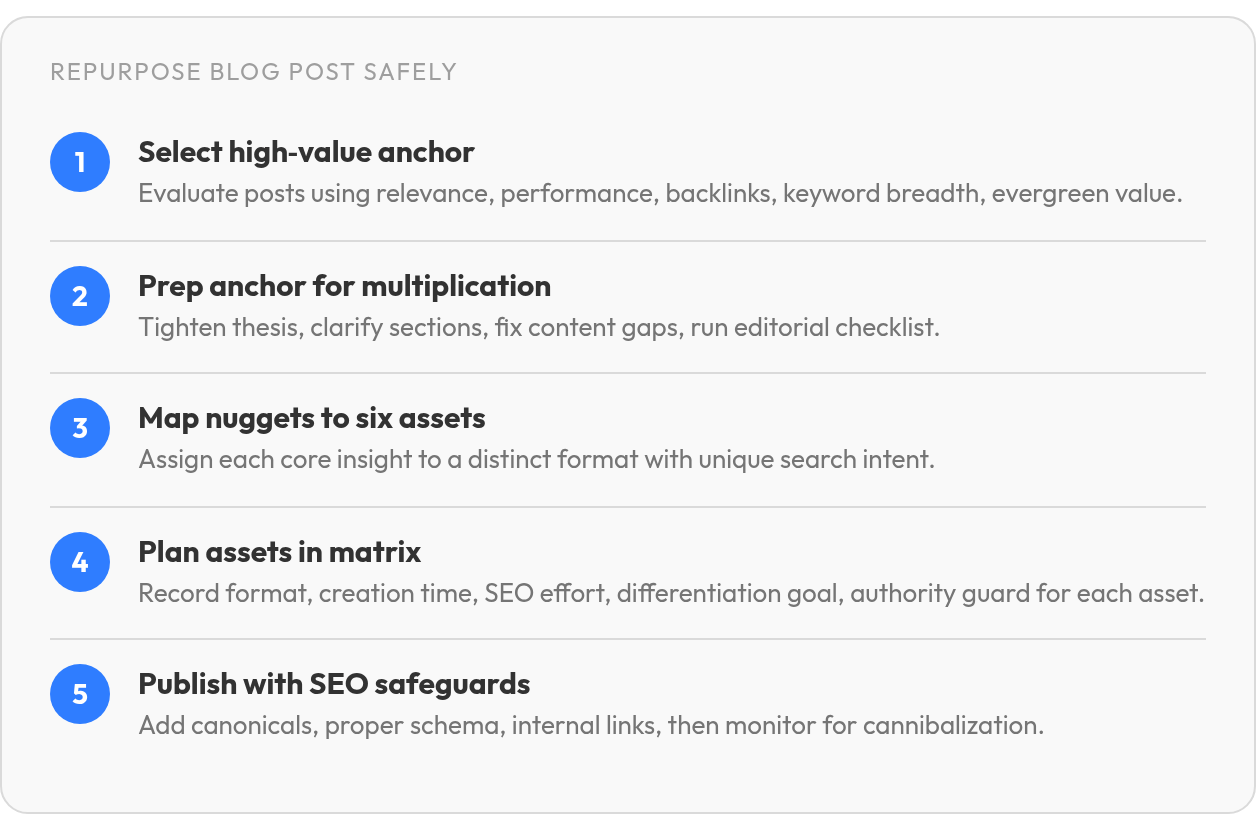
If a topic attracts traffic but offers no second angle, move on. A weak foundation tends to produce thin derivatives instead of useful entry points.
Which Blog Post Should You Choose as Your Anchor?
Choose a post that solves a meaningful problem, covers a topic with room for multiple search intents, and can earn links because it contains something worth referencing.
Strong anchors often combine clear buyer or customer relevance with ideas another writer could support with a template, quiz, infographic, data article, video, or newsletter.
We assess candidates across five practical signals:
- Relevance: Does the post address a problem your audience actively needs to solve?
- Existing performance: Does it already attract engagement, links, or meaningful search traffic?
- Backlink potential: Does it contain original data, useful frameworks, or a strong point of view?
- Keyword breadth: Can one core topic support several related searches without repeating one intent?
- Evergreen value: Will the subject remain useful after a short news cycle passes?
Avoid posts tied to a single campaign, an outdated product launch, or a topic with no room for new angles. They can still support distribution, but they make poor foundations for an SEO-led multiplication system.
How Do You Prepare the Post for Six Assets?
Prepare the anchor by tightening its thesis, separating its supporting points, and repairing any content-health gaps. The original should be the clearest source for the subject. New material can answer narrower questions and point readers back when more context is useful.
Run this short editorial check:
- Can a reader state the main thesis after one paragraph?
- Does each supporting section earn its place?
- Are the headings descriptive and easy to scan?
- Do internal links connect the post to relevant pages and from related content?
- Have we updated examples, references, and product details that may have changed?
Then assign one distinct purpose to each supporting point. A step-by-step explanation can become a template, a diagnostic question can become a quiz, and a data-backed claim can become an infographic or data article. Map each asset to its own search intent and reference the anchor post where it adds context.
This structure reduces duplication because the assets have jobs rather than recycled paragraphs. The central article carries the broad explanation. Its companions offer different entry points, formats, and tasks.
Before publication, ask a simple question: why does this page exist? If the answer is not more specific than “because we needed more content,” keep editing.
Extract Core Nuggets and Map Them to Six Asset Types
A set of formats only helps when each one gives the audience a different reason to engage. We treat the original article as the authority hub, then extract its core insights into formats suited to scanning, watching, studying, completing, or sharing.
How do you map one post to six differentiated assets?
Start with a content-atomization framework. Identify the anchor post’s central promise, supporting claims, examples, and actionable steps. Then assign each format a distinct job:
- Template: Turn a step-by-step explanation into a fillable document. It targets task-completion search intent, earns links from sites that reference practical resources, uses a self-referencing canonical on a unique URL, and links back to the anchor post for the complete explanation.
-
Quiz: Turn a diagnostic question into an interactive assessment. It targets problem-assessment search intent, earns attention through distinct questions and answers, uses quiz or interactive markup only when the page contains that visible quiz, and links to the anchor post for the full explanation.
-
Infographic: Visualize a process, framework, or set of relationships. It targets visual-reference search intent, can attract links because another publisher may reference the diagram itself, uses its own canonical and schema that matches the image, and links to the anchor post.
-
Data article: Expand one data-backed claim into a research-led post. It targets research-oriented search intent, earns links because other sites have practical material to reference, keeps a self-referencing canonical, and links to the anchor post and related guides.
-
Video: Focus on one question the article answers. Open with the problem, show the solution in two or three scenes, and point viewers to the anchor post for the complete explanation. It targets question-answering search intent, uses VideoObject markup, and links to the anchor post in the description.
-
Newsletter: Lead with one useful insight, then expand it with a short example and a link to the source article. Keep the promise specific so subscribers know what they gain. It targets email-subscriber intent, uses a self-referencing canonical if published as a web page, and links to the anchor post and one related asset.
The formats are interchangeable only in theory. A newsletter may be less useful than an infographic for a highly visual framework. A video can work well for a question that needs a quick demonstration.
How do you avoid duplication and cannibalization?
Assign a primary search intent to every asset. The anchor post keeps the comprehensive keyword target, such as “how to repurpose content for seo,” while each derivative focuses on a narrower phrase or audience need. The format, headline, and opening line should signal that difference.
Internal links should create a deliberate path to the anchor post and between related assets where that helps someone continue a task. Review structured-data requirements and indexation decisions according to the page type.
We cannot claim that our platform automatically applies those technical elements, so treat them as explicit implementation checks in your workflow.
Skip this approach for routine updates with no meaningful subtopics. Thin derivatives can compete without adding value. If the source post has one strong idea and no room for distinct formats, publish fewer assets and do them well.
Build an SEO‑Safe Repurposing Framework
The work doesn’t stop at publication. Several URLs can still compete with one another and split attention across the wrong search terms.
Effective repurposing treats each asset as a distinct entry point, not another version of the source article. That means giving every asset a clear purpose and matching it with the format and intent it serves.
The anchor post can cover the broad problem, while a template targets a task, a video answers a specific question, and an infographic supports a concept worth citing. If two assets serve the same purpose, rewrite the intent or merge them.
For routine campaign updates, you can often skip extra search-planning work when the content is not intended to compete for durable organic search.
How Do You Prevent Duplicate Assets From Competing?
Canonical tags and indexation need an intentional plan. A canonical tag identifies the URL you consider the primary version of similar content, but it does not automatically make substantially different assets safe to publish.
Use self-referencing canonicals for unique pages. If two URLs serve the same purpose, redirect one to the other or consolidate them. Before relying on an evergreen asset for long-term visibility, confirm that its published page is accessible and works as intended.
Structured data should describe what the page actually contains. Use Article markup for an editorial asset, VideoObject for a video, and FAQ markup only when visible questions and answers appear on the page.
Never add schema to imply a list, review, or step that readers cannot see. Search engines can ignore misleading structured data, so compare the markup with the visitor-facing page during review.
How Do You Build the Internal-Link and Review System?
Link the anchor post to each relevant asset with descriptive, natural anchor text. Then connect assets back to the anchor when the relationship helps someone continue their task.
Avoid repeating the exact target keyword in every link. Supporting pages should pass users and link equity through related material rather than form a closed loop.
Use real-time analytics to review performance after publication. Compare impressions, clicks, and engagement signals with the anchor post, then look for pages that repeatedly surface for the same query. If that happens, consolidate them or sharpen their differentiation.
If a page earns impressions but receives few clicks, improve its title, promise, or format. That is usually a better next move than producing another asset immediately.
FAQ
1. When should a blog post not be turned into six assets?
The model is a poor fit when the source is a routine announcement, tied to an outdated campaign, or too narrow to support genuinely different search intents. In those cases, distribution may be more productive than building a full asset set. A smaller package can preserve the useful idea without creating pages that have little independent purpose.
2. Does using a canonical tag solve cannibalization between repurposed assets?
No. Canonicalization addresses duplication and close variants; it does not turn unrelated pages into one coherent SEO strategy. First decide whether the pages answer the same question. If they do, consolidation or a redirect may be more appropriate. If they serve separate audiences or tasks, maintain clear titles, content, links, and page-level implementation that reflect those differences.
3. How do you decide whether a supporting asset needs to be consolidated after publication?
Review search and engagement data after publication, especially which pages surface for the same queries. Repeated competition is a signal to compare the pages side by side: examine their promises, openings, coverage, and calls to action. Consolidate when one page cannot justify its separate role; otherwise, sharpen the weaker page’s audience, format, or task. Assets earning impressions but few clicks may need a clearer title, promise, or presentation.