
Turn One Blog Post Into X Threads, Newsletters, and YouTube Scripts

Quick Answers
- A well-structured long-form blog post can often yield enough distinct material for a full week of derivative pieces across platforms.
- AI has made format testing much cheaper, which makes it practical to seed low-cost derivatives on purpose.
- Some creators have seen identical material flop in one format and thrive in another—video can fail while a written version builds an email list.
- Source posts break into five reusable asset types: hooks, frameworks, data points, stories, and calls-to-action, each suited to a different platform.
- Thin listicles yield far fewer derivatives, because the count follows directly from how much the source actually says.
- Some repurposing platforms can queue generated carousels and posts across LinkedIn, X, Instagram, TikTok, and YouTube from one dashboard.
- News-pegged and trend-only posts make poor repurposing candidates, since the topic goes stale before the derivatives reach a new platform.
Why one blog post is worth a week of content
A single well-researched article holds enough raw material to feed a full week of content across every platform your audience actually uses. That polished post on your website, the one nobody has read since launch week, could be your next thread on X.
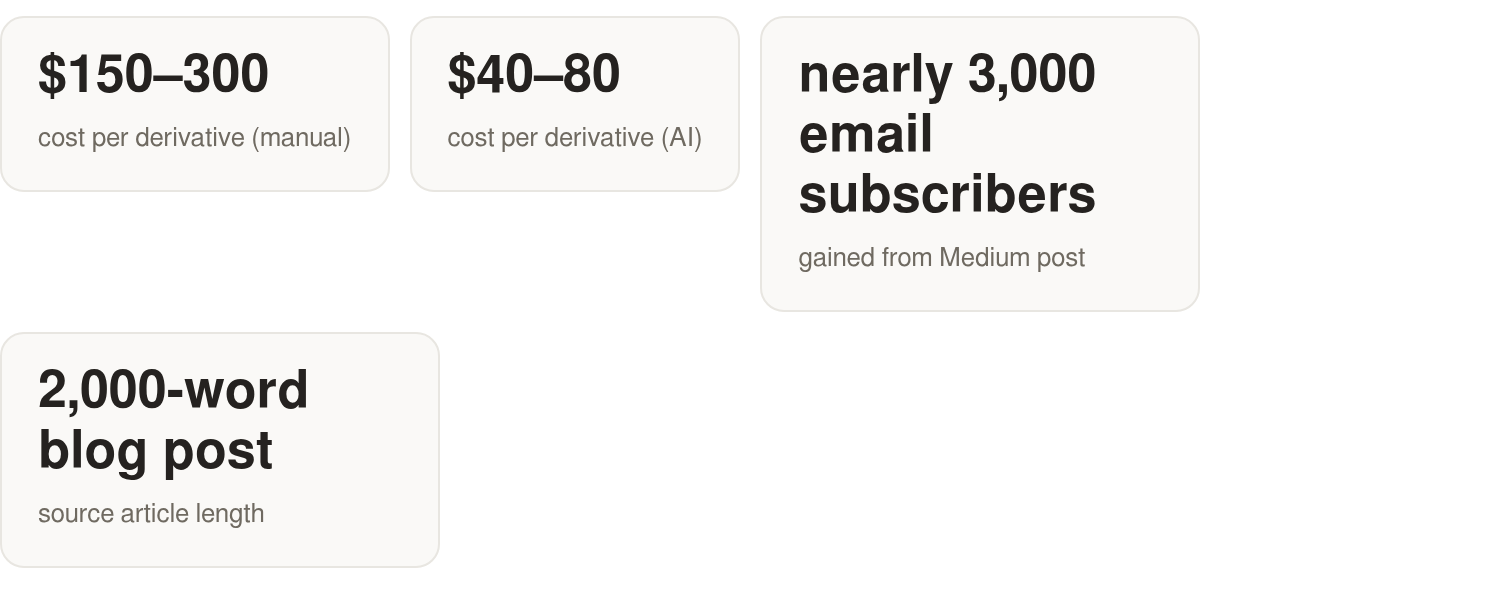
Writing a solid blog post takes real thinking time. Repurposing lets you pay that cost once, then use it across threads, newsletters, and YouTube scripts without staring down a blank page each time. Most teams sit on material they never fully use. How you repurpose is the edge.
What you actually gain from one repurposed post
Reach, budget efficiency, and stronger search signals from work you already paid for.
A long-form post holds distinct knowledge units: the opening stat, the framework, the data point, the story, the how-to steps. Each maps to a different format and a different reader. Some people want a quick X thread on a coffee break. Others want a five-to-eight-minute video walkthrough. Serve each format, and you meet demand you'd otherwise miss.
This is where AI content generation earns its keep. A repurposing platform can turn one article into social carousels and native posts, then queue them across LinkedIn, X, Instagram, TikTok, and YouTube. This used to take hours of manual adaptation.
Let engagement data pick the format, not your gut
Format resonance is genuinely unpredictable, and testing is now cheap. Seed low-cost derivatives across formats, watch what your audience engages with, then put deeper production into what the data shows.
We've seen the same idea flop as a video and take off in writing. Some creators report that the same note-taking material went nowhere on YouTube but added email subscribers on Medium. You can't predict that from a spreadsheet.
That's why a workflow that pairs generation with real-time analytics can help you see what's working and double down on the formats your audience rewards instead of guessing up front.
Manual vs. AI: what's the effort gap?
The core advantage of automation is a lower cost per test. That is what makes a seed-then-scale approach affordable. Instead of adapting each derivative by hand, a repurposing platform can turn your source article into ready-to-publish carousels, posts, and multi-platform content from one dashboard.
| Dimension | Manual repurposing | AI-automated workflow |
|---|---|---|
| Effort per blog post | Repeated manual adaptation | Automated from one dashboard |
| Format coverage | One piece at a time | Carousels, posts, multi-platform |
| Publishing | Platform-by-platform | Queued to LinkedIn, X, Instagram, TikTok, YouTube |
Skip aggressive repurposing for news-pegged or trend-only posts. If the topic goes stale before it reaches a new platform, the derivatives fall flat. For evergreen pillar content, this is the highest-return move you can make.
Pulling the source post apart before you generate
Before you touch a repurposing tool, audit the source post. This is where most teams go wrong. They dump the whole article into an AI prompt, ask for "10 social posts," then wonder why the output feels flat. The fix: break the post into its parts first, then decide which part belongs on which platform.
Run a quick qualification pass before generating anything:
- Durable: the insight holds beyond the publish week.
- Deep: the post contains several self-contained knowledge units.
- Already earning: the post has traffic or engagement from at least one audience segment.
- Not news-pegged: the topic won't be stale before derivatives go out.
The economics reward the extra care. If AI lowers the cost per derivative enough, testing a format becomes cheap enough to afford deliberate extraction instead of feeding everything into a generic rewrite. A well-structured long-form post can carry enough material for a full week of derivatives; a thin listicle yields far fewer. Your count follows directly from how much your source actually says.
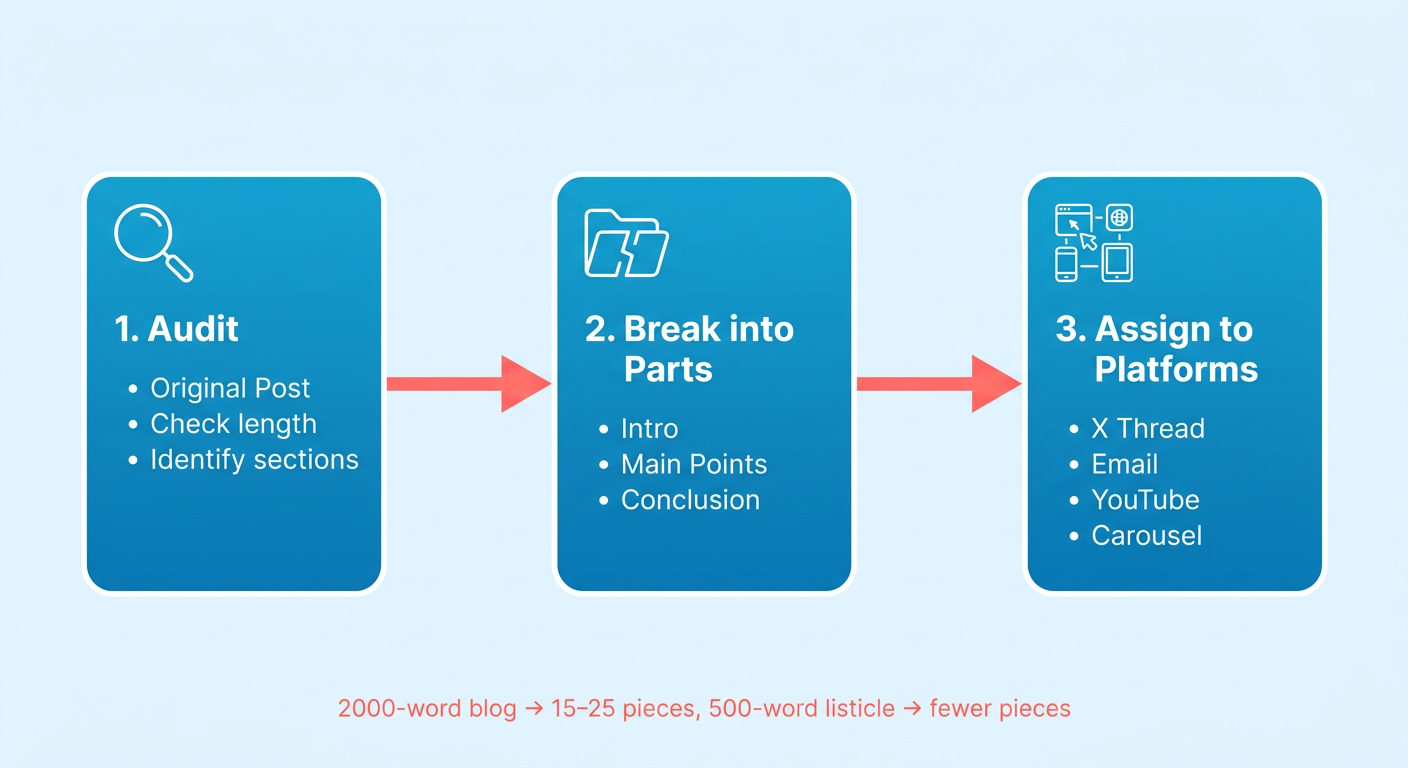
The five assets you're actually extracting
Read the post once with a highlighter mindset and tag five kinds of assets. Each has a home.
- Hooks. The opening stat or provocative claim. These become X thread openers, video hooks, and email subject lines.
- Frameworks. Step-by-step processes and comparison models. These translate cleanly into carousels and tutorial scripts.
- Data points. Benchmarks and results. These stand alone as quote graphics and newsletter callouts.
- Stories. Examples and before-and-after narratives. These fuel LinkedIn posts and video segments.
- Calls-to-action. The specific next step you want readers to take.
Those bulleted lists you wrote to make the blog skimmable are perfect for carousels. Turn each bullet into a slide with a bold header and a one-line description. Numbered steps translate the same way into an X thread, one step per post.
Tag each asset by audience segment first
Here's the shift: tag each asset by which segment it serves before you generate anything. A framework aimed at busy executives might become a tight LinkedIn carousel. The same framework, rewritten conversationally with visual cues, becomes a YouTube script for learners who'd rather watch.
| Asset type | Example audience segment | First format to test |
|---|---|---|
| Hooks | Skimmers on X | Thread opener, video hook |
| Frameworks | Busy executives | LinkedIn carousel |
| Data points | Newsletter subscribers | Email callout or quote graphic |
| Stories | Story-driven readers/viewers | LinkedIn post, video segment |
| Calls-to-action | Bottom-of-funnel readers | Email close, video end screen |
Because format resonance is unpredictable, decide per asset which single segment and format wins before you spend production effort. That constraint is exactly why the cheap-first approach works. Seed low-cost derivatives across formats. Watch which ones earn engagement. Then put deeper production into the winners. Cheap generation made testing cheap enough to let the data decide.
Keep your SEO keywords aligned across formats
When you break a post apart, carry its target keyword into each piece's metadata. Pull the primary keyword and two or three variants from the source, then map them to the YouTube description, the newsletter subject line, and the social post's first line.
One caution: skip content that only ranked because it was trendy. If the topic is stale, a fresh format won't save it. Reserve this deconstruction work for evergreen posts and pieces already earning traffic. Those are the ones worth the effort.
Turning a blog post into X threads
X threads live and die on the first line. A blog post gets found by people actively searching; a thread gets caught by people scrolling on a break. Two different reading modes make pasting your blog intro into the first post a mistake. As one repurposing guide from Matt Giaro puts it, "X rewards concise points, hooks that stop the scroll, and valuable insights delivered in bite-sized chunks."
You don't guess which blog gets the thread treatment. Watch which articles already pull engagement from an X-heavy segment, then generate the thread draft for those first.
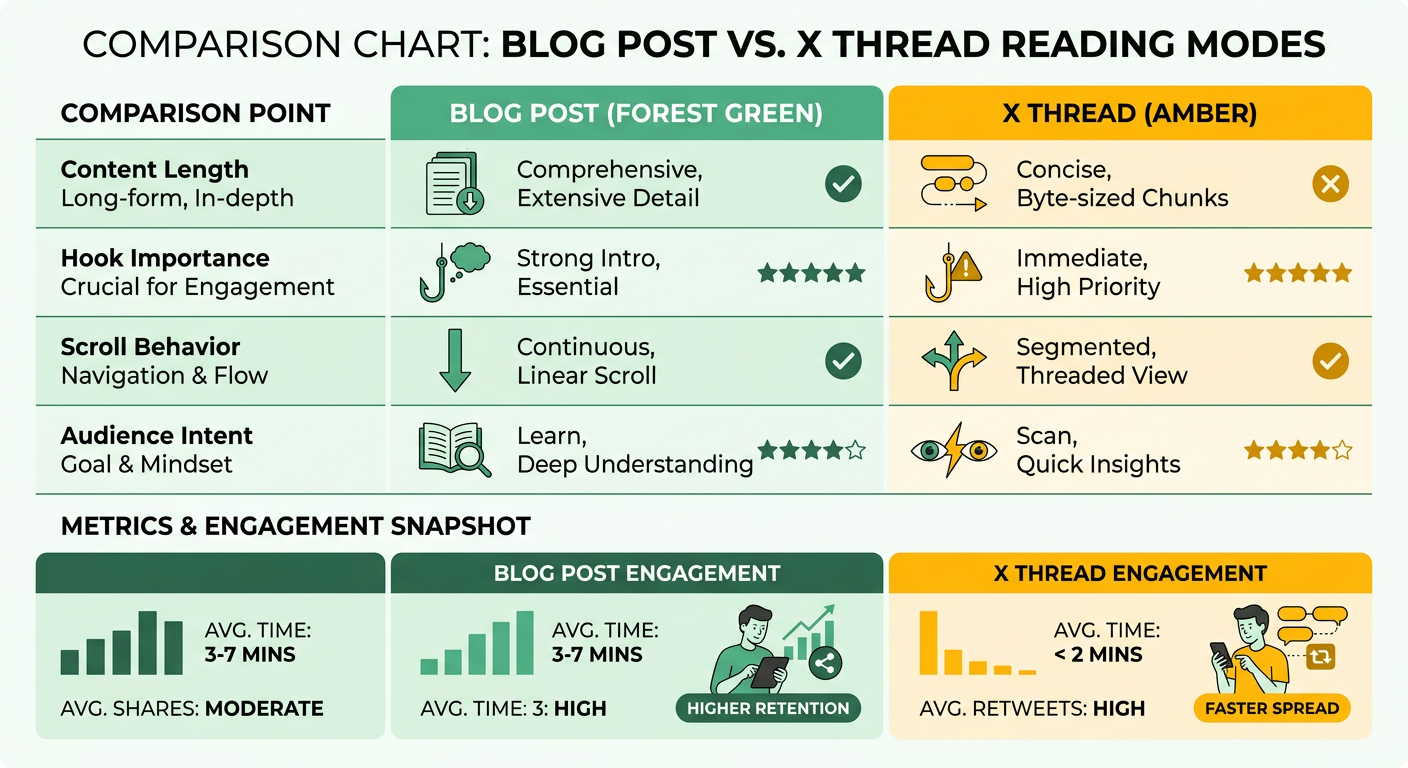
How long should an X thread be?
Keep each post under 280 characters. That's the hard constraint, and it shapes everything upstream. A single dense paragraph from your blog becomes three or four punchy posts, not one truncated mess.
A 10-part thread is a reliable working target. Long enough to deliver two or three real takeaways from the article. Short enough that a scroller finishes it. The structure is simple: a hook post, your extracted insights one idea per post, and a closing call to action linking back to the full piece.
Match thread count to how atom-rich the source is. A thin listicle gives you one, maybe two. Don't force 30 posts out of a post that only holds five real ideas.
What hooks actually stop the scroll?
Your first post carries the whole thread. Three formulas earn their keep: a bold claim, a question that names the reader's problem, or a single surprising stat pulled from the article. Test all three against the same blog and let the numbers pick the winner.
The contrarian angle is underused. Flip a common tip on its head. "Everyone says post every day. Here's why we don't" beats a polite summary because it creates tension in one line. Your blog probably already contains a stance most people disagree with. Extract that.
One warning on models. Study creators who are new to X but pulling traction, not the established gurus. Big accounts break the rules and get away with it because they already have reach. Their tactics won't transfer to a small account. Borrow the workflow of scaled operators; don't copy their content style.
Do visuals and automation matter here?
Yes. Add a chart, screenshot, or GIF pulled straight from your blog. Those skimmable bulleted lists convert cleanly into thread posts and image overlays with almost no rewriting.
Automation can handle the grunt work. A publishing trigger can queue an AI drafting step, and a thread draft comes back ready for review. Seed cheap drafts across formats, then double down where real engagement shows up. Cheap generation makes testing a rational default.
Converting a blog post into an email newsletter
A newsletter is the one format where your audience opted in. They chose to hear from you. That changes how you repurpose. On X, a blog gets caught by strangers scrolling; in the inbox, it lands with people who already trust you enough to hand over their email. Waste that with a wall of pasted text, and you train them to stop opening.
You don't newsletter-ify every post. Watch which articles pull engagement from your email-heavy segment, then generate the email version of those first. Context-based AI matters here more than anywhere: feed the tool the actual blog URL rather than a vague prompt, and the draft stays true to the original argument instead of hallucinating a new one.

What subject line and preview text get the open?
The subject line and preview text are the only two things that decide whether the rest of your work gets read. Treat them as one unit. The subject earns the open; the preview text extends the promise without repeating the subject word for word.
Pull the subject line from the sharpest specific claim in the post, not the blog's title. Blog titles are written for search; subject lines are written for a person deciding in half a second. A curiosity gap works, but only if the email pays it off fast.
How do you keep the email short without gutting the value?
Modular sections are the answer. Build the email as three or four stackable blocks, each making one point, each skimmable on its own. This structure plays well with AI-generated copy, because you can regenerate a single weak block without rewriting the whole email.
The principle is simple: share a short, valuable excerpt of the insight rather than dumping the full text. Give the reader the takeaway, hold back the depth, point them somewhere for the rest.
Your email is the trailer, not the movie. One primary "Read the Full Post" link, placed after you've delivered a genuine standalone takeaway, not buried at the bottom or crammed up top before you've earned the click. If you've written a strong summary that stands on its own, the click becomes a choice, not a demand.
Which posts should skip the newsletter entirely?
Not every post deserves an email. Skip the time-sensitive ones. BrandLume's guidance is blunt: avoid repurposing news-based or highly time-sensitive content unless you move fast, or it feels stale by the time it reaches a new format. An email sent Tuesday about Monday's news reads as late.
The strongest candidates pass two tests. They're evergreen, so the insight holds a month from now. And they're deep enough to carry a standalone takeaway plus a reason to click through. A thin listicle fails both. A meaty guide passes both.
One practical note on automation. An automation that drops your blog into an email layout only helps if it preserves your voice through the transformation. The bottleneck should shift from writing to scheduling. If the automated draft needs a full rewrite every time, the automation isn't saving you anything.
Re-formatting a blog post into a YouTube script
Video is where the audience gap shows up hardest. As BrandLume notes, people consume content in different formats: some enjoy reading, others prefer video, which means a big share of your audience will never read your full article. A YouTube script is how you reach them. The trick is deciding which post earns one first, and audience data answers that faster than instinct.
Pull views from a video-leaning segment, then script those before anything else. Feeding the tool the actual blog URL matters more here than in any text format, because a video that drifts from the source argument wastes a whole production cycle, not just a paragraph.
How long should your YouTube script run?
Length follows the video type, not a fixed rule. An explainer built from a single blog section runs tight and short. A listicle can stretch to match the number of points you pulled from the article.
The screen to apply before scripting: durability times depth. BrandLume warns against repurposing content that only performed because it was trendy, and news-based pieces that will feel stale by the time they hit YouTube. Combine that with the fact that a rich pillar yields far more derivative material than a thin listicle, and your best video candidates are both evergreen and deep. A trending post that dies in a week is the wrong thing to spend a production cycle on.
How do you turn written headings into scene cues?
Your blog's H2s are already a scene list. Read each heading as a spoken transition, then mark what the viewer sees while you talk. A heading becomes a voice-over line; the paragraph beneath it becomes the on-screen graphic or B-roll note.
Keep the intro hook separate from the article intro. Same rule that governs X threads. People scrolling YouTube are in a different reading mode than people who searched for your post, so a pasted blog opener falls flat. Open with the payoff, then earn the runtime.
On-screen graphics should carry the numbers your voice-over states, not repeat your sentences word for word. Say the point out loud; show the stat on screen.
Can AI generate the video assets from the script?
Yes, and this is where the economics tip. Context-based generation—where the tool ingests the actual blog URL—tends to stay closer to your real content than a vague prompt. A platform configured to ingest the blog post can draft the script, generate a voice-over, and assemble an avatar-led presentation without a camera or a studio. That can turn one article into a first-pass video asset in a single pass.
For SEO, keep the video working with the same keywords the blog already ranks for. Match your video title to the original post's search intent, pull tags from the article's core terms, and write a description that reuses the blog's language so the two pieces reinforce each other in search.
We walk through the full workflow in our guide on turning blog posts into YouTube scripts and faceless videos in one pass.
Measuring what worked and pruning what didn't
Measuring repurposing starts with how you allocate budget, not just how you count results. A derivative draft is cheap to produce, so seed low-cost versions across every channel first, then let real engagement decide where to pour deeper production budget. Cheap testing turns measurement into a routing decision.
That's the whole point. You don't commit to a full video production before you know a post has a video-leaning audience. Watch which pieces pull attention from which segment, then double down. Cross-channel distribution can increase total impressions and site traffic relative to single-channel publishing, so the tracking itself is where the compounding comes from.
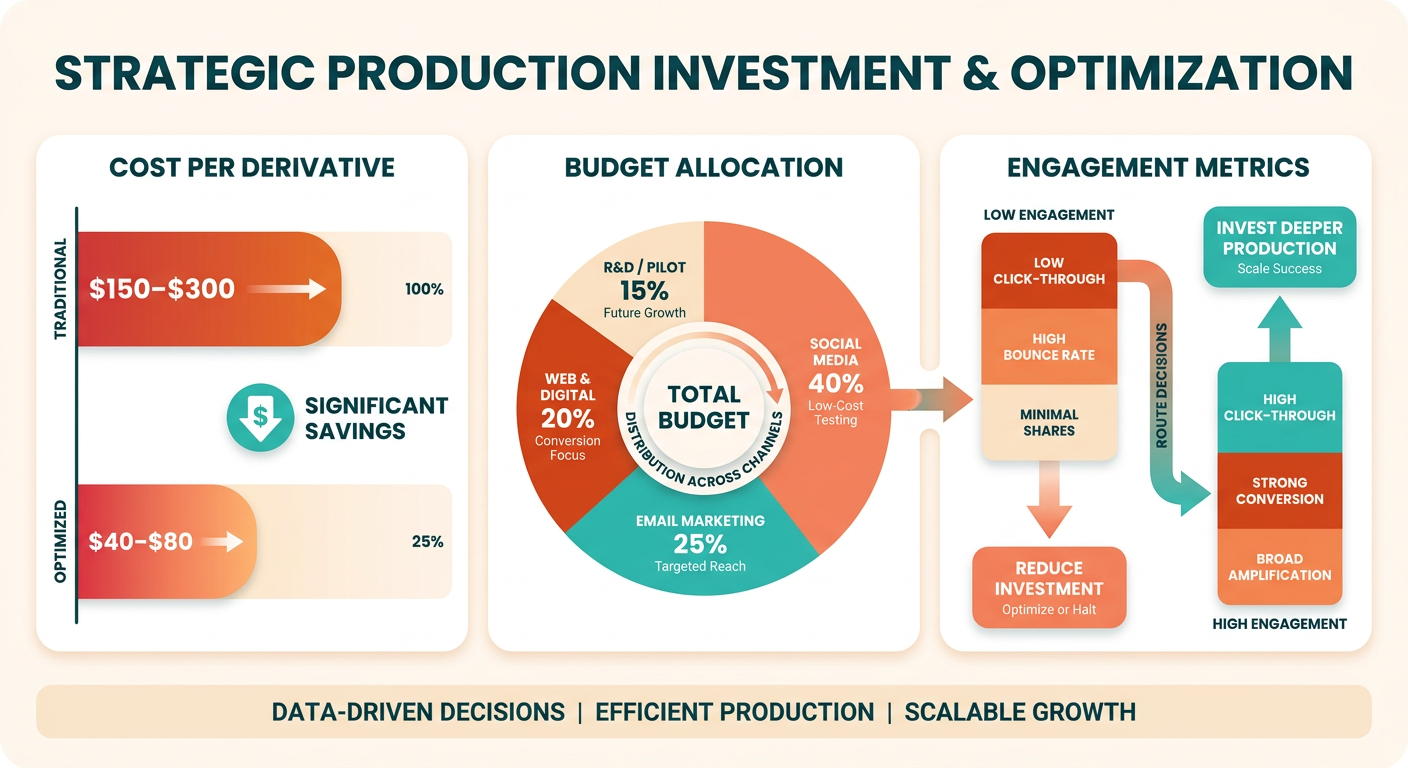
What metrics actually tell you a format is working?
Track engagement by segment, not by vanity totals. A thread with many likes from the wrong audience matters less than a newsletter with a strong open rate from buyers. What matters is which segment engaged, because that tells you which format to generate next for that group.
Set a baseline per format before you optimize. X threads live on reply and repost rates. Newsletters live on open and click-through. YouTube scripts live on average view duration and click-through to your site. Comparing a thread's likes against a video's watch time tells you nothing. Compare each format against its own prior runs.
The real signal is cross-channel attribution: which repurposed asset drove the click that became a lead. Tag every derivative with a source parameter so a newsletter click and a thread click show up as distinct entries in your analytics. Without that tagging, you're guessing which piece of the original post actually converted.
Starting gates for deeper investment:
- X threads: a source post has an X-heavy engaged segment, and a cheap thread draft clears your baseline reply/repost rate.
- Newsletter: the post is evergreen and deep enough for a standalone takeaway, and a draft email opens above your email segment baseline.
- Video: the post is both durable and deep, and a video-leaning segment shows enough early watch time or click-through to justify production.
How do you refine AI prompts based on performance?
Feed the winners back into your next generation cycle. When a data-heavy carousel outperforms a story-driven one for a segment, your next prompt for that segment should weight statistics over narrative. Prompt refinement is just pattern-matching against what already landed.
Context-based generation beats prompt-based generation here. Give the tool the blog URL rather than a vague description, and the draft stays anchored to your real argument instead of drifting. Layer in what the data taught you about format fit, and each cycle gets sharper.
Run headline variations as your cheapest test. The same asset can open a thread, a subject line, and a video hook. Try two subject lines against a segment, two thread openers, two video titles. The winning angle often transfers across formats, which means one A/B test informs three channels at once.
When should you stop repurposing a post?
Stop when a post has run dry of distinct pieces. The multiplication factor depends on how many self-contained knowledge units your original post actually holds. A shallow post carries fewer, so forcing a video script and multiple clips from the same limited material produces a couple of mediocre assets, not a full set of good ones. Let the depth of the source dictate how far you push it.
And pull the plug on a format that consistently underperforms for your audience. If your newsletter segment ignores video summaries after three tries, stop scripting them for that group. The data earned you that call. Real-time analytics is what makes continuous improvement a measured loop rather than a guess.
Your next move this week
Pick one evergreen post that already earns traffic. Not your newest one, not the trending one that'll be stale by Friday. The durable one.
Run the highlighter pass first: tag the hooks, frameworks, data points, stories, and CTAs. Then seed cheap derivatives across two or three formats, one X thread, one newsletter draft, one short video script, and tag each with a source parameter so you can tell them apart in analytics later.
Worked example: Suppose you have an evergreen post about client onboarding. You tag the opening churn stat as a hook for X, the five-step onboarding checklist as a framework for a LinkedIn carousel, the retention benchmark as a data point for the newsletter, and the client turnaround as a story for a YouTube script. You seed the X thread, the carousel, and a newsletter draft, each with a source parameter. After a week, if the X thread clears your baseline replies and reposts for that segment, produce more threads from the same source. If the newsletter draft opens well with a buyer segment, expand it into a full email. If the video script shows weak early watch time, hold video production and repurpose the story as a written case study instead.
Then wait. Let a week of engagement data come in before you commit real production budget anywhere. The whole method rests on one habit: generate cheap, measure by segment, and pour effort only into what the data already rewarded.
Common Questions
1. Can I repurpose a blog post that's older than a year, or does age hurt performance?
Age matters far less than durability. An evergreen post published years ago repurposes well if its insight still holds today. The disqualifier isn't age but staleness—posts that only ranked because they were trendy or news-pegged fall flat in a fresh format regardless of publish date.
2. If a thread flops, does that mean the blog post itself is weak?
Not necessarily—format resonance is genuinely unpredictable. The same material can flop as a video yet thrive as written content, and some creators have seen note-taking material go nowhere on YouTube but add email subscribers on Medium. Test the atom in another format before writing off the source.
3. How do I compare a thread's performance against a newsletter's when the metrics are so different?
Don't compare across formats directly—compare each format against its own prior runs. X threads live on reply and repost rates, newsletters on open and click-through, and YouTube on average view duration. A thread's likes versus a video's watch time tells you nothing useful.
4. Does AnyPost keep my writing voice when it converts a post into other formats?
Voice preservation depends on using context-based generation rather than vague prompts. Feeding a context-aware repurposing tool the actual blog URL keeps drafts anchored to your original argument instead of hallucinating a new one. If an automated draft needs a full rewrite every time, the automation isn't saving you anything.