
AI Content Tools Draft Fast, But Editors Still Decide What Ranks

The Short Version
- Many B2B marketers keep documented brand voice guidelines, yet far fewer actually use those guidelines to train or prompt their AI tools.
- Raw draft speed barely separates the major AI writing tools. Latency tends to show up once you stack tone-matching or multi-source citation on top.
- AI drafts cannot reliably supply statistics, dates, or citations, so every figure in a draft needs checking against a real source before it ships.
- Search rankings often reflect the editorial layer stacked on top—fact-checking and restructuring—not just the raw output a detector flags.
- Google’s Search Quality guidance emphasizes first-hand testing, expert judgment, and original data; a language model cannot generate those inputs on its own.
Draft Speed Is the Number Everyone Overrates
Ask most teams to rank AI writing tools and they reach straight for raw speed. Fair enough. When you're staring down a content calendar, “how fast can this thing draft 1,000 words” feels like the whole game. But after working with AI content generation across client workflows, we’ve learned that raw output speed is one of the least interesting numbers on the page.
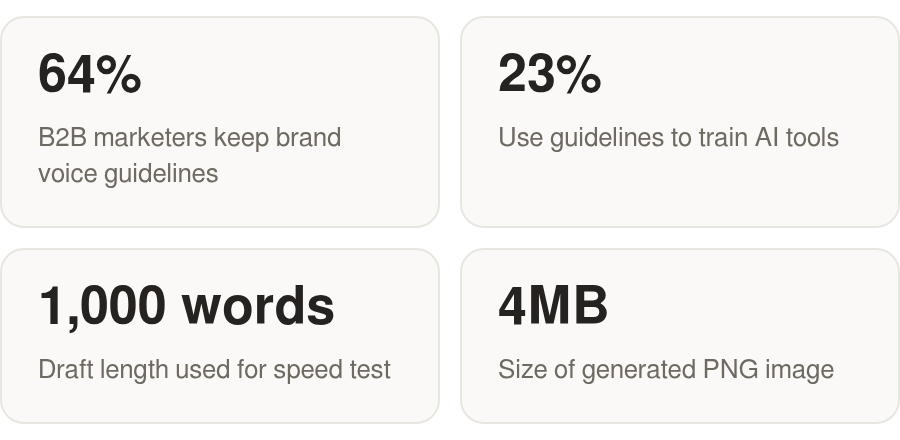

Most tool comparisons stop before the part that costs you time. When much of AI-generated language may not survive a real edit, a lot of that early draft speed is producing text you throw away. The time you actually save often shows up later, in review and approval, not in the first sixty seconds.
Raw draft speed looks similar across the major tools
Most platforms now spin up a full-length draft quickly, and on raw output the gap between the top tools is often small enough that it rarely decides anything. Latency tends to creep in only when you stack advanced features like tone-matching or pulling from multiple sources at once.
That latency is worth understanding. Ask a model to match a specific voice, cite multiple source documents, and hold a structure, and generation may slow. You’re trading a few seconds of speed for a draft that may need less rework. That trade is often worth taking.
Usable output beats words per minute
The metric that matters is how much of the draft you keep. Governance and structured review are where the real gains may live. Teams that put a genuine review workflow in place may cut repeated revision rounds and move approvals through faster.
Notice what moved those numbers. Not a faster model. A tighter process. A tool that drafts fast but hands you unusable copy just relocates the bottleneck to your editors.
This is where our approach differs. Instead of racing to fill a blank page, we aim to drive one draft across multiple channels and hold tone steady through a Persona Engine, so the version you get back may need fewer passes before it ships. See how one draft can move across five channels.
How the tools compare on speed that actually counts
| Dimension | Most standalone AI writers | AnyPost.ai |
|---|---|---|
| Raw draft speed | Fast | Fast, at scale |
| Tone-matched output | Optional, adds latency | Built in via Persona Engine |
| Multi-channel drafting | One format per run | One draft, repurposed across channels |
| Where time is saved | Initial draft only | Draft plus potentially fewer revision rounds |
The pattern is common. Standalone tools often optimize the part of the job that was never slow. Our bet is on batch generation and repurposing, because the second, third, and fourth pieces of content are where a single draft either pays off or forces you to start over.
One caveat, and it’s a real one. If you publish a handful of pieces a month and edit everything by hand anyway, batch and multi-channel features may be overkill. A simple writer will do. The speed argument only holds up once volume and review cycles are your actual constraint.
What Humans Still Add That Moves Rankings
Here’s a puzzle worth sitting with. AI-generated pages can rank well for some queries, yet much of the raw language these tools produce may still need heavy editing before it’s usable. Both findings can hold. The resolution tells you where AI content generation ends and editorial work begins.
A detector often flags the drafting method, not the human layer stacked on top. A page labeled “AI-written” may have passed through fact-checking, restructuring, and a dozen judgment calls before it shipped. Rankings often reflect that editorial investment, not the raw draft. So the interesting question isn’t whether machines can draft. It’s which decisions a human still has to own.
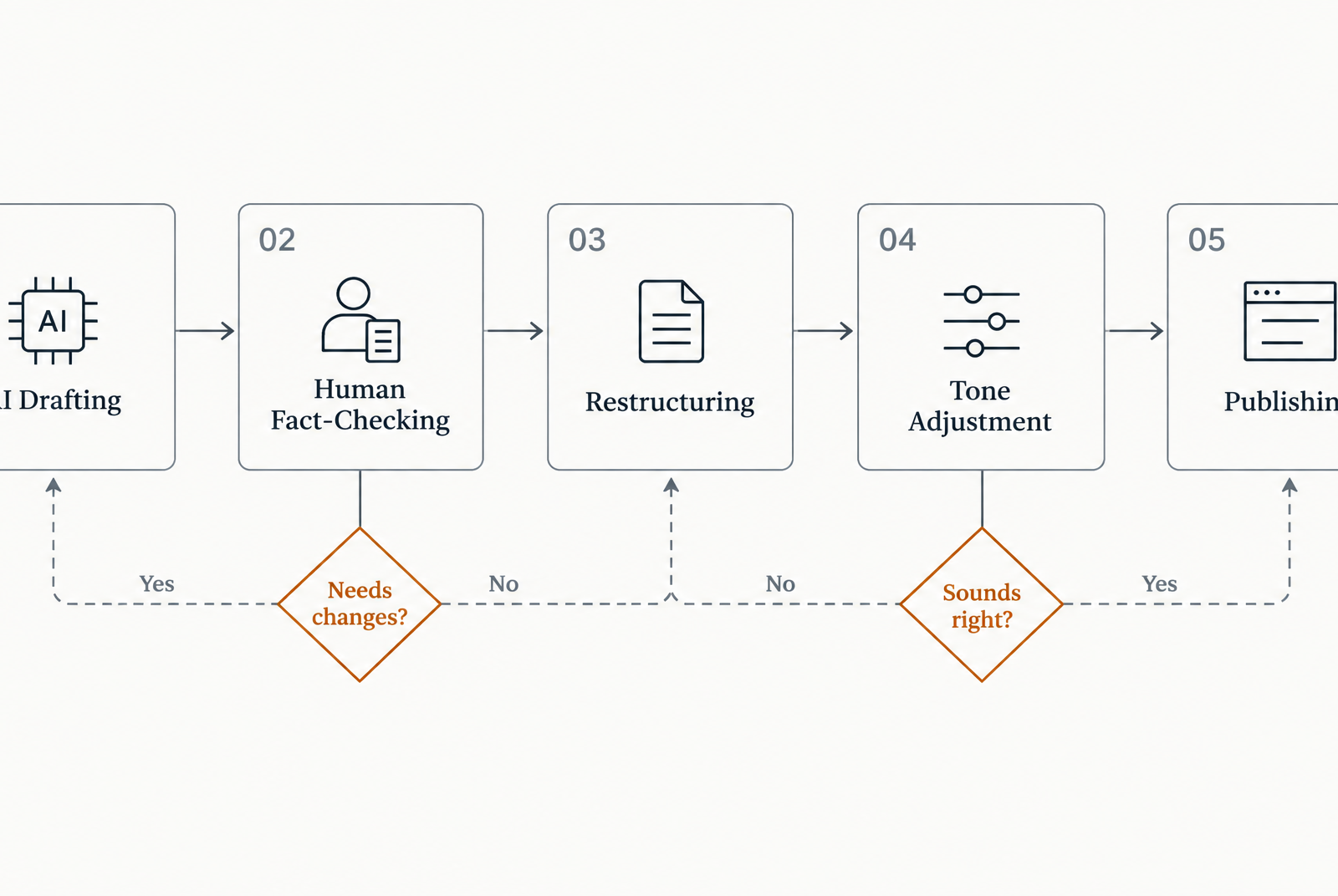
Which editorial checks actually move rankings?
Start with facts, because this is where drafts may break. Some reviewers note that AI drafts often contain only statistics the operator provided. That’s the hallucination problem in miniature. Any figure, date, or citation in a draft needs verification against a real source before it counts.
Google’s Search Quality guidance has pushed content to demonstrate real experience and accuracy. A model can arrange notes well, but it cannot fabricate lived experience. First-hand testing, expert judgment, and original data are the inputs a draft can’t invent.
Why does generic AI content all read the same?
Content convergence has a likely mechanism. Industry surveys suggest many marketers keep documented brand voice guidelines, yet far fewer use those guidelines to train or prompt their AI tools. Feed the same generic prompts into the same models and every brand can start to sound identical.
That makes editorial differentiation the scarce input. As some editorial frameworks put it, a style guide that few people actually read is not a review standard; it’s a suggestion. Tone consistency and voice can separate a strong page from the indistinguishable majority. We treat voice as a pass-fail gate in our tone and ranking tracking approach, not a nice-to-have.

Where should AI hand off to a human?
| Editorial action | AI draft alone | Human editor adds |
|---|---|---|
| Fact-checking | May repeat what it’s given and can invent the rest | Verifies every claim against sources |
| E-E-A-T signals | No lived experience | First-hand testing, expert judgment |
| Internal linking | May miss site context | Maps links to strategy and intent |
| Keyword placement | Can be blunt or stuffed | Natural fit to reader questions |
| Brand voice | Can converge to generic | Enforces documented tone |
Structure is what pays off. A repeatable governance framework may cut revision rounds and shorten approval timelines by grounding every draft in approved knowledge before it reaches review. Research on AI adoption points in a similar direction: while many organizations now use AI for content, consistent quality remains a common challenge. The satisfied adopters often aren’t drafting faster; they’re editing smarter.
The Plumbing: Metadata, Schema, and Internal Links
Technical SEO is mostly mechanical work, and that’s the part people underrate. Title tags, meta descriptions, JSON-LD schema, internal links: these follow patterns. Patterns are exactly what AI content generation handles well. That’s why many serious platforms now include some form of metadata automation.
Mechanical doesn’t mean risk-free, though. A tool can generate many meta descriptions quickly, and some of them can still miss search intent, run past the truncation limit, or bury the term someone actually searched. The speed is real. The judgment gap is real too. So the useful question isn’t whether AI can generate these layers. It’s how much cleanup each one demands after the machine finishes.
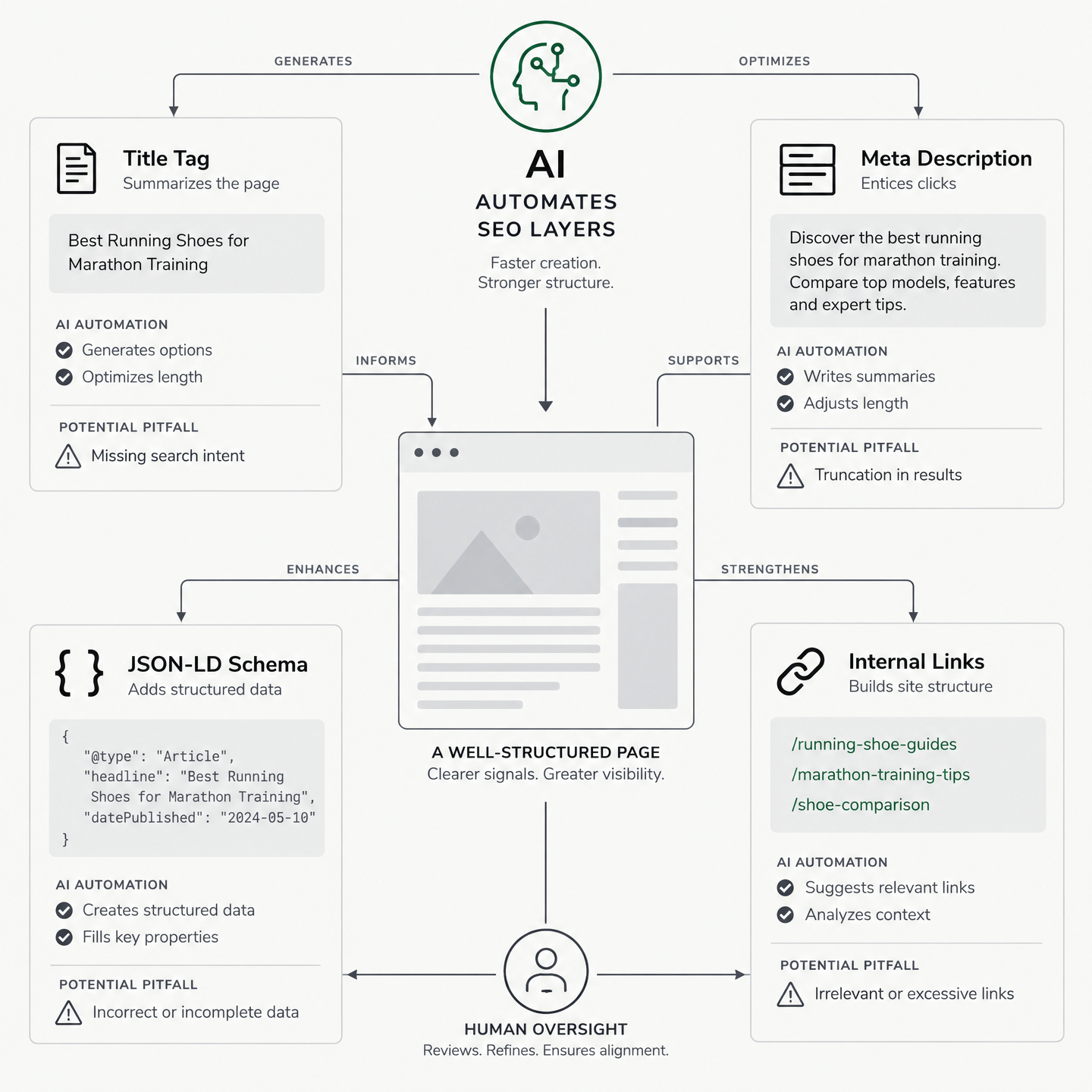
Metadata automation saves keystrokes, not judgment
Auto-generating title tags and meta descriptions is one of the more mature features across these tools. Point the engine at a page, and it may pull the topic, draft a title under the pixel limit, and write a description that reads cleanly. For a site with thousands of URLs, that can save significant manual effort.
The catch often shows up in intent. A generated title can be grammatically perfect and still target the wrong version of a query. Same editorial layer the earlier sections described: the draft is fast, but a human decides whether it matches what a searcher wants. Some platforms include real-time keyword density flags to help nudge you before you publish.
Schema is where automation earns its keep
Schema is where automation may get genuinely useful, because JSON-LD is structured and repetitive. Tools that detect page type and inject the right markup—Article, FAQ, Product—can save you from hand-writing brackets. For programmatic SEO builds, injecting schema across many templated pages at once is often the main value.
Accuracy is the failure mode to watch. Schema that declares fields the page doesn’t actually contain can trigger errors or get ignored. Validate a sample before you push at scale. And a scope check: if you’re running a small brochure site, bulk schema tooling is likely overkill. Do it by hand once and move on.
| Technical layer | What AI drafts on its own | What still needs a human |
|---|---|---|
| Title tags & meta descriptions | Bulk generation from page content | Intent match, truncation, click framing |
| JSON-LD schema | Boilerplate markup by page type | Correct type selection, field accuracy |
| Internal links | Candidate suggestions by topic overlap | Relevance, anchor text, link priority |
Internal links are the hardest layer to automate
Internal linking is where suggestions may get shaky. A tool can spot topic overlap and propose a link, but relevance is a judgment call. We see the best results when bulk link-mapping produces candidates and an editor approves anchor text and priority.
This is where consolidating tools may pay off. Instead of stitching a metadata plugin to a separate schema tool to a third link mapper, one workflow that drafts, maps links, and publishes can reduce handoffs. AnyPost.ai is built around that programmatic angle, and we make the case for a single pipeline in Skip the 12-Tool Stack. The platform still hands the final relevance call back to you, which is exactly where it belongs.
Visuals: AI Generation vs Human Curation
The trade-off in plain terms: AI content generation now covers visuals, not just words. Image generators, avatar videos, and auto-built carousels can fill a page quickly. But the machine may optimize for “looks done,” while a human editor optimizes for “fits the brand and loads fast.” Those are different goals.
Visual work sits at the intersection of page experience and relevance, and that’s exactly where AI-generated media can stumble. A model can spin up a slick illustration that has little to do with your actual point. It can hand you an oversized PNG that slows your load time. So the question isn’t whether AI can make images. It’s which parts of media optimization you can safely automate, and which still need a person.
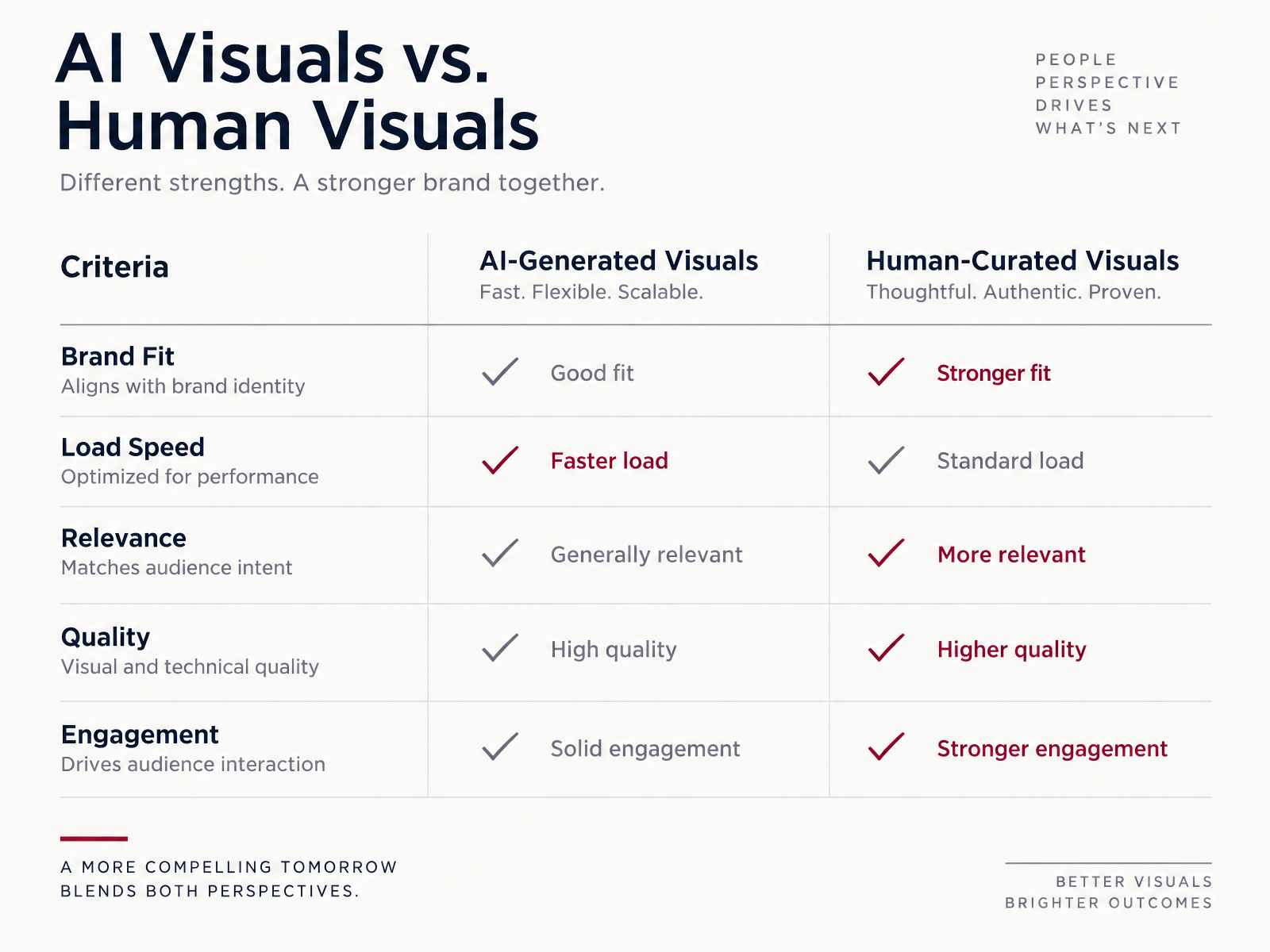
AI handles production, humans own relevance and performance
AI generation is strong at raw asset creation and weaker at judgment calls. It can produce stock-free images, art, and avatar clips at scale, which solves the blank-canvas problem. What it may not reliably solve: whether the visual matches search intent, whether the alt text describes the image accurately, and whether the file is compressed enough to protect your Core Web Vitals.
Alt text is the clearest example. A generator can auto-fill it, but it may describe pixels rather than meaning. A human editor rewrites alt text to serve both accessibility and the query behind the page. That’s the same editorial layer this article keeps circling back to.
| Media task | AI handles well | Human still owns |
|---|---|---|
| Image/asset creation | Fast, stock-free generation | Relevance to the actual topic |
| Alt text | Auto-drafted descriptions | Accuracy + intent match |
| Compression & format | Batch export | Load-time targets that protect page experience |
| Brand consistency | Templated styling | Palette, tone, on-brand judgment |
| Video/avatar clips | Rapid short-form output | Message clarity and edit quality |
Free AI video tools hit a wall fast
If you’re leaning on free tools for short-form video, expect limits. Free generators often cap how much you can produce and how polished the output gets, which is why teams shipping real volume may outgrow them quickly. That ceiling can push them toward integrated suites rather than a pile of stitched-together free generators.
The other common pattern: people juggling separate tools for clip generation and posting. Fragmentation is the tax. Every extra tool is another export, another format mismatch, another handoff where quality can slip.
Where AnyPost.ai fits: integrated avatar and carousel generation
We built our visual automation to reduce that fragmentation gap. The platform can generate avatar videos and multi-slide carousels inside the same workflow that drafts and publishes your written content, so you’re not exporting assets across a pile of apps to get one post out the door.
That integration is often the real advantage, not the novelty of AI art. When your carousel, your copy, and your channels live in one system, the editorial pass gets easier: you check brand fit and relevance once, in context, instead of chasing files around. And because AnyPost publishes directly to LinkedIn, X, Instagram, TikTok, and YouTube, one approved draft can move to multiple channels without a separate export for each.
One boundary, though: don’t expect any generator, ours included, to make the relevance call for you. AI gets the asset onto the page fast. Deciding whether that asset earns its place is still your editor’s job.
AnyPost.ai: The End‑to‑End Content Engine
Here’s the uncomfortable question we sit with as the team building an end-to-end engine. If ranking data rewards the human editorial layer, does automating the entire pipeline optimize for the exact input the evidence may not pay out on? It’s a fair challenge, and it shaped how we approached AI content generation from the start.
The signal from recent analyses of AI versus human content for SEO is fairly consistent: pages that carry a clear editorial fingerprint often hold up better in search than undifferentiated drafts. That kind of evidence doesn’t reward raw drafting throughput. It rewards editorial investment: differentiation, original data, and review scaled to risk. So AnyPost is designed to automate the mechanical stages of production—generation, SEO-optimized publishing, backlinking, GBP and review management, newsletters, and multi-platform distribution—while still giving you room to create, edit, and publish from one place.

What does an end-to-end engine actually cover?
Most teams run a stack of single-purpose tools: one for drafts, one for metadata, another for backlinks, a scheduler for social, a separate service for the newsletter. Every handoff is a place work can get dropped or duplicated.
We collapse that into one workflow. Drafting, SEO-optimized metadata, backlink generation, Google Business Profile management, newsletter automation, and multi-platform publishing can all live in the same place.
Coverage is where an integrated engine can pull ahead. But coverage isn’t the same as unattended coverage, and that distinction matters.
Where do we keep humans in the loop?
Our position: the mechanical layers should be hands-off, the judgment layers should not. The table below maps that split.
| Funnel stage | What the engine handles | What a person still decides |
|---|---|---|
| Drafting | Full-length first drafts, multi-format variants | Angle, original data, what to cut |
| SEO technical | Title tags, meta, internal and external links | Whether the meta matches real intent |
| Backlinks | Generation and outreach mechanics | Which targets fit the brand |
| GBP + social | Scheduling and cross-posting across channels | Timing, tone, response to comments |
| Newsletter | Assembly and send automation | Editorial framing and segmentation |
Notice the right-hand column never empties out. That’s deliberate. An engine that promised to remove it entirely would be selling you the input the ranking evidence may not reward.
Is full coverage worth it over point tools?
For a solo blogger publishing twice a month, an all-in-one engine may be overkill. A single drafting tool plus manual scheduling can get you there cheaper, and the integration overhead isn’t worth it at that volume.
The math flips for agencies and marketing teams running many properties across several channels. When you’re managing drafts, local listings, backlinks, and newsletters at once, the cost of stitched-together tools isn’t always the subscriptions. It’s the coordination tax and the dropped handoffs between them.
That’s the use case we’re built for: high-volume, multi-channel teams that want one pipeline instead of twelve. Keep the human on differentiation and intent, let the platform absorb the repetitive production, and you’re spending editorial hours where the rankings may actually respond.
So Which Tool Should You Actually Pick?
After evaluating AI content generation across several tool categories, the verdict is simple: no single tool wins on all fronts, and the right pick depends entirely on which stage of the work you’re trying to speed up. Raw drafting, SEO structure, visuals, and full-pipeline automation each reward a different design.
The buying decision rarely comes down to output quality alone. Teams pick based on where their pipeline stalls: some drown in first drafts, others lose days stitching outputs between five separate apps. Match the tool to your actual bottleneck, not to the feature list with the most checkboxes, and you’ll often get more mileage from a narrow tool than from a broad one you only half-use.
The best-for grid, trade-offs included
Here’s how the four tool archetypes we evaluated stack up against the trade-offs each one surfaces.
| Tool type | Best for | Main strength | The trade-off you accept |
|---|---|---|---|
| Speed-first drafters | High-volume first drafts | Fast raw output | Much of that text may get rewritten in review |
| SEO-heavy optimizers | Metadata, schema, keyword fit | Mechanical accuracy at scale | May still miss search intent without a human check |
| Visual/multimedia generators | Filling a page with images or video | Production speed | Often optimizes for “looks done,” not brand fit or load time |
| All-in-one automation (AnyPost.ai) | Complete pipeline automation | Generation through publishing in one workflow | Best fit for repeatable, verifiable content, not pages that hinge on first-hand experience |
The pattern holds across the whole grid. Speed buys you a draft, not a finished page. Depth of automation buys you fewer handoffs, but the pages that hinge on lived experience still need a human at the center.
AnyPost.ai earns the all-in-one slot because it automates many mechanical stages end to end, from content creation and SEO through publishing, backlinks, and social distribution. If your bottleneck is coordinating a dozen disconnected tools, that consolidation may be the win.

Where a specialist tool still wins
Don’t reach for full automation when the page depends on something a machine can’t reliably supply. A model often cannot output a statistic it wasn’t fed, and it cannot manufacture first-hand testing or a genuine expert opinion. As some analyses frame it, AI can organize notes or improve prose, but the value of a page may depend on first-hand experience the model simply doesn’t have.
For thought-leadership pieces, original research, or high-stakes commercial pages, a human-led workflow with a narrow AI assist often beats any end-to-end engine. The all-in-one tools can shine on repeatable, verifiable content. They are the wrong call for pages where your differentiation is the whole point.
Your next move
Start by sorting your content calendar by risk. Route the low-stakes, high-volume work to automation, and reserve human-led production for the pages where experience and original data may drive the ranking.
Then define your editorial checkpoints before you scale anything. Decide who owns fact-checking, differentiation, and final approval. That handoff is what separates a hybrid workflow that works from one that ships generic drafts at speed.
Trial one all-in-one tool against your current stack on a batch of real assignments. Measure the time saved in review and approval, not just draft generation. That’s where the honest number lives.
Still Wondering?
1. If an AI detector flags my published page as machine-written, will that hurt my search rankings?
A detector often flags only the drafting method, not the editorial work layered on top. Rankings tend to reflect fact-checking, restructuring, and judgment calls a human made before publishing, not just the raw output. A page can read as AI-drafted and still rank because search may reward the editorial investment, not the tool that produced the first pass.
2. Which types of content should I keep away from full automation entirely?
Thought-leadership pieces, original research, and high-stakes commercial pages often need a human-led workflow with only narrow AI assist. A model cannot manufacture first-hand testing, a genuine expert opinion, or a statistic it wasn’t fed. All-in-one automation fits repeatable, verifiable content, but it may be the wrong call when your differentiation is the whole point.
3. How do I stop my AI-generated content from sounding identical to every competitor?
Feed your documented brand voice guidelines directly into the model rather than leaving them in a PDF nobody reads. Generic prompts into the same models often produce indistinguishable output, so tone consistency becomes a differentiator. Treat voice as a pass-fail gate before publishing, not an optional finishing touch applied after the draft ships.
4. I’m a solo blogger publishing twice a month. Is an all-in-one engine worth it for me?
Probably not. At that volume, a single drafting tool plus manual scheduling may get you there cheaper, and the integration overhead likely isn’t worth it. Batch generation and multi-channel repurposing tend to pay off once volume and review cycles become your real constraint. The math can flip for agencies running many properties across several channels.
5. Can I trust AI to inject schema markup across hundreds of pages without checking it?
Validate a sample before pushing at scale. Schema that declares fields the page doesn’t actually contain can trigger errors or get ignored entirely. AI can handle boilerplate JSON-LD well because it’s structured and repetitive, but correct type selection and field accuracy usually still need a human review pass first.