AI SEO Content Generators: Clusters, Entities, and Passages Google's AI Overviews Quote

TL;DR
- AI Overviews appear in roughly 15% of Google searches, and organic click-through falls about fourfold when one shows up.
- Query fan-out favors pages that already rank for a head term and its sub-queries. Pages built around a single phrase don't get picked.
- The cited source set is chosen per surface and reshuffles between refreshes, so a page that wins one answer can drop out of the next.
Quick Summary
The stage that decides whether Google's AI Overview quotes you usually isn't the drafting stage. It's the mapping that happens before anyone opens a document. Generate straight to prose and you tend to get pages that rank, then get passed over while Gemini stitches an answer out of a fan of hidden sub-queries.
| Layer | Role | What the evidence shows | Workflow check |
|---|---|---|---|
| Topic cluster | Covers the breadth one query fan-out reaches | Pages ranking for the head term and its fan-out sub-queries are far likelier to be cited than pages ranking for one only | One cluster per sub-intent, mapped before drafting |
| Entity map | Tells the model what the page is actually about | Google's AI features need no special schema, so markup supports relevance rather than buying citations | Name products, places and people precisely; validate structured data |
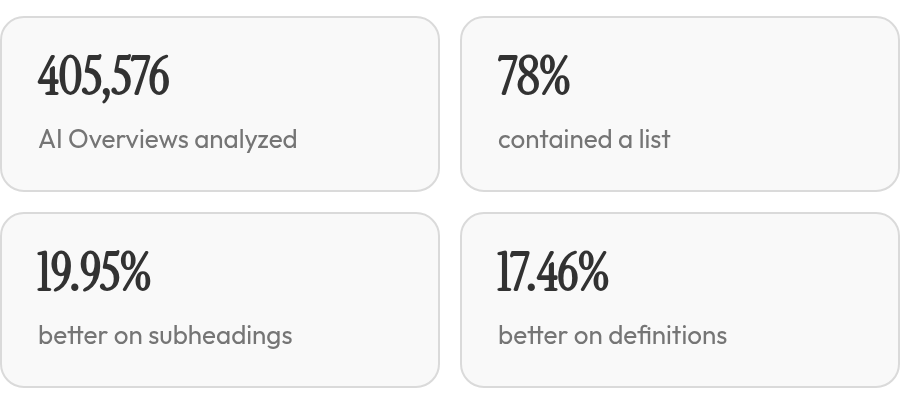
| Passage | The unit that gets lifted into an answer | Clear lists, subheadings, and concept definitions help passages stand alone | Direct answer first, self-contained blocks of 40 to 60 words |
| Citation process | Google fans out, selects sources, then synthesizes | The source set is chosen per surface and reshuffles between refreshes, so a page that wins one answer can drop out of the next | Check citations per surface, not once overall; expect movement between refreshes |
Why AI SEO content generators matter, and when they don't
Teams still buying content one keyword at a time watch impressions climb while clicks slide, and the reason is structural. Google's AI surfaces run a query fan-out: they break a question into subtopics and fire many searches at once. A page aimed at a single phrase has little to contribute to most of those branches. An AI SEO content generator earns its place only when it publishes concepts and citable passages instead of strings.
Why a citation now outranks a position
Because the decision happens inside the answer, not at the link. AI Overviews surface on roughly 15% of Google searches, and the feature keeps expanding. Organic click-through falls about fourfold when a summary is present. A page can be seen without ever being clicked.
The upside is specific. Brands cited in an Overview tend to keep more of that thinning stream than uncited ones do. The impression happens either way; the citation is the part that turns it into a visit.
The same shape shows up in traffic quality. AI-search visitors can be a small slice of a site's sessions and still account for a share of signups well out of proportion to their volume. Treat citation as a conversion channel, not a vanity metric.
One boundary worth marking: Business Profiles and Product Knowledge Panels surface inside AI Mode as cards, and ordinary pages don't manufacture those. Schema buys relevance. It doesn't buy a citation.
What you check before you scale it
Accuracy, mostly. Google says plainly that generative models predict likely word sequences rather than retrieve facts, so every draft needs a human pass. Audits of generated output routinely turn up claims the pages cited beside them don't actually support. How often depends on the prompt and the topic, which is exactly why the review step stays human rather than automated.
Speed is the trade. Automation compresses research, clustering and first drafts into a few hours, and Google's quality-rater guidelines treat low-effort scaled pages as a problem category of their own. Plausible prose can outrun the evidence sitting behind it.
So the recommendation is narrower than the hype. Publish a handful of pages a quarter and own a tight niche already? Skip the generator route. At that volume the review overhead outweighs the gain. It starts paying when you need clusters mapped before drafting across a topic with real depth to it.
Mapping clusters to client goals
Start with the client's sentence, not their keyword export.
The most useful input we get is one line about what a booked lead looks like. From there we pick a single pillar page, break it into subtopics, and only then open a tool. A generator will spin forty subtopics out of a head term without complaint. What it can't tell you is which of them the client can actually win. That call belongs in the map, before drafting starts.
Tagging subtopics for AI Overview opportunity
Tag each node with the intent behind the query someone would actually type, using the same intent logic we apply when we cluster LSI keywords, just moved up a level. Question, why, yes/no, definition and long-query tags go first. Those phrasings give a summarizer something to expand on; each can be restated three or four ways before the answer settles. A node that resolves to one fixed answer leaves nothing to condense. Across the cluster maps we've audited, the nodes that drew a citation nearly always carried a question tag and at least two fan-out queries beneath it.
Commercial-investigation and transactional tags stay on the map as workflow labels. Nothing in the evidence ties them to higher citation rates, so we don't let them eat the calendar.
What a working cluster map looks like
Illustrative, not a screenshot of anyone's dashboard:
PILLAR (client goal, one line)
├─ SUBTOPIC A [question] [fan-out: q1, q2] → links up to pillar.
│ └─ SUBTOPIC A1 [definition] [fan-out: q3] → links to A + sibling.
└─ SUBTOPIC B [yes/no] [fan-out: q4, q5] → links to pillar + A.
Membership follows fan-out coverage, not a target count. The ratio is deliberately one-to-many: each page answers a spread of the pillar's sub-questions rather than a single search string. If a subtopic answers none of the pillar's fan-out queries, we move it to its own cluster.
Entity graphs: the unglamorous work that decides the quote
The stage that decides this isn't the drafting sprint. It's the argument about what the page is actually about, held before anyone types.
An entity is just a thing a model already recognizes: a person, a product, a place, or a concept like query fan-out. Gemini parses a query down to those objects before it retrieves anything, so consistent naming gives it something to grip. That work belongs in the map, not the prose. A generator that opens with a blank page tends to hand you adjectives instead of nouns.
Building an entity graph that survives a real cluster map
The versions that hold up are deliberately unglamorous. Pull candidate entities out of the cluster, standardize each to one spelling, note the two or three attributes that matter, record how each relates to its neighbors. Then every entity gets assigned to a page.
NLP passes and Knowledge Graph lookups can speed up the extraction if you want them, and this is one of the few places where it's reasonable to let automation carry the load. They don't make the call on which entities you can win, though. Where a platform genuinely earns its keep is downstream of that judgment: a Persona Engine keeps voice consistent across every page once the decisions exist, and publishing pushes them to your site instead of into another handoff. Skip the whole exercise for a single landing page with no siblings. The overhead outweighs the upside.
What keeps the graph alive after publishing
Descriptive internal links between the pillar, its subtopics, and related-entity pages. Readers and crawlers then walk the same paths a fan-out walks. Structured data helps machines read the page, and Google encourages it, though the company has never confirmed a citation lift from markup alone.
The failure mode isn't missing schema. It's repetitive entity mentions, keyword stuffing, and a dozen thin entity pages nobody asked for. Every one of those needs an editor before it ships.
Writing passages that survive being lifted out
The passage is where a page wins or loses the quote, and it's almost always written last, in a hurry. Run a generator pass across a finished draft and the paragraphs that fail fail the same way: three ideas stacked into one block, and not a single sentence that survives being lifted out alone.
The budget for what gets pulled into an answer is smaller than most writers assume. It isn't really a word count, either. Length tends to be the wrong dial. Snipping a paragraph to fit an arbitrary ceiling usually costs you the specificity that made it quotable, while a tight section answering one question cleanly can travel much further than a sprawling one circling the topic. Write for the pull, not the scroll.
What makes a paragraph passage-ready
One idea, stated in the first sentence, supported over the next two or three. If a reader can't tell what the paragraph is about with the heading stripped away, neither can the model that strips it.
That vagueness carries a hidden tax. Every sentence doing two jobs at once muddies the signal, and a diluted paragraph can get skipped entirely rather than quoted partially.
Fact-checking belongs in drafting, not in review. One claim per sentence, one named source per claim. Two questions get tangled together here and shouldn't be: whether you get cited at all, and whether the citation comes out accurate. A sentence that gets lifted and distorted does more damage than one that gets passed over, because the reader meets your half-claim with your name attached to it.
Test every paragraph by pasting it into a blank document. If it still makes sense and still says something specific, it's ready. If it needs the surrounding page to hold it up, rewrite it.
Measuring impact and staying compliant
Citation count is the easiest number to report and the least useful one to act on. A generator can slot your page into an answer and still cost you the click. Being quoted is not the same as being visited. Real-time analytics tracking is meant to close that gap: keep the citation and the reader in one frame, so you see what the model did with your passage next to what happened on the page afterward.
What a citation count leaves out
Log citations per query and per surface, because the surfaces disagree with each other. The same brand can get named in AI Overviews and go missing in AI Mode. Keep your expectations honest about the payoff, too. Ahrefs' analysis found AI Overviews contributing to a 34.5% drop in click-through rate, with Seer Interactive reporting drops as steep as 61%. Underneath citations sit position, CTR and conversions, and those are the columns that tell you whether a quote is doing real work or just decorating an answer.
Then three quality columns, scored separately: key-information coverage, attribution accuracy, and faithfulness. A citation can be real and still wrong. Your page gets named for a claim it never quite makes, or the summary drops the qualifier that made the claim true. The miss is usually omission rather than outright invention.
Compliance is two audits, not one
Google's rater guidelines split scaled content abuse (section 4.6.5) from main content with little effort, originality, or added value (4.6.6). A page can dodge one and fail the other, and the remedy tends to be the same either way: content that carries something of yours rather than a generic answer restated at volume. That's the part the Persona Engine is built for, matching tone to your brand so scaled output still sounds like the people behind the site.
Merchant Center adds a labeling layer. AI-generated images need the IPTC DigitalSourceType value TrainedAlgorithmicMedia in their metadata, and AI-generated product titles or descriptions get marked as AI-generated rather than blended in.
Skip the full audit on a page with no checkable claims. The hours go further elsewhere.
Questions People Ask
How many pages do I need to publish before an AI SEO content generator pays off?
The generator stops being worth the review overhead below roughly a handful of pages a quarter, particularly if you already own a narrow niche. Under that line, the human check on generated claims tends to eat the hours automation saved. Volume only makes sense once clusters are mapped before drafting across a topic broad enough to justify the audit.
Does repeating entity names more often make a page more likely to be quoted?
Repetition tends to work against you. The failure we see isn't missing structured data — it's stuffed entity mentions, keyword loops, and slim entity pages nobody searches for. Each one needs a human editor before it ships. Naming something precisely once, then linking descriptively between the pillar, its subtopics and related pages, does the job repetition is assumed to do.
Do AI Overviews and AI Mode cite the same sources?
The source set is picked per surface, so the same brand can appear in an AI Overview and go missing in AI Mode for an identical query. Track citations per query and per surface rather than as one sitewide figure, since a single score hides which surface your passages actually reach. Business Profiles and Product Knowledge Panels show up inside AI Mode as cards that ordinary pages can't manufacture through markup.