Any Post to Qualified Leads: A 2026 Micro-Intent Content Cluster Plan for SaaS Teams

The Short Version
-
Content built around micro-intent clusters can pull in more organic traffic and often holds rankings longer than standalone articles.
-
Traditional topic clusters often organize around topics instead of buyer intent, which dilutes the message and leaves the pipeline thin.
-
Comparison queries, integration searches, and pricing research each signal a different buyer stage, and each needs its own page built for that moment.
-
A persona-intent matrix that maps pain points to query patterns and buyer stages guides production toward content that converts, not just content that attracts.
Why your clusters rank beautifully and still starve the pipeline
Your content can rank well and still send sales nothing. That's the uncomfortable gap most SaaS teams hit, and it almost never shows up in the traffic dashboard.
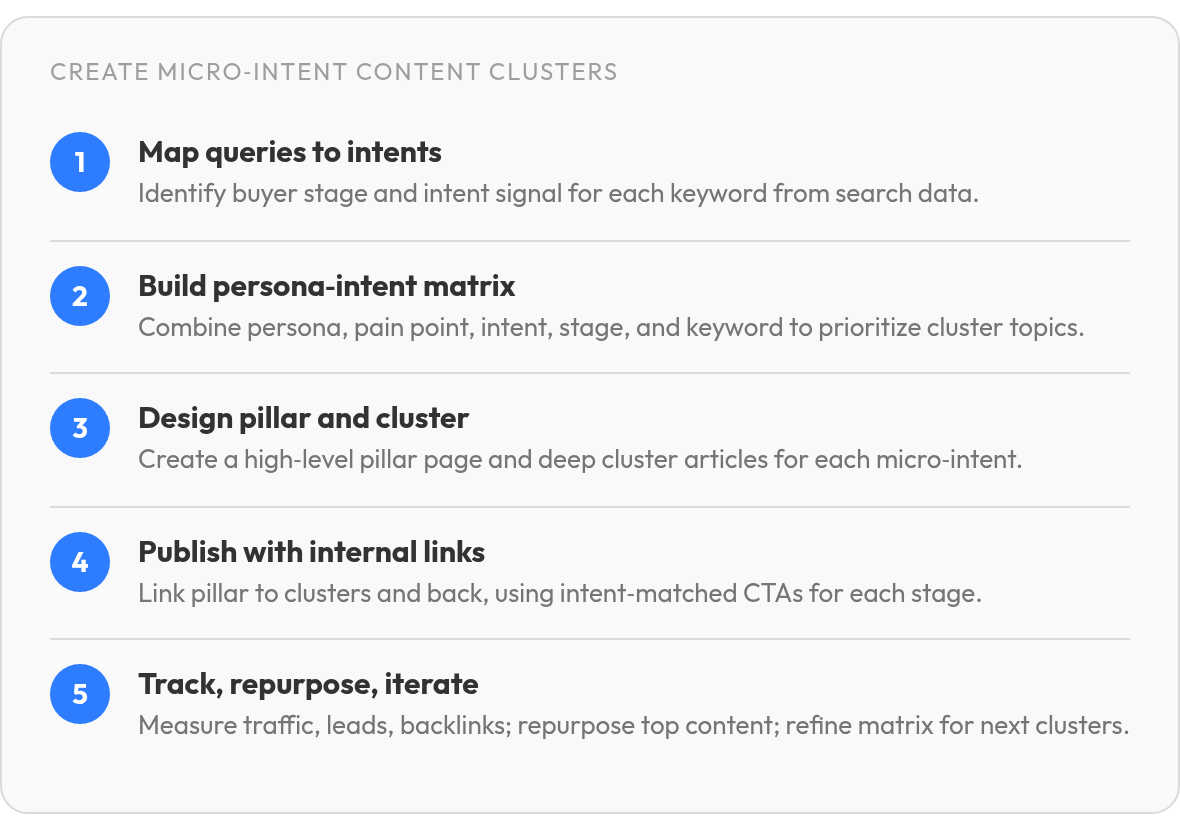
Micro-intent content clusters are the first fix we'd recommend. The idea is simple: organize content around the specific actions buyers take at each stage of research, not around broad topics. Instead of one generic article on "project management software," you build a pillar page that covers the category at a high level, then cluster articles that each target a distinct intent, comparison searches, integration questions, pricing research, use-case fit. Every piece answers one precise question and hands the reader the next logical step.
What a connected cluster actually buys you
Interconnected content tends to outperform isolated articles because it shows breadth, depth, and the relationships between subtopics. The structure signals to Google that your site covers a subject thoroughly rather than chasing scattered keywords. A site with twelve well-linked articles on keyword research can outrank a site with one definitive guide, even when that single guide is technically better.
The compounding effect is real. Mature clusters covering a subject in depth deliver sustained visibility that isolated posts struggle to match. Our automated publishing and SEO optimization can support that work, since each article ships keyword-optimized, semantically structured, and distributed across your site and social channels without someone doing it by hand.
The intent gap that keeps pipeline flat
Clusters built on intent ask a sharper question: what does this person want to accomplish right now, not just what did they type. A query like "CRM software" hides at least three intents. Someone defining what a CRM does. Someone comparing tools. Someone pricing options to build a business case. Each deserves its own page, because the action they're trying to take, and the content that converts them, is fundamentally different. Comparison, alternative, and integration queries consistently beat broad educational content when you measure pipeline contribution instead of raw traffic.
Mapping Micro‑Intent Signals to Buyer Personas
Reading intent off the query itself
Comparison queries signal active evaluation. Someone searching "Asana vs Monday" or "best project management tools for remote teams" is past problem awareness and building a shortlist. Integration queries like "Does [Product] integrate with Salesforce?" point to due diligence, the buyer testing technical fit before taking a recommendation to their team. Pricing and ROI searches usually mean someone is assembling a business case, often the last hurdle before purchase.
Problem-specific, solution-aware queries sit in the middle. "How to reduce churn with automation" tells you the buyer knows the problem and suspects automation is the answer, but hasn't committed to a vendor. Use-case and workflow searches like "project management software for remote engineering teams" reveal buyers who need proof your product fits their exact context, not just their industry. Each pattern maps to a distinct stage in the buying committee's research, and each deserves content built for that moment.
Building a persona-intent matrix that actually guides production
Start with a spreadsheet. Column headers: Persona, Pain Point, Intent Signal, Buyer Stage, Query Pattern, Cluster Topic, CTA, and Priority. Each row is a combination you see in the query data. A VP of Engineering searching "how to improve sprint velocity" (awareness, educational intent) needs different content than a Product Manager searching "Jira alternative for growing teams" (decision, commercial intent), even though both care about team productivity.
Pull Google Search Console exports and run keyword-clustering tools to surface the queries actually driving traffic, then tag each by intent type. Filter for queries that balance search volume against a realistic ranking shot for your domain's current authority. Newer sites tend to compete better on lower-difficulty keywords, while established domains can reach for more competitive terms. Every query that clears your bar gets mapped to a persona, a buyer stage, and a cluster topic. The matrix becomes your production roadmap, prioritized by commercial relevance and stage alignment rather than volume alone.
Designing the Pillar‑and‑Cluster Blueprint
Teams tend to rush straight into writing pillar pages before mapping the structure underneath. By the time they publish, the content exists but the system doesn't. No clear path from awareness to decision, no internal-link logic, no alignment between buyer stage and call to action. The content sits idle because the architecture was never designed to move readers forward.
A SaaS pillar-and-cluster system works when each structural decision reflects buyer intent. That means sizing each piece to match research depth, anchoring heading hierarchies in semantic relationships Google can parse, and matching CTAs to the exact evaluation stage a reader has reached when they land on the page.
Sizing pillars and clusters to match how people research
Your pillar needs enough depth to introduce every subtopic at a high level while linking out to cluster pages for the detail. It targets the broad head term, something like "project management software" or "SEO for SaaS," and covers the category without trying to answer every granular question in one place.
Cluster articles go deep on a specific long-tail keyword and answer one precise buyer question. "How to migrate from Trello" is a cluster article. "Asana vs Monday for remote teams" is a cluster article. These capture the detailed, intent-rich searches that signal someone is actively evaluating or solving a specific problem.
Sizing matters because depth signals authority. The cluster model tells Google you've covered the topic from every angle, not just once.
Internal-linking logic and heading structure that signal relevance
Bidirectional internal linking is the connective tissue. The pillar links out to every cluster article using descriptive anchor text that matches the cluster's target keyword. Each cluster article links back to the pillar and to related cluster pages where the connection is genuinely relevant.
Contextual internal links route authority, signal topic relationships to search engines, and guide readers to the next step. They're structural, not decorative.
Heading structure follows the same logic. Use H2 headers for major subtopics on the pillar, and let those H2s mirror the titles of your cluster articles. When a reader scans the pillar's table of contents, they should see a roadmap of the whole cluster. On cluster pages, use H3 and H4 headers to break down specific points, keeping the hierarchy clear so both readers and crawlers understand how each section connects to the next.
Mapping CTAs to buyer stage without overselling
The most common mistake we see is one CTA stamped across every page. A reader on an awareness article about "what is team productivity" isn't ready for a demo request. Push a high-intent CTA too early and you kill trust.
For early-stage topics, offer educational CTAs: downloadable guides, checklist PDFs, links to related explainers. The goal is to keep them engaged and moving deeper into the cluster.
For mid-stage comparison and evaluation topics, use CTAs that support the decision: feature comparison checklists, pricing calculators, side-by-side guides. These readers want tools that help them choose, not a hard sell.
For bottom-funnel topics like alternative pages, pricing research, and migration guides, deploy demo CTAs, free trial signups, and consultation links. These searches signal purchase intent, and the CTA should match that readiness.
Each cluster article should map to a specific micro-intent, buyer stage, persona, target keyword, internal-link target, and CTA type. Build that mapping into the spreadsheet before you write a single word. The structure turns a post into a qualified lead.
Turning Cluster Traffic into Qualified Leads
Once your cluster ranks, you need a post-publish system that moves passive readers toward demos, trials, and eventually closed deals.
Use contextual links to guide high-intent visitors
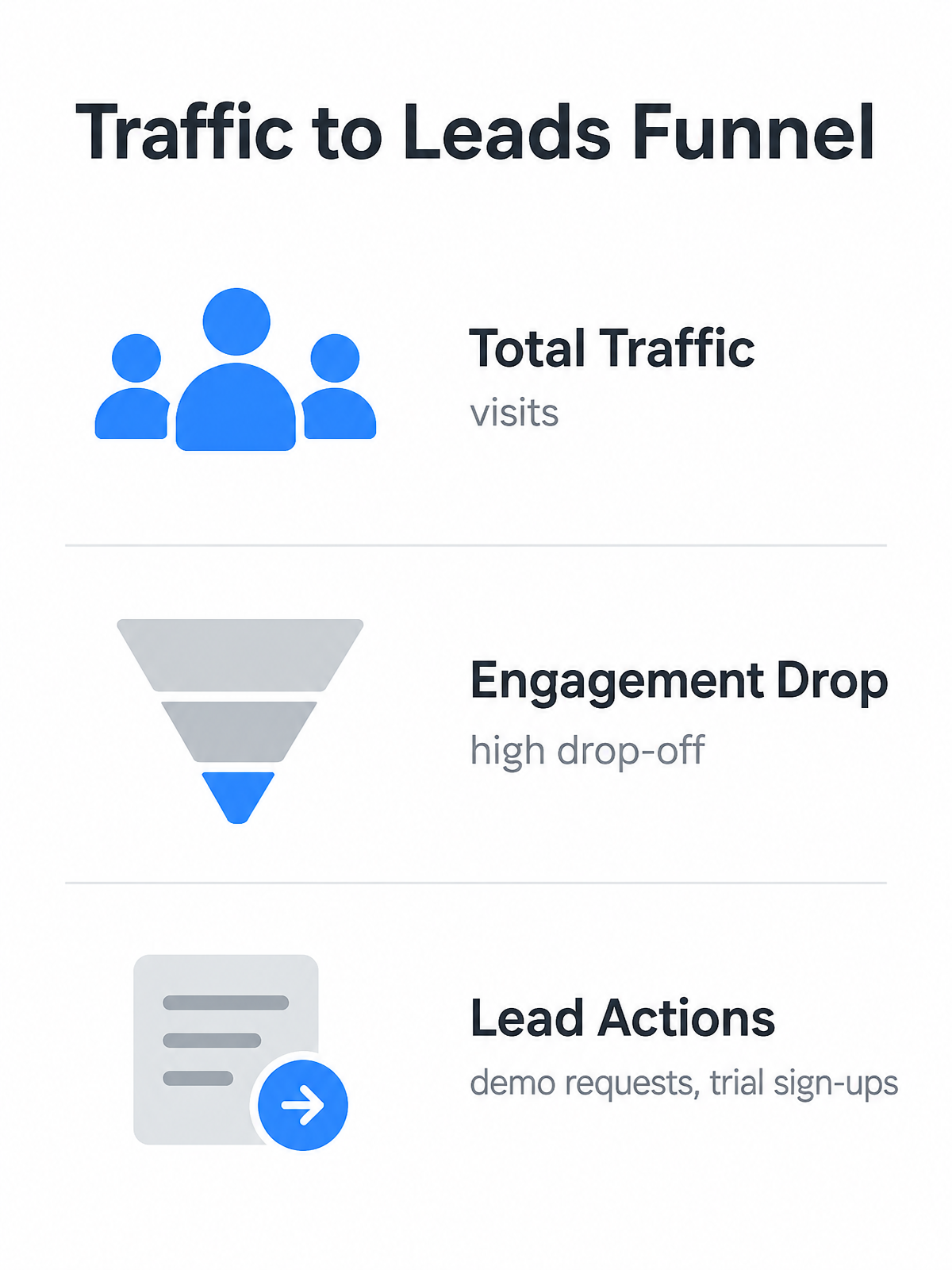
Contextual internal links route authority across the cluster and tell Google which pages matter most, but they also build pathways that match how buyers actually research. Embed links contextually in each new cluster piece, anchored in sentences that explain why the reader should click. Contextual links tend to outperform navigation menus because they appear exactly when a buyer needs the next piece of information.
A comparison article should link straight to your alternative page and pricing guide. A problem-aware educational post should link to the pillar and to a bottom-of-funnel case study. When someone lands on "how to reduce churn with automation," they're signaling intent. If that page links to "best customer retention tools for SaaS" and your product comparison, you've built a conversion path that mirrors their research instead of making them hunt through your nav.
Track backlinks as a lagging authority signal
Backlinks are still one of the strongest signals Google uses to judge topical authority. A mature cluster that proves depth and utility tends to attract links over time. Track backlink growth as a lagging metric that confirms your cluster is earning recognition, and skip the expectation that you can automate or force large-scale link acquisition in the short term.
Use a tool-agnostic workflow to watch which cluster pages earn external links, then double down on those topics with updated content, related subtopics, and deeper technical detail. When a cluster article starts accumulating backlinks, that's a signal the topic has real authority potential. Expand around it rather than treating it as a static asset.
Repurpose cluster content across channels without over-claiming
Once a cluster page ranks and resonates, repurpose it into LinkedIn posts, X threads, short-form video scripts, and email snippets that drive traffic back to the original article. A substantial piece on "pricing research for SaaS buyers" can become a LinkedIn carousel on common pricing objections, a thread on tiered pricing psychology, and a YouTube Short walking through a pricing calculator. Each format reaches a different slice of your audience and funnels them back to the cluster page where the CTAs live.
The workflow is simple: pull the most quotable insight, the most actionable step, and the most counterintuitive finding from each cluster article, then format them for each channel. Email subscribers get the actionable step with a link to the full guide. Social followers get the counterintuitive hook with a teaser that drives clicks. Avoid claiming specific engagement benchmarks unless you've tested them yourself. Repurposing is about reach and reinforcement, not guaranteed conversion rates.
Map distribution channels to lead-stage KPIs
Every traffic source brings visitors at different stages of readiness, and your measurement should reflect that. Organic search typically delivers mid-funnel visitors researching solutions. Internal links move engaged visitors deeper into evaluation. Social posts often drive awareness-stage traffic. Email reaches subscribers who've already raised their hand. Retargeting catches high-intent visitors who didn't convert the first time.
Build a KPI map that ties each channel to the lead stages it should produce: engaged visit, CTA click, content download, trial signup, demo request, marketing-qualified lead, sales-qualified lead. When organic traffic from a comparison article drives more demo requests than social traffic to the same page, you know where to put distribution effort. Track whether content-led acquisition reduces your CAC over a six-to-twelve-month window, and read it as a trend rather than expecting an instant drop the moment a cluster goes live.
Proving it worked, then scaling without the chaos
The part most SaaS teams underestimate isn't publishing the cluster. It's proving it worked, then using that proof to justify the next one. We watch teams ship eight cluster articles, wait sixty days, report "traffic is up," and never connect a single post to a qualified lead. Leadership asks for pipeline impact, gets a Google Analytics screenshot, and the content budget stays flat. That gap between organic impressions and closed revenue is where cluster strategies stall.
A KPI framework closes it by tying cluster-level traffic to business outcomes: ranking durability, assisted conversions, and the revenue contribution of content over time. Not vanity metrics. You want to see which clusters compress evaluation cycles, which pages turn visitors into MQLs, and how SEO ROI stacks up against paid acquisition. Measuring SEO ROI correctly means attributing leads to the content that influenced them, not just the last page they clicked.
The dashboard that connects content to revenue
Start with cluster-level organic traffic and keyword growth. Track how many keywords each pillar and its supporting articles rank for, how many moved into positions 1–10, and whether those rankings hold past the initial spike. At the cluster level, ranking stability can matter as much as the first jump, because durable visibility is what creates a predictable lead source. Watch impressions, average position, and click-through rate by topic group, not just site-wide. That tells you which subjects are earning sustained attention from qualified searchers.
Add assisted MQLs and SQLs with first-touch and assisted-touch attribution. A prospect might find your brand through an educational article, come back twice through comparison pages, then convert on a pricing page. Multi-touch attribution reflects the reality that SaaS buying usually involves multiple touchpoints before a decision. Tag content by funnel stage, awareness, consideration, decision, and track how often each stage shows up in closed-won deals. Teams that connect content to pipeline can prove which articles move buyers forward instead of just attracting casual traffic. That turns attribution data into real leverage at budget time.
Then track CAC impact and organic-search revenue contribution. Add up the cost to produce each cluster (writer hours, editor time, design, promotion) and divide by the qualified leads attributed to it over six months. Compare that cost-per-lead to your paid channels. If an awareness cluster costs $4,000 to produce and generates 80 MQLs over six months, your organic CPL is $50, likely a fraction of paid search or LinkedIn ad spend. Document SEO ROI as (revenue influenced by organic content − production cost) ÷ production cost, then measure how long break-even takes. Teams that track this can show an exec that a $10,000 cluster returning $70,000 in influenced pipeline over twelve months delivers a 600% ROI, not just "more blog traffic."
Audits, gap analysis, and scaling without chaos
Run quarterly content audits to spot which cluster articles need a refresh, which should be consolidated, and where new micro-intent gaps are opening. Teams that audit regularly tend to squeeze more from existing assets instead of endlessly producing new ones, which compresses the time and cost to show returns. Flag articles ranking positions 11–20 for high-value keywords, since those are usually refresh or consolidation candidates. Update stats, add recent case studies, strengthen internal links. The synthesis we use: split micro-intents into separate pages when the query pattern and buyer stage differ enough that one page would need to serve two CTAs; consolidate when two pages target the same intent with different phrasing; and update existing assets that already hold authority instead of publishing a competing post.
Use gap analysis to find micro-intent topics buyers are searching for but you haven't covered. Cross-reference your cluster map against Search Console queries, sales call transcripts, and competitor content. When a recurring question keeps surfacing that your cluster doesn't answer, that's your next article. Target keywords that match your domain's current authority, because chasing volume alone often means months of effort with no traction. Commercial-intent pages like "X alternative," "X vs Y," and "X pricing" should anchor each cluster since they tend to convert better than purely educational content, while educational pages funnel traffic toward those hubs through strategic internal links.
Before you expand from three pillars to twelve, build a scaling checklist. Document SMART goals tied to pipeline metrics, not just traffic targets. Build content templates that codify your proven structure, pillar depth, cluster word count, internal-linking rules, and CTA placement so new writers can replicate what works. Set keyword-difficulty thresholds so you're not chasing terms your domain can't realistically rank for yet. Assign clear roles: who researches, who writes, who edits, who handles internal linking. Set review cycles so every piece gets a technical SEO pass before it ships. Define where AI speeds up outlining and research versus where human judgment stays non-negotiable. Allocate resources from the ROI data your existing clusters produced, not gut feel. That governance is what lets you move from one cluster a quarter to one a month without quality collapsing or attribution breaking.
Questions People Ask
1. What's the difference between a traditional topic cluster and a micro-intent cluster?
Traditional topic clusters usually gather articles under a broad subject. Micro-intent clusters go one level deeper: they separate content by what the buyer is trying to accomplish in that moment. That distinction prevents your pages from competing with each other and makes it easier to match each article to the right CTA, internal link, and funnel stage.
2. How many cluster articles do I need before seeing pipeline impact?
You need enough supporting content to cover the major decision paths around a pillar, not just one or two related posts. In practice, pipeline impact shows up when the cluster answers awareness, evaluation, comparison, integration, implementation, and purchase-readiness questions as a connected system rather than as disconnected blog entries.
3. Should I prioritize high-volume keywords or high-intent keywords when building clusters?
Prioritize keywords that balance commercial intent with realistic ranking opportunity for your domain's current authority. A narrow vendor-alternative query may bring fewer visits than a broad tips-style keyword, but it usually attracts buyers who are closer to evaluation and more likely to take a meaningful next step.
4. What's the most common mistake when mapping CTAs to buyer stage?
The most common mistake is asking for too much commitment before the reader has enough context. Early research pages should reduce friction and keep the visitor learning, while comparison and decision pages can ask for stronger actions because the buyer is already evaluating options.
5. How do I prove a content cluster contributed to closed revenue, not just traffic?
Connect CRM attribution to your cluster map so you can see which articles influenced opportunities before they became customers. Then compare the cluster’s production cost against the qualified pipeline and closed-won revenue it touched. That gives leadership a business case for content investment instead of another traffic report.