Auto-Generate Content That Ranks: The Three-Stage Workflow

Related Video
Watch: Build 6 Months of SEO Content in 60 Minutes (Complete Workflow) by Surfer Academy
Key Takeaways
- Content automation only works when research, production, publishing, and reporting flow between systems without manual handoffs.
- Bottlenecks hide in the transitions: brief approvals, CMS prep, and reporting often consume more time than drafting.
- Automating a broken process amplifies the confusion. The brief must settle intent, audience, angle, and promotion before any AI runs.
- Editorial control belongs in the workflow, not tacked on at the end. Approve the strategy, then review the draft for accuracy and voice.
- Performance tracking now spans Google, ChatGPT, Perplexity, and similar discovery engines. Visibility can split across surfaces.
- Volume without judgment produces accurate pages that fail to differentiate. Publishing faster does not matter if the content is forgettable.
What Most Teams Get Wrong About AI Content Workflows
Most content teams slow down not because they cannot write, but because context keeps breaking between tools.
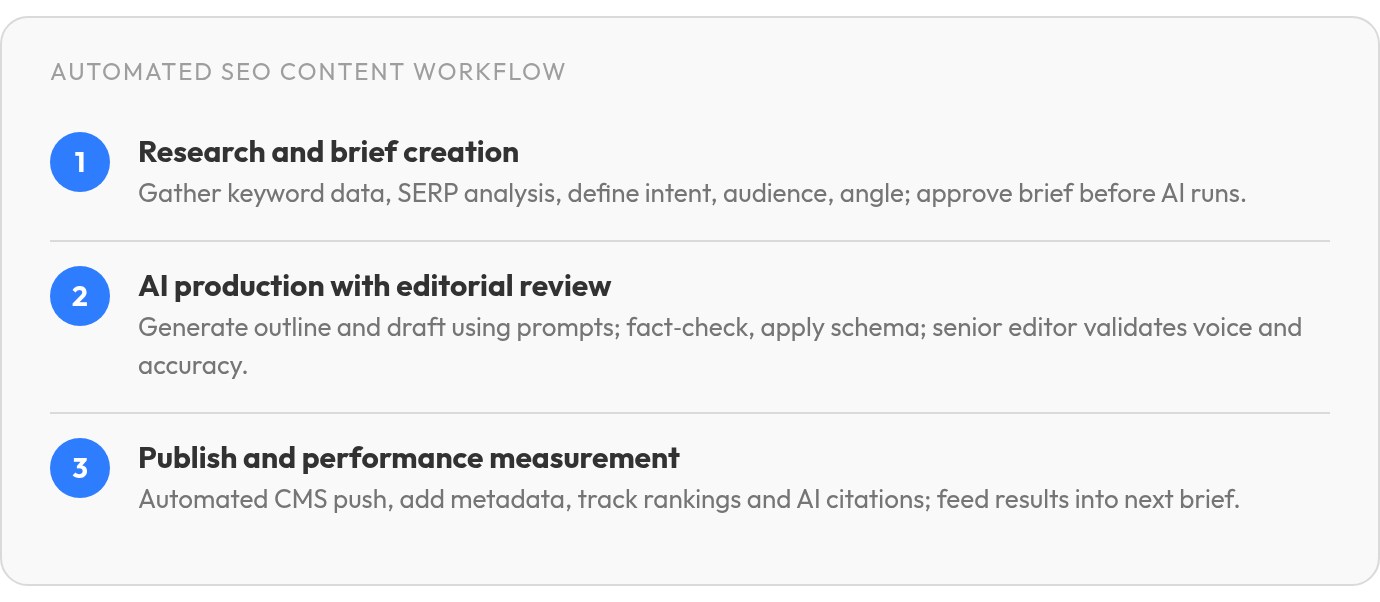
A ranking-focused automation system needs three connected stages: research and briefs that define what gets built, production that combines AI speed with human editorial oversight, and publishing with measurement so results inform the next cycle. The table below maps the workflow.
| Stage | Goal | Inputs | Owner | Automation Layer | Human Checkpoint |
|---|---|---|---|---|---|
| Research & Brief | Identify rankable topics and frame the angle | Keyword data, AI-search demand, SERP competitor analysis, existing content gaps | SEO strategist or content lead | Query research tools, data-populated brief templates, competitor SERP scrapers | Approve brief before any agent runs |
| Production | Draft, fact-check, format, and prepare for publish | Approved brief, branded prompt library, reference content, schema templates | Writer/editor or AI agent with human review | AI drafting via branded Skills, outline-first generation, fact-check agents, schema validators | Senior editor reviews every draft against voice and accuracy checklist |
| Publish & Measure | Ship content, track rankings and AI citations, feed results back | Approved draft, CMS integration, analytics instrumentation | Content ops, growth marketer, or publishing agent | CMS/integration automation, staging queues, one-click or scheduled publish | Person approves staging queue; measurement runs automatically |
Why Content Automation Actually Matters
Auto-generating SEO content that ranks is not about asking a model to write a blog post and hoping it performs. It is about designing a repeatable system where every article starts with evidence, moves through review, publishes cleanly, and creates data that improves the next brief.
That distinction matters because modern SEO is no longer a single-channel game. Buyers find brands through Google results, social distribution, AI-generated answers, email, or repurposed content. A content system has to prepare for that reality before the first draft is written. Otherwise, the article may be technically complete but operationally disconnected: no clear internal links, no promotion assets, no schema plan, no tracking, and no plan for future updates.
A useful automation workflow starts by reducing ambiguity. The system should know what query cluster the page targets, what audience problem it solves, what opinion it takes, what evidence it uses, how it will be reviewed, where it will publish, and which signals will determine whether it worked. Once that scaffolding exists, AI can assist with research synthesis, outline development, drafting, formatting, repurposing, and refresh planning without replacing the strategic decisions that give the piece a reason to rank.
The Coordination Tax Nobody Talks About
Brief creation, review cycles, and publishing workflows become expensive when every step lives in a different place. Keyword research sits in one spreadsheet. The brief lives in another document. Draft comments happen in a separate editor. CMS metadata gets rebuilt during upload. Technical updates happen later, if someone remembers. Reporting may arrive weeks after publication, detached from the original strategy.
A better question is whether the team can connect research, drafting, review, publishing, and measurement into a repeatable process. Data-populated templates, centralized feedback, and automated handoffs can reduce the coordination burden. That gives strategists and editors more time for the decisions that actually influence performance: what to build, why it matters, and how it should be positioned.
Why Speed Without Structure Backfires
Businesses adopt AI for content marketing because it makes production feel easier. But ease can hide a weak process. If the workflow is poorly defined, automation does not fix it—it scales the confusion.
The failure mode is familiar. The team increases output, but the articles start to sound the same. They answer obvious questions, avoid sharp opinions, and provide little evidence of brand expertise. The calendar fills up, yet the content does not create authority. Readers leave with information they could have found anywhere, and editors spend their time repairing tone, structure, and factual precision after the fact.
A defensible process treats quality as a built-in control. Before drafting, the team confirms the intent, audience, angle, and distribution plan. During production, the draft is checked against the brief rather than judged only on whether it is grammatically clean. After publishing, performance data returns to planning so future briefs reflect what the market is actually showing.
Publishing, Refresh Triggers, and Performance Tracking
Once a piece clears approval, many teams treat publishing as the finish line. In a serious SEO workflow, publishing is where the feedback system starts.
The approved article still has to move into the CMS, carry the right metadata, connect to internal links, trigger distribution, and enter the reporting loop. If those steps are handled manually every time, the team creates a new bottleneck after editorial approval. The draft may be done, but the content is not yet working.
Publishing Automation and CMS Integration
Publishing automation starts with CMS integration. Approved content can move from the review queue to a scheduled publish slot without anyone copying and pasting. Metadata—title tags, descriptions, internal links, and tracking parameters—flows in from the brief and production stages. If those fields were completed earlier, the final publishing step becomes an approval action rather than a rebuild.
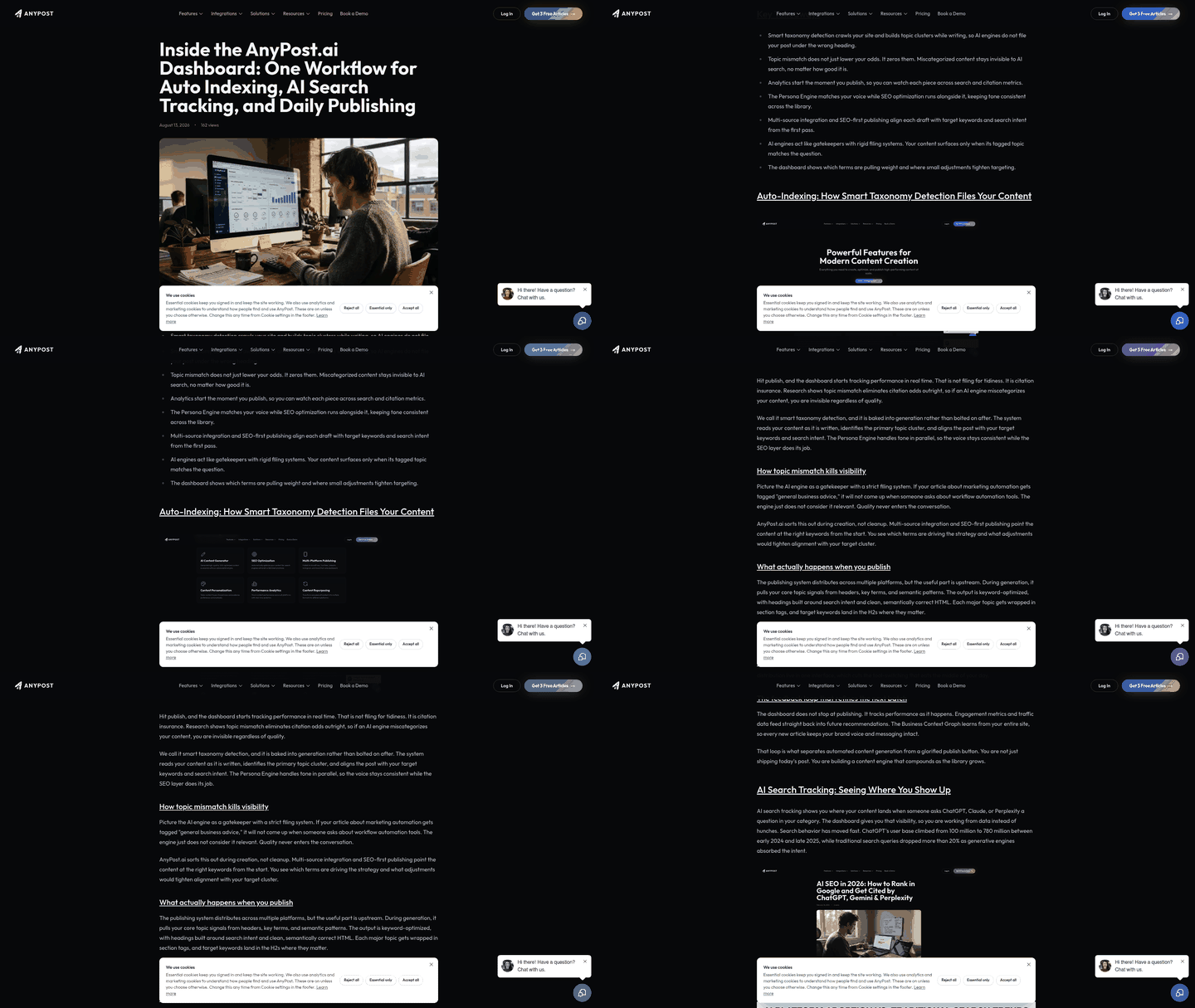
Measurement setup belongs in this same handoff. Traditional analytics can show rankings, clicks, and engagement after publication. AI-crawler monitoring can show which bots access the site, which pages they request, and where access fails. Keeping those data streams visible in one reporting environment helps the team understand whether a page is discoverable across different search and answer surfaces instead of relying on one metric as a proxy for all visibility.
Distribution, Refresh Planning, and Authority Building
Distribution should be prepared before launch, not improvised after publication. Social posts, email snippets, and repurposed formats can all be drafted during production, so the article ships with a promotion package. The goal is not to spray the same message everywhere. It is to support the article on the channels where the audience and authority signals matter.
Refresh planning is the other half of publishing. A page may need another pass when rankings soften, clicks decline, engagement drops, conversions slip, or the search result itself changes. Those signals should not depend on someone remembering to check an old URL. The workflow should assign recurring reviews and define what happens when a threshold is crossed.
When a refresh trigger fires, the article should re-enter the system with its performance history attached. That allows the next brief to diagnose the issue instead of starting from scratch. Maybe the title no longer matches intent. Maybe competitors added more complete examples. Maybe the piece ranks but fails to convert. Maybe the topic now appears more often in AI answers than traditional results. Each scenario calls for a different update.
Publishing becomes a loop instead of a launch event. The article goes live, gathers signals, returns with evidence, and improves through a planned refresh cycle.
How to Scale Without Losing Quality
Scaling AI content is not mainly a writing challenge. It is a governance challenge.
A team needs branded prompt libraries that preserve voice at draft time, editors who review every piece against a quality checklist, and clear strategic decisions before generation begins. Without those controls, high-volume workflows can produce content that is technically acceptable but commercially weak. The articles may be readable, but they do not build differentiation, authority, or trust.
Research on AI content workflows points to formal human editing as a useful control, but it should support the broader governance checks rather than replace them. That does not mean every sentence needs manual rewriting. It means someone accountable has to evaluate whether the piece is accurate, useful, on-brand, and aligned with the search opportunity.
The most important scaling decision is where humans intervene. They should not be used only as cleanup labor after the machine has already chosen the topic and written the draft. Human judgment belongs at the front of the process, where the team decides what the article should accomplish, and at the end of production, where the team verifies whether the asset is strong enough to represent the brand.
Build for Depth, Not Just Volume
Sustainable content cadence requires different content types that serve different jobs. Money pages sit closest to purchase decisions. Topic clusters build authority around major themes and support those commercial pages. Backlink-focused assets give other sites a reason to reference the brand. AI-visibility content addresses the conversational questions people ask in answer engines rather than only the keyword phrases they type into search boxes.
Depth also changes how the team evaluates success. A money page may be judged by qualified conversions. A cluster article may be judged by assisted traffic, internal-link contribution, and topical coverage. A backlink asset may succeed through mentions and referring domains. An AI-visibility page may matter because it helps answer engines describe the brand accurately in conversational results.
Measurement has to return to planning, not sit in a dashboard no one uses. Bot-traffic monitoring and answer-engine visibility checks should shape the next round of briefs so the workflow expands into gaps instead of simply producing more of what already exists.
Quick Questions, Straight Answers
What's the difference between automating content production and automating the entire workflow?
Production automation focuses on creating the asset: drafting, formatting, summarizing research, generating schema, or preparing variants for different channels. Workflow automation manages the full path around that asset, including intake, approvals, CMS movement, distribution, reporting, and refresh triggers.
The distinction matters because a fast draft can still sit idle if no one owns the next step. A complete workflow makes the status, owner, and required action clear at every stage.
Why do I need separate measurement for AI answer engines if my content already ranks in Google?
Google visibility and answer-engine visibility do not always move together. A page may earn search traffic but never be selected as a source in conversational answers, while another page may influence AI-generated responses without sending obvious click data.
Separate measurement helps diagnose that split. Search reporting shows how users interact with results pages. AI visibility tools reveal whether crawlers can access the content and whether answer engines cite or describe the brand accurately. Together, those views give a more complete picture of discoverability.
What happens when you automate content without brief approval before drafting?
The system starts making strategic choices by default. It may choose easy topics, mimic competitor structures too closely, or produce safe summaries that lack a clear point of view.
Brief approval prevents that drift. It forces the team to decide the purpose of the article before generation begins: who it serves, what intent it targets, what angle it takes, and how it will be used after publication. That makes automation an execution layer rather than the strategy itself.