Automate SEO Content from Competitor Gaps, Not Your Editorial Calendar

What to know before you read on:
- Teams that automate drafting and publishing while skipping competitor discovery still produce wrong content, just faster — the input stage is where the whole loop either gets aimed right or does not.
- Narrowing the competitor list to 3-5 sites targeting the same audience and content type produces cleaner gap data than benchmarking against large publications.
- GSC keywords with meaningful impressions but rankings outside the top spots are higher-priority targets than starting from scratch with brand-new keywords.
- Each analysis cycle covers 6 pages: your article alongside the top 5 organic results for the target keyword, consolidated into one document.
- Firecrawl's free tier covers 1,000 credits per month and SearchAPI provides 100 free searches — both sufficient to validate the workflow before any budget commitment.
- AI agents can surface which topics competitors cover, but they cannot judge which gaps will move rankings. Human prioritization and E-E-A-T review remain necessary.
Quick Summary
Most teams that automate content creation for SEO still lose because they automate the wrong half. They wire up drafting and publishing while competitor discovery and gap scoring stay manual. The stage that decides whether the loop points right is the one most teams leave out.
A complete competitor-gap pipeline runs in stages, each with its own input, tool category, and review point.
| Stage | Input needed | Tool category | Effort | Cost & caution | Human checkpoint |
|---|---|---|---|---|---|
| Competitor & keyword discovery | Search Console impressions, seed keywords | Rank tracker, SERP API | Low | API fees; thin keyword lists | Confirm keyword fits the business |
| Competitor scrape | Your article URL + target keyword | Scraping tool | Low once built | Silent failures pull wrong content | Spot-check your page and competitor pages landed in one doc |
| Gap scoring | Scraped competitor docs + your page | LLM gap agent | Low | Flags gaps that won't rank; AI can identify coverage differences but not business value | Rank fixes before acting |
| AI-assisted brief & draft | Prioritized gaps, brand voice | AI writing tool | Medium | Output surfaces gaps but still needs human validation | Edit for accuracy and E-E-A-T |
| Optimization: metadata & schema | Draft article | SEO optimization tool | Low | Over-optimization, stuffing | Review title, meta, schema |
| Publishing | Final article, CMS | CMS integration | Low | Formatting breakage | Check rendered page post-publish |
| Performance iteration | Published URLs, rank & traffic data | GSC, analytics | Low, recurring | Noise read as signal | Re-run full analysis on a scheduled refresh cycle |
Step 2: Brief Generation & Drafting
AI can take over scraping, comparison, and early sorting work. That frees your team to focus on judgment. The output often reveals structural and topical gaps that are hard to catch by reading competing pages one at a time. Those recommendations still need editorial and SEO review before they become briefs, drafts, or published pages.
Speed is real. You still own strategic judgment.
Why Gap-First Planning Beats a Content Calendar
Calendar-first SEO planning is a time sink because it starts with the wrong question. Instead of asking what your competitors rank for that you do not, it asks what month it is. Automating content creation without fixing that input just produces misaligned content faster.
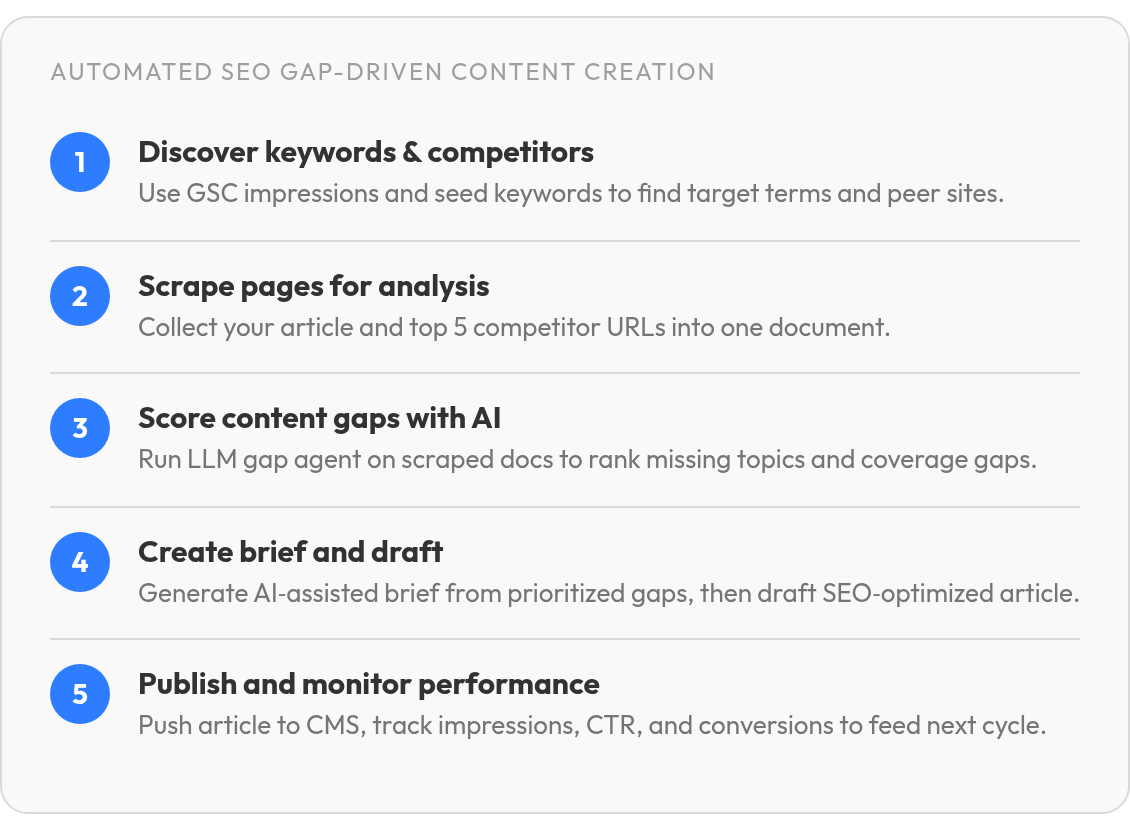
Gap-first planning flips the signal. It starts with competitor rankings and asks which uncovered topics your site can realistically close. Wire automation to that signal instead of a calendar date, and your content queue starts to organize around search demand.
The difference shows up in the queue before it shows up anywhere else. Topic ideas stop coming from internal guesses, seasonal planning habits, or whoever asked loudest. They start coming from places where search engines already reward similar pages and where your site has a plausible reason to compete.
That matters because speed is easy to measure and quality improvement is quieter. Treating a completed automation run as proof of good analysis is where workflows break down. The right question is not how much content your automation can generate — it is whether the briefs feeding it were worth generating in the first place.
Step 3: Optimization & Publishing
The strategic gap we see most often runs deeper than which tools you pick. Running AI on an existing editorial calendar is a tactical move. Building a loop that starts with competitor discovery, routes findings into prioritized content briefs, generates SEO-optimized drafts, and feeds performance signals back into the next discovery cycle is a strategic one. AnyPost.ai connects those steps: from SERP competitor analysis and keyword gap identification through automated publishing and real-time analytics, so each cycle informs the next.
Step 1: Mapping Competitor Gaps at Scale
Most teams building this for the first time start the competitor list with whoever they already know: brand competitors, big publishers, the sites they have bookmarked. That list is often wrong for gap analysis.
The signal you need comes from a tighter peer set — sites competing for the same audience and producing the same type of content you do. A niche company benchmarking against a major industry publication will pull back thousands of keyword "opportunities" that never had a realistic path to ranking. Tighten the comparison set first, and everything downstream gets cleaner.
Your First Data Source Is Already in Google Search Console
Before you scrape a single competitor page, pull your GSC queries filtered to terms where Google is already showing your site but not yet rewarding it with strong placement. These are your "almost there" topics. Google already associates your site with them; the page quality, intent match, or coverage depth simply has not caught up. They deserve priority over keywords where your site has no existing foothold.
Pair that with a structured competitor scrape. The practical model is to gather your page and the current organic competitors for the target query into one working document, so the analysis happens against comparable source material rather than scattered tabs. The free allowances from the scraping and SERP tools mentioned above are enough to prove the workflow before you build a larger process around it.
When you build the gap analysis sheet, every row needs: keyword, competitor URL, ranking position, search intent, content type, estimated search volume, difficulty score, your current owned URL if any, and recommended action. That last column is where the sheet stops being a research dump. It becomes a prioritized build queue.
Step 4: Tracking Performance and Closing the Loop
Most teams that automate content creation for SEO treat publishing as the finish line. It is not. The gap-derived page you just published is your best signal for what to gap-hunt next — but only if you are watching the right numbers.
Organic impressions and CTR are your early indicators. Impressions show whether Google is testing the page in search results; CTR shows whether the snippet earns the click from the audience you intended to reach. When visibility appears before engagement, metadata and search-result positioning usually deserve attention before you rewrite the article itself.
Conversion rate is where gap-driven work pays off. Pages built from real gaps tend to reach searchers with clearer intent because the topic came from demonstrated demand, not an internal publishing slot. Teams that win on this metric set up measurement before the article goes out the door, then use the results to decide whether the page needs optimization, promotion, or a different angle.
How the Loop Gets Sharper Over Time
The feedback step most teams skip is taking monthly performance data back into the gap-hunt. Pages that attract visitors without generating leads may be answering the wrong stage of intent. Pages that convert but struggle to gain visibility may need stronger internal links, external distribution, or a clearer SERP hook rather than another round of copy edits. These are different diagnoses with different fixes, and your content marketing automation workflow should route each path without manual triage.
Backlink acquisition is a quieter signal, but worth tracking. When a gap-derived page earns inbound links without outreach, it usually means you covered something the competing pages missed. That confirms the gap was not just present; it was useful.
The competing pages around any given topic do not stay fixed. A topic your rivals had neglected can quickly become crowded once several strong pages enter the result set.
Pages that underperform do not get written off. Real-time analytics tracking surfaces the signal early, whether the page needs a title adjustment, a topic pivot, or a distribution push, so it can move back into the gap-hunt instead of drifting in your archive.
Step 5: Where Automated SEO Workflows Actually Break
The part most teams underestimate is not writing the content. It is checking whether the automation actually worked.
When we look at how automating content creation for SEO tends to fail in practice, the clearest pattern is not bad AI prose; it is silent process failure. An automation can complete without errors and still return flawed analysis — a gap misidentified, a competitor structure missed, a source page scraped incorrectly, a finished run that looks clean but produces something off-brief. A completed run is not proof of correct analysis. Your QA step has to assume otherwise.
That failure mode connects to a broader problem. AI tools tend to get adopted for their speed, not their accuracy. Faster production creates the feeling of progress, but speed and quality can move in opposite directions when review is treated as optional. The space between "output generated" and "output validated" is where the most expensive mistakes hide.
Does Automating Content Creation for SEO Mean You Can Skip Refreshing Old Work?
No. Gap-driven systems decay when the competitive set changes and no one updates the assumptions. A page that once filled a clear opening may eventually face better, newer, or more complete rival content. Automated monitoring can flag drops in visibility or engagement before the page becomes a real problem, covering the interval between deeper reviews.
The human checkpoint in a gap-driven workflow is not about recreating a manual calendar. It targets risk: fact accuracy, brand voice, intent match, and the automation steps most likely to produce a plausible-looking but wrong result. A quick human review at that point often pays for itself.
Quick Questions, Straight Answers
1. What should I watch to know a gap-derived page is working before rankings shift?
Look for evidence that the page is being tested, clicked, and acted on in that order. If search visibility starts to appear but users are not entering the page, adjust the SERP-facing elements before rewriting the body. If visitors arrive but do not take the next step, the issue is more likely intent alignment, offer fit, or on-page conversion support.
2. If AI can surface the gaps, why can't it also decide which ones are worth chasing?
Because coverage comparison and strategic priority are different jobs. AI can show that competitors discuss a topic you skipped, but it cannot reliably decide whether that missing section fits your authority, your audience, your offer, or your realistic ranking path. Human review turns a detected gap into an SEO decision.