Automated SEO Drafts Stall Without Internal Links, Bylines, and Source Citations

Key Takeaways
- Automated SEO drafts stall in three predictable places: disconnected internal links, credibility-lacking bylines, and missing or competitor-linking source citations.
- An editor can review 100 internal link suggestions in under an hour using a spreadsheet workflow, making pre-publish checks scalable.
- Each automated draft needs contextual internal links and citations to original, credible sources rather than competitor blogs.
- New posts link backward to older content, but those authority pages never link forward, leaving new articles orphaned from site architecture.
- Named authors with linked credentials give readers a clear point of accountability and help them assess relevant expertise.
- Internal linking improvements surface as growing impressions over time rather than producing immediate traffic spikes after publication.
Quick Summary
The part most teams underestimate isn't generating the draft. AI content generators spit out articles in minutes, but that speed creates a finish line that isn't real. We treat the handoffs as part of publication: semantic matching proposes links and an editor approves them, a real person owns the byline, and someone opens each source to confirm it supports the claim. Automation can draft and suggest; editorial review owns publication.
Internal Link Quality
Your internal linking pattern determines whether search engines understand how your content fits together.
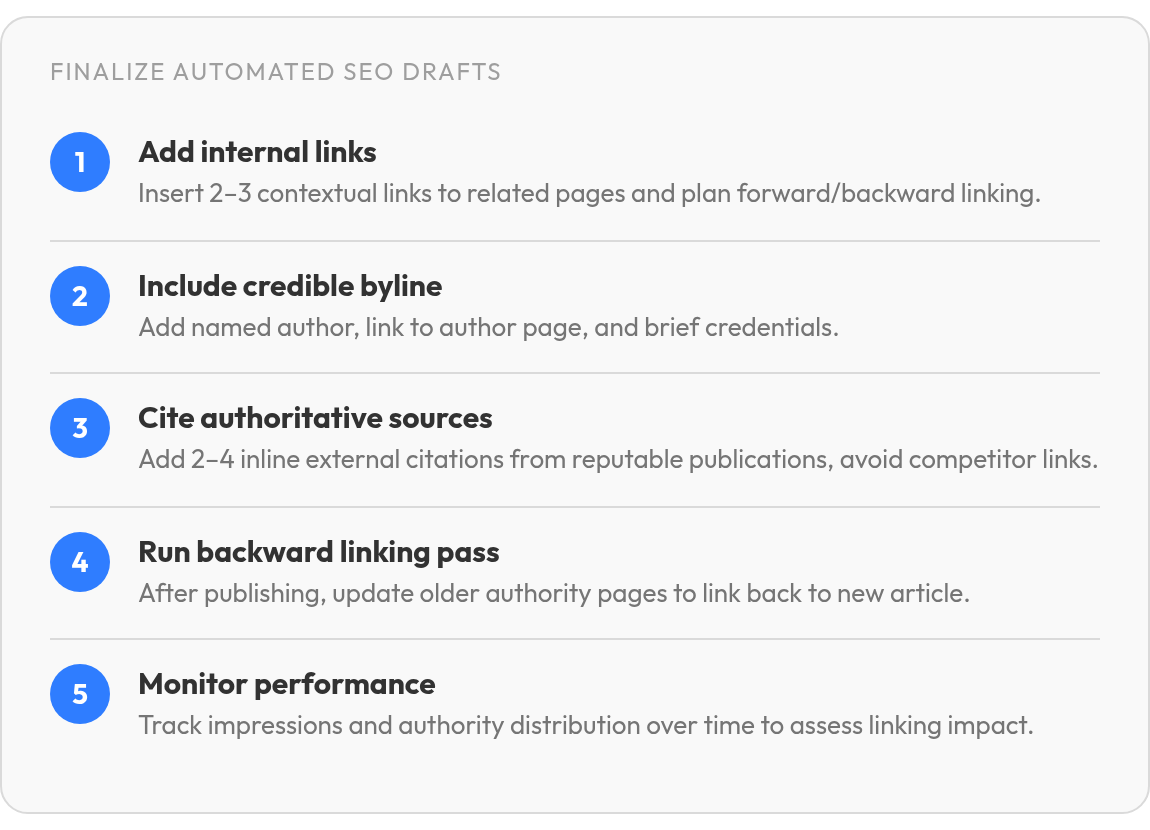
- Add relevant contextual internal links to related service pages, pillar content, or recent posts that expand on a subtopic mentioned in the draft
- Check that older authority pages link forward to this new content by re-running your linking workflow after publish, reversing the typical one-directional pattern that leaves new posts isolated
Byline and Author Credibility
A clear byline with a brief bio or author page link signals expertise.
- Include a named author or editorial team byline so every post has a clear point of accountability
- Link the byline to an author page showing credentials, past work, or professional background, especially when readers need relevant expertise to judge the topic
Source Attribution
External links to credible sources prove you've done the research.
- Cite original, credible sources such as research papers or official documentation—not competitor blog posts
- Use inline links within the paragraph where the fact appears, not buried in a "sources" footer that readers skip
Why These Three Elements Determine Crawl Discovery
These three elements determine whether search engines understand how your content fits your site's authority structure. Skip them, and automated drafts become orphaned pages that crawlers struggle to place in your topical hierarchy.
What Internal Link Quality Actually Delivers
An editor can review 100 internal link suggestions in under an hour using a spreadsheet workflow. The value shows up as better crawl discovery and authority distribution across your content hierarchy, not as an immediate traffic spike. This builds over time as search engines understand how your pages connect.
Why Bylines and Citations Support Verifiability
Clear author information and credible external citations help readers and editors assess whether claims are grounded. We can't claim the research proves a direct ranking effect from E-E-A-T signals, but we know these elements support the reader's ability to judge accountability.
The Workflow Asymmetry Most Teams Miss
The speed of an AI SEO content generator creates a workflow asymmetry most teams miss. New posts link backward to older content, but those older authority pages sit frozen—they never link forward to what you just published. Each new article creates dozens of potential linking opportunities across your existing content, and leaving them unconnected means crawlers struggle to understand how your newest work fits your site's topical structure.
We see this pattern stall automated drafts in a predictable way. The draft arrives complete, but publication waits while someone manually hunts for pages that should link to it. That hunting step swallows hours when you're publishing at scale, and skipping it entirely means your newest content sits orphaned from the rest of your site architecture.
What Your Internal Link Review Should Catch
Your pre-publish checklist should verify that links connect content bidirectionally, use descriptive anchors, and support crawl discovery without creating redundant or forced placements.
- Review suggested links editorially using the spreadsheet workflow, where semantic matching proposes candidates and you approve the ones that read naturally
- Trigger a backward linking pass after publishing so older related posts link to your new content within days, distributing authority bidirectionally instead of only forward
Internal link automation works as a suggestion-and-review workflow, not a set-and-forget system. The semantic matching finds candidates, the editor confirms they read naturally, and the insertion happens only after approval.
Who Actually Wrote This
An AI SEO content generator produces drafts without attribution. The speed creates an accountability gap: someone needs to own each piece, and generic "Staff Writer" or "Admin" bylines make published content look like it came from nowhere.
We see automated drafts go live with missing or placeholder author fields because teams treat bylines as an afterthought. That's an editorial problem, not an SEO ranking lever. The fix is quick if you establish a consistent format and assign ownership before the draft reaches publication.
What Your Byline Format Should Include
A clear byline tells readers who wrote the content and whether that person has relevant expertise. Your format doesn't need to be elaborate.
- Author name: Use a real name, not "Content Team" or "Marketing Department"—readers scan for accountability
- Relevant role or credentials: Brief context that signals topic authority without inflating qualifications (e.g., "Content Strategist" or "Former SaaS Product Manager")
- Current photo: A headshot humanizes the byline and avoids the placeholder-avatar look
Common Byline Errors to Catch Before Publishing
Most byline errors happen when drafts move too quickly from generation to publication. Catch these before the post goes live.
- Missing author field: The CMS field is left blank or populated with a default user ID instead of a real name
- Outdated bio: The author left the company six months ago, or the credentials reference a role they no longer hold
- Recycled generic attribution: Every post shows "Staff Writer" because no one assigned ownership during the content workflow
Review bylines the same way you'd review metadata—it's part of the pre-publish editorial checklist, not a one-time setup task.
Where Confident Claims Actually Come From
The part most teams skip is verifying that confident-sounding claims in AI-generated drafts actually trace back to credible sources. An AI SEO content generator can produce statistics, case studies, and expert opinions that read as authoritative but collapse under fact-checking. We see automated content go live with fabricated numbers and unattributed copying because citation verification is the step where automation stops.
Uncredited copying creates plagiarism risk. If your draft paraphrases a competitor's research without attribution, you're exposing your site to copyright complaints. The fix isn't about legal immunity—it's about editorial hygiene before you publish.
What Your Citation Format Should Cover
Your citation workflow doesn't need formal academic styling unless your publisher requires it. Focus on descriptive inline links that show readers where the claim originated.
-
Link directly to the original credible source, not a summary or aggregator site. If you're citing a study, link to the journal publication or the researcher's institution, not a news article about the study.
-
Use a consistent inline format: "According to [Author/Organization], [claim] ([linked source title])." This keeps attribution visible without breaking reading flow. If the source includes a publication date, include it only when recency matters for the claim.
-
Verify the linked source directly supports the claim. If your draft says "43% of marketers report X," open the link and confirm that percentage appears in the source. AI content generators sometimes hallucinate statistics that sound plausible but don't exist in the cited material.
Skip formal bibliography sections for web content. Inline links serve the same credibility function without adding friction for readers scanning on mobile.
Quick Questions, Straight Answers
Should I go back and fix automated posts I already published without internal links and citations?
Yes, treating published posts as fixable prevents them from staying orphaned. Start with your highest-traffic automated posts, adding relevant contextual links; then prioritize older authority pages with the clearest topic overlap for the backward linking pass. Add missing citations and bylines during the same editing pass to avoid multiple republish cycles.
How do I identify which older posts should link to my new automated content?
Semantic matching tools generate candidates by analyzing topic overlap between your new post and existing pages, then you review those suggestions in a spreadsheet to approve the ones that read naturally. This workflow catches relevant connections manual searching would miss.
Can I generate author bios with AI, or do they need to be written about real people?
Author bios must reference real people with verifiable credentials. Using AI to draft the bio text is fine, but the person named needs to exist and have relevant expertise. Generic attributions like "Content Team" and fabricated personas leave no clear point of accountability, while real names with linked professional backgrounds benefit reader trust.
What separates an authoritative source from a competitor blog when citing research?
Authoritative sources publish original research, official documentation, or primary data—like journal publications, government reports, or institutional studies. Competitor blogs summarize that research but add brand promotion, making them secondary sources that redirect your readers to competing service providers. When a study appears in both formats, link to the journal or researcher's institution directly.