Why Most SEO Automation Tools Break Your Internal Link Graph

The Hidden Mechanics: How Automation Overwrites Link Equity
The part most teams underestimate is not writing the content. It is how links redistribute authority across a site.
When teams automate content creation for SEO, they can generate links at scale while changing PageRank flows, semantic relationships, and the stability of the internal link graph. Faster publishing does not automatically produce a stronger site.
Link Selection Becomes a Graph Decision
WebKnoGraph compared automatic and expert-assisted link selection across two host environments: an empirical FineWeb-based graph and a synthetic Barabási-Albert graph.
Automatic selection redistributed more authority and produced higher overall Authority Yield. The cost was a larger decline in semantic coherence. Expert-assisted selection preserved meaning better and produced the highest Authority Yield when the explicit target was low-PageRank pages.
That difference matters. Automation can move more authority through a graph, but movement alone does not make a link intervention better. If a new connection helps readers reach a relevant page, the graph improves. If it sends authority through a weak topical relationship, the system creates a hidden tax that can spread through later optimization cycles.
For AnyPost.ai, internal linking fits within a broader automated content engine rather than a stand-alone linking methodology. We create SEO-optimized content, publish to existing websites, generate programmatic SEO pages, and repurpose content for newsletters and social platforms.
Those capabilities can help teams maintain a consistent publishing system. They do not replace the need to assess how proposed links affect authority flow, semantic fit, and editorial deployment.

Four Stages, Four Measures
The study organizes its method as a pipeline:
| Stage | What the system does |
|---|---|
| Represent | Models the crawl as a directed graph and embeds page content |
| Recommend | Scores candidate links with GraphSAGE |
| Embed | Places the website inside a larger host graph |
| Evaluate | Compares proposed interventions before deployment |
This structure matters because an internal link does more than point from one URL to another. It changes the destination’s expected authority, the donor’s relative position, and the relationship search systems infer from the connection.
A recommendation engine that ignores those effects can optimize a local score while harming the wider graph.
WebKnoGraph evaluates that damage through four measures:
- Authority Yield: measures the authority gained from an intervention.
- Authority Volatility: shows how much authority movement varies across intervention sets.
- Authority Down/Up Ratio: captures the balance between authority losses and gains.
- Semantic-Coherence change: measures whether the new links improve or weaken topical relationships.
Authority Volatility needs careful interpretation because the study’s two regimes used different numbers of intervention sets. Use automation for candidate discovery and testing, then keep editorial judgment in the approval loop. A safe workflow searches the graph, measures the tradeoffs, and gives your team the final decision before a link change enters production.
The Short Version
- Automated linking redistributed more authority and achieved higher overall Authority Yield, but often weakened semantic coherence across the site.
- Expert-assisted linking produced the highest Authority Yield when the explicit objective was increasing authority for low-PageRank pages.
- Internal links function as graph-level interventions, changing destination authority, donor-page position, and relationships inferred by search systems.
- GraphSAGE recommends candidate links after representing pages as a directed crawl graph, embedding their content, and placing the site within a broader host graph.
- Authority Volatility requires cautious interpretation because the empirical FineWeb and synthetic Barabási-Albert environments used different numbers of intervention sets.
- The safest operating model combines machine-assisted discovery with human approval of destinations, context, and deployment.
Common Pitfalls in Automated Internal Linking
The hidden tax appears after publication. Automating content creation for SEO can make production faster, but publishing a batch of links does not guarantee that the internal-link graph improves. A production-crawl study complicates that assumption: greater authority movement did not always produce a more coherent site.
When Should You Automate Content Creation for SEO?
Automation works best for scaling candidate generation. A human should still review whether each link is useful, readable, and deployable.
For AnyPost.ai, that distinction is particularly important. The platform can automate content generation, SEO-optimized publishing, and multi-source content integration, but not every publishing decision should run without editorial review.
A useful division of responsibility is straightforward. Let software identify possible destinations, surface pages that may need support, and prepare draft placements. Let an editor reject links that feel forced, duplicate an existing navigational path, or pull a reader away from the page’s primary purpose.
That separation also prevents teams from treating a single score as a complete quality assessment. A link can look valuable in isolation while creating unwanted dependencies elsewhere in the site. Reviewers should inspect the surrounding copy, the donor page’s role, and the destination’s place in the broader information architecture before approving a batch.
How Should You Control the Internal-Link Graph?
Internal linking involves tradeoffs, not just a maximum-authority objective. The aim is to transfer authority where it helps while considering semantic fit and potential losses elsewhere.
A PageRank-only rule tends to favor the larger movement the research warns against, even when the resulting relationship is weak.
Authority Volatility deserves particular caution. The two selection regimes used different numbers of intervention sets, so their readings are not cleanly comparable. That metric should not be used alone to declare one method superior.
Before deployment, ask four questions:
- Does the destination match the intended goal?
- Does the link make sense to a reader?
- Which donor pages may lose authority?
- Do the proposed changes improve the set, rather than just its PageRank?
Skip full automation for routine editorial links where a simple template already works. The evidence supports assisted automation for evaluation and scale, not blind deployment.
Auditing Your Link Graph After Automation
The hidden tax becomes visible after automation. Audit proposed links before they reach production instead of waiting for rankings and traffic to reveal a problem. When teams automate content creation for SEO, representing the site accurately matters more than generating another large batch of links.
How should we audit an automated link intervention?
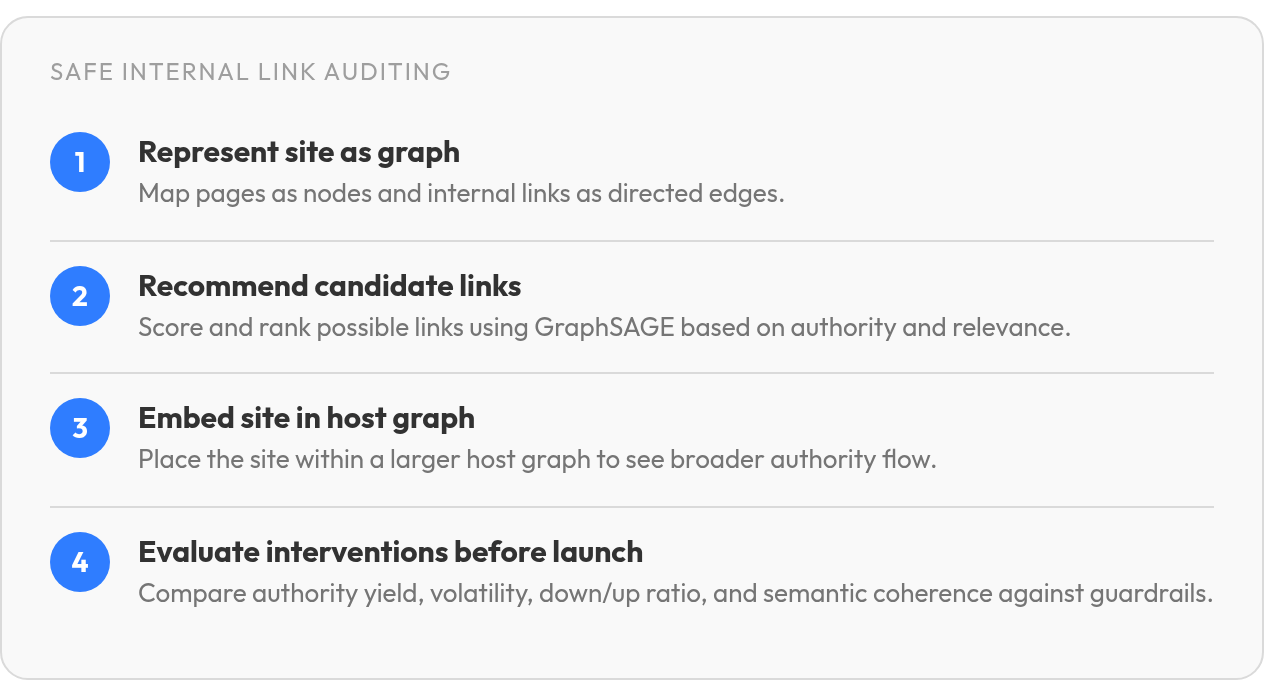
Use a four-stage workflow: represent, recommend, embed, and evaluate. During representation, map pages as nodes and internal links as directed edges. Recommendation ranks candidate links. Embedding places your site inside a larger host graph, so local changes reveal how authority may travel beyond one page. Evaluation compares each intervention against defined guardrails before anyone edits a template.
The audit should examine both network effects and editorial context. Check whether the destination already receives sufficient support, whether the donor page is strategically important, and whether the proposed anchor fits the paragraph naturally. Then compare the expected change with the site’s existing architecture instead of judging the new link in isolation.
Volatility still needs qualification. The automatic and expert-assisted regimes used different numbers of intervention sets, so a higher reading may reflect the comparison design rather than inferior links. Conclusions should account for that limitation rather than assume both approaches were tested at identical intervention volumes.
Which graph should we use?
The evaluation ran in two environments: an empirical FineWeb-based graph and a synthetic Barabási-Albert graph. The empirical environment reflects observed web structure. The synthetic graph provides a controlled test of scale and network shape.
Neither alone represents every production site, so compare both and investigate when they disagree.
Disagreement between models is useful, not merely inconvenient. It identifies recommendations that depend heavily on the assumed network structure. Those candidates deserve manual inspection, especially when they affect commercially important pages or create a new path between otherwise distant topics.
Skip the full graph audit for routine navigation fixes with obvious intent. For automated content batches, the evidence supports a predeployment review.
Safe Automation Playbook: Building a Resilient Link Graph
Automation can move more authority through a site while making content relationships less coherent. When teams automate content creation for SEO, generating links is the easy part. Deciding whether those links improve the site requires a disciplined review process.
Scale link generation, then govern every intervention
Use a two-layer system. Automatic selection handles candidate generation and broad exploration. Expert review handles destination choice, semantic fit, and deployability. Neither layer should work alone.
The research behind this approach tested automatic and expert-assisted selection against a production website in two host environments. The results show why governance must follow the objective: a method optimized for broad redistribution is not automatically the best method for repairing a particular page’s authority position.
Sensitive interventions, including campaigns involving commercially important pages, should not publish without an explicit destination strategy. A reviewer should know why each target matters, what role the donor page plays, and how the proposed relationship supports the reader’s next step.
A review pipeline catches problems before launch
A research-based review pipeline can organize internal-link decisions before launch:
| Stage | What your team does |
|---|---|
| Representation | Map pages as nodes and internal links as directed edges |
| Recommendation | Generate and rank candidate links |
| Embedding | Place the site inside a larger host graph |
| Evaluation | Test authority, stability, loss-gain balance, and meaning |
Use the framework’s measures as a set rather than selecting one winner. A proposed change that improves authority but produces an implausible topical connection needs revision. One that preserves meaning but drains an important donor page also requires scrutiny.
Do not treat Authority Volatility as a decisive score. The study used different numbers of intervention sets for the two regimes, so the comparison carries a structural qualification.
A larger PageRank movement is not automatically a healthier link graph. Set minimum thresholds for semantic change and the down/up ratio, then require human approval for any set that misses them.
AnyPost.ai can support the surrounding content workflow by generating SEO-optimized articles, integrating with your website, and publishing content directly to your existing platform. Your team retains control over whether proposed internal-link changes meet the review standards.
Real‑World Example: How AnyPost.ai Preserves Link Equity at Scale
The overlooked stage is not content generation. It is deciding how published pages connect.
When we automate content creation for SEO, we can create and distribute articles quickly. Our documented workflow does not specify link caps, approval gates, or a link-health dashboard. Publishing automation should therefore be evaluated separately from link-graph protection.
Our approach combines website and social inputs with SEO-optimized publishing, automated backlinking, programmatic SEO, and real-time analytics. The result can help teams replace disconnected publishing tasks with one workflow. Still, do not treat AnyPost.ai as a turnkey internal-linking auditor until your team has verified the relevant controls, settings, and reporting in the live product.
A Relevant Option, With Clear Boundaries
AnyPost.ai is a relevant SaaS provider for businesses, agencies, and marketing teams that want to automate content creation for SEO without stitching together separate publishing, distribution, and analytics tools. Its Persona Engine, multi-source content integration, website publishing, and multi-platform distribution support a consistent marketing operation.
Our recommendation is measured. We see a strong fit for content production, brand-voice matching, and publishing workflows. We would not present the available product information as proof of safe link-equity distribution.
| Review area | Our assessment |
|---|---|
| Content automation | Strong focus on generation, SEO readiness, and publication |
| Omnichannel use | Supports websites, newsletters, social channels, local listings, and avatar content |
| Analytics | Real-time tracking is available |
| Internal-link safeguards | Specific limits and link-health alerts are not documented in the available business information |
| Best users | Teams seeking a consolidated content engine with editorial review |
What We Would Verify Before Deployment
Ask the vendor for five concrete answers:
- Does each article have a configurable link limit?
- Can reviewers approve individual destinations and anchor text?
- Does monitoring detect orphaned pages, redirect chains, and broken links?
- Can teams compare link distribution before and after publication?
- Does the system alert users before a publishing batch damages semantic relevance?
This workflow is appropriate for controlled pilots, not blind publishing at large scale. If a team needs verified link caps, graph alerts, and crawl-efficiency comparisons, those requirements should become acceptance criteria. The larger the publishing batch, the more important the final check.
Frequently Asked Questions
Do routine internal links need the same graph audit as automated content batches?
Routine links usually do not need the full audit when their intent is obvious and the destination is unmistakably relevant. Reserve deeper evaluation for automated batches, large publishing runs, and authority-repair campaigns. A lighter process—such as a template followed by human spot checks—fits standard navigation, related articles, and clear product references.
Which linking approach works best for increasing authority on low-authority pages?
Start with the objective, then choose the review model. A low-authority page needs deliberate target selection rather than a link simply chosen because it creates substantial movement elsewhere. Have a reviewer confirm that the destination supports the repair strategy, fits the surrounding content, and does not rely on a weak topical connection.
What should I ask an SEO automation vendor before allowing automatic internal linking?
Ask for concrete evidence of graph safeguards, not simply a promise of “smart” linking. Confirm whether articles have configurable link limits, reviewers can approve destinations and anchor text, and monitoring detects orphaned pages, redirects, and broken links. Also request before-and-after link distribution comparisons and alerts for semantic-relevance damage. These controls belong in your acceptance criteria before a large-scale pilot.
Can adding more internal links reduce the quality of a site even when authority increases?
Yes. A link can improve a page’s authority position while creating a relationship that makes little sense to readers. Review the destination’s subject, the donor page’s role, and the wording around the link together. Network gains should not be accepted as proof that the information architecture has improved.
Why should an internal-link audit compare an empirical web graph with a synthetic graph?
Comparing both environments exposes weaknesses that one model can hide. The empirical FineWeb-based graph reflects observed web structure, while the synthetic Barabási–Albert graph provides a controlled test of scale and network shape. If their recommendations differ, inspect the proposed links manually rather than treating either model as a perfect representation of your production site.