
Before You Automate Content Publishing, Check Your Research and Approval Gates

Before we get into it, the short version:
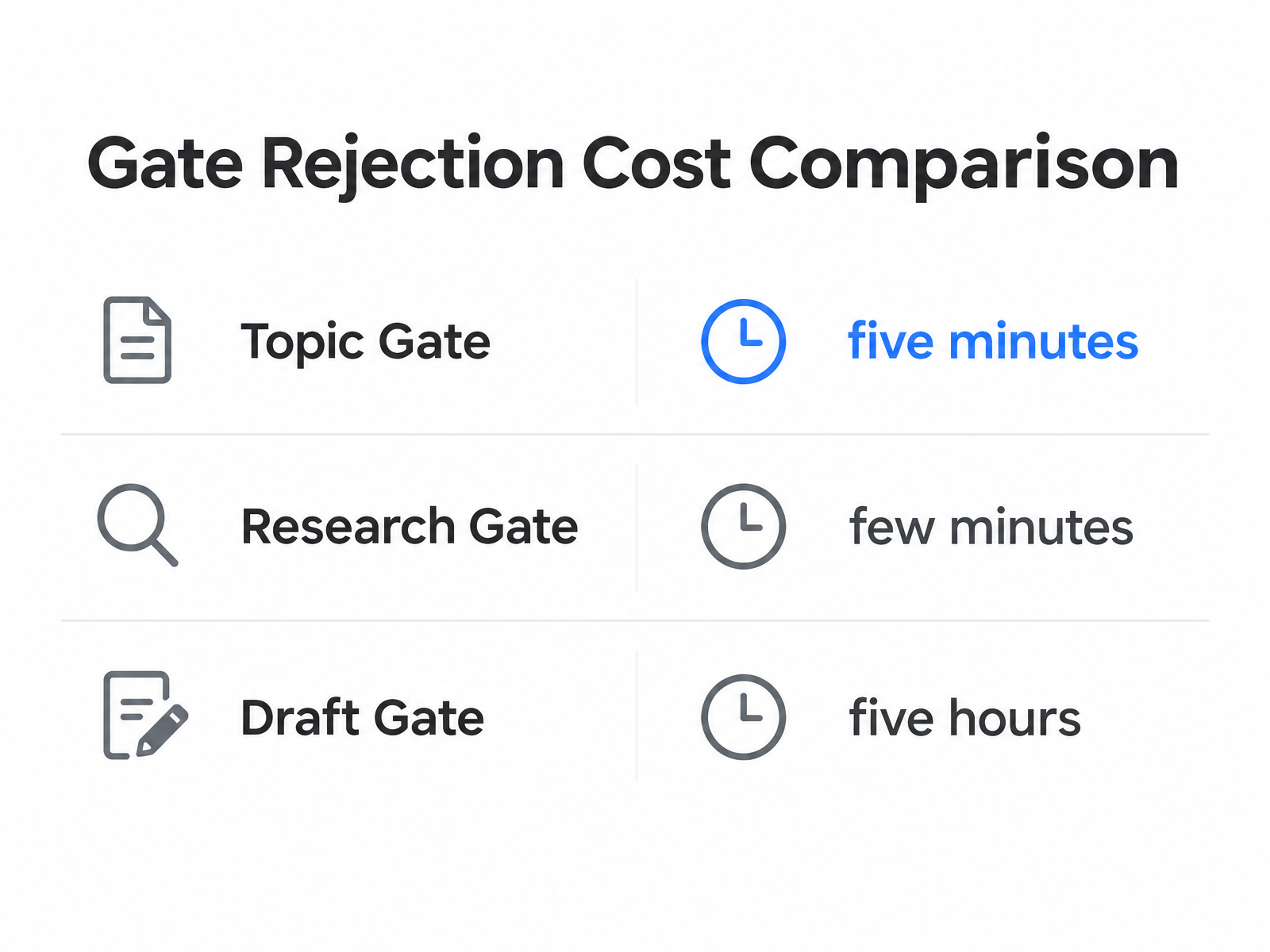
- Rejecting a topic idea takes five minutes. Rejecting a finished draft after someone's already researched, written, and laid it out wastes hours. The trick is putting your approval gate before the expensive work starts.
- Parallel review means brand, legal, and technical experts all weigh in at once on the same version, instead of waiting in line while each person takes their turn. Elapsed time drops to whoever's slowest, not the sum of everyone.
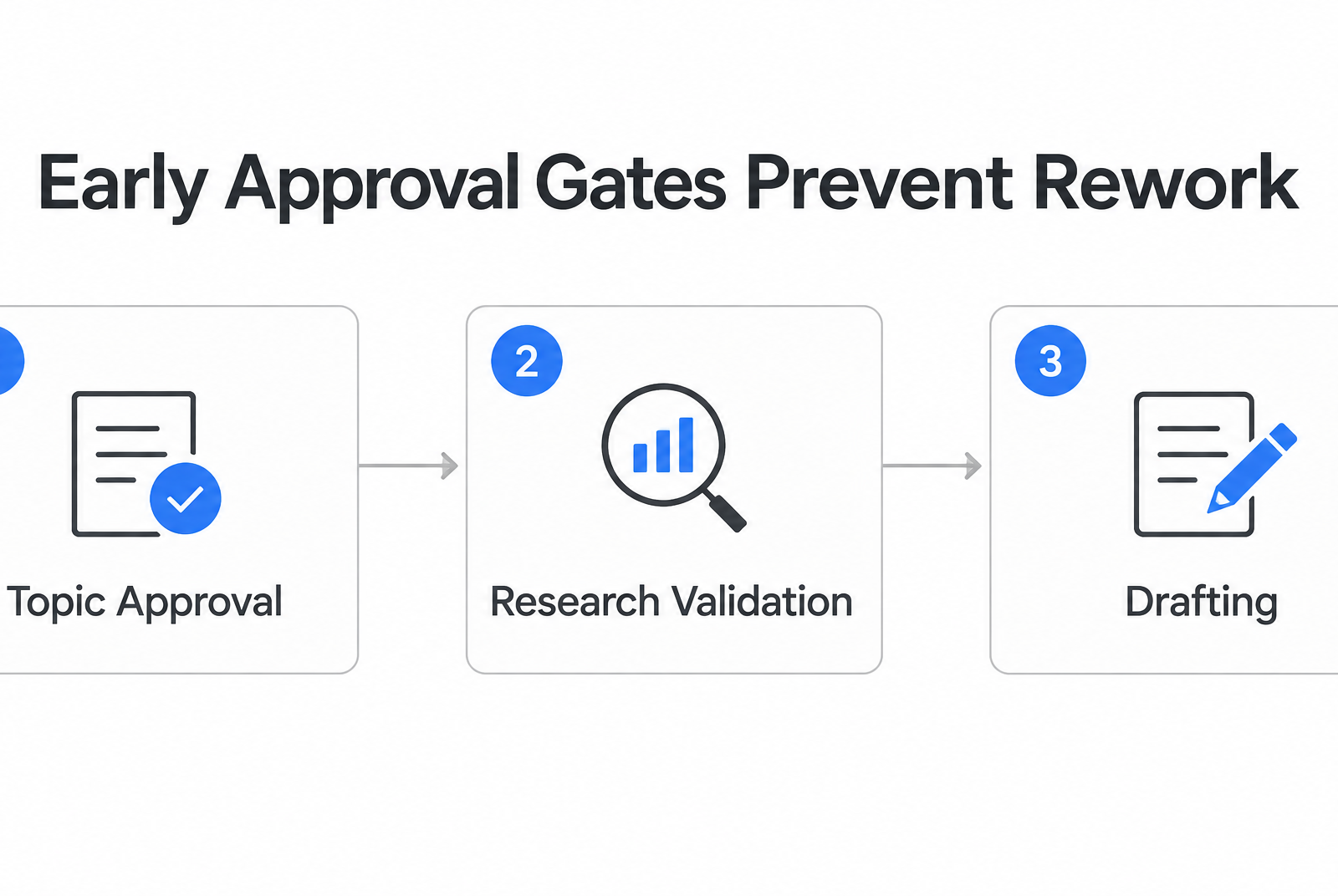
- High-volume teams use two early gates: one on topic selection, another on research validation. Both use structured feedback loops so rejected work routes back to the AI brief instead of a human rewrite queue.
- Comment-only access keeps reviewers from editing directly, which preserves attribution and prevents the version history from turning into an unreadable mess of conflicting changes.
Quick Summary
The part most teams underestimate when they automate content isn't publishing. It's the approval gate before anyone drafts a word. We see workflows fail at scale because they approve finished pieces instead of topics, which means rejected content wastes more effort than a planning-stage check. High-volume operations put two gates before expensive work happens: one on topic selection and another on research validation, with automation routing rejected topics back to the AI brief instead of asking humans to rewrite from scratch.
When you automate content across multiple channels, the gate matrix becomes your quality insurance. Each stage needs a clear owner, a realistic SLA timer, and automated escalation when deadlines slip. Parallel review can cut elapsed time compared to sequential handoffs, because brand, legal, and technical experts comment simultaneously instead of queuing up.
Research and Pre-Drafting Gates
Your first two gates should protect against wasted drafting effort, not polish finished work.
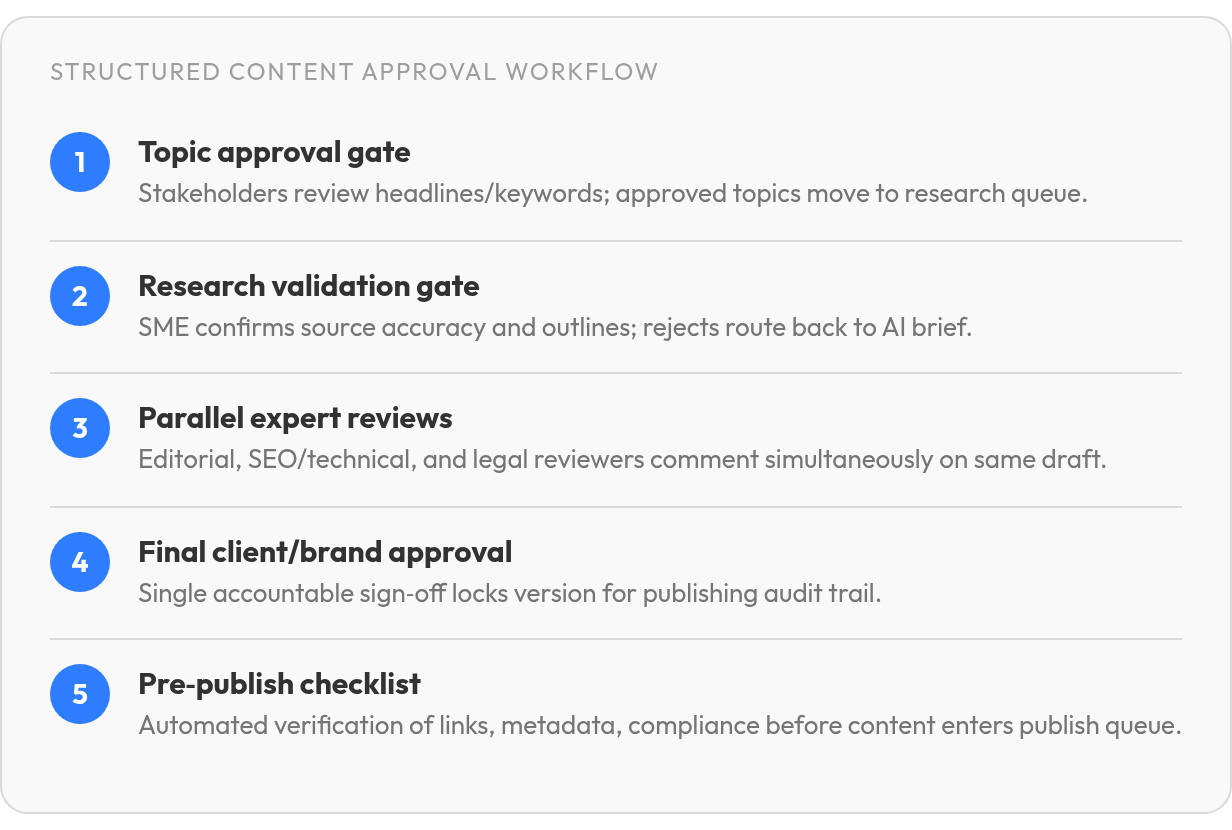
- Topic approval gate – Stakeholder reviews proposed headlines and target keywords before research begins; automation routes approved topics to research queue and rejected ones back to ideation with structured feedback
- Research validation gate – Subject matter expert confirms factual accuracy of source material and outline structure; sets difficulty rating (low/medium/high) that determines how many review rounds to budget
Content Review Gates
Parallel review stages let multiple experts weigh in without multiplying elapsed time.
- Editorial sign-off – Reviews style, structure, and brand voice; comment-only access prevents attribution confusion between author and reviewer
- SEO/technical review – Covers keyword placement, meta descriptions, internal linking, and technical accuracy; automation flags missing elements before human review starts
- Legal/compliance review – Tiered by content type, with standard claims moving faster than medical, financial, or regulated statements; automation can expire stale reviews and trigger re-approval when content changes substantially
Final Approval and Publishing Gates
- Client/brand approval – Single accountable sign-off against specific version; automation records which reviewers cleared it and locks that version for the publish record
- Pre-publish checklist – Automated verification of links, image alt text, formatting, and required disclaimers before content enters publish queue
The Cost of Misplaced Gates
When you automate content without approval gates in the right places, you don't find the problem during publishing. You find it weeks later when a compliance team flags a claim you can't support, or when a bulk update breaks pages because no one checked the output before it went live.
Many businesses run content operations without a formal workflow, and satisfaction is often low even among those that do. That's not a quality problem waiting to happen—it's a quality problem actively happening, just slow enough that teams attribute delays to normal review cycles rather than structural design flaws.
Research Validation Comes Before Drafting Investment
The most expensive mistake in automated publishing is rejecting finished content. Moving the first approval gate to topic selection means rejection at that stage wastes only the brief review itself. Reject the same topic after drafting and you've burned the research pass, the writing cycle, and the initial editorial review.
A second gate can sit on research validation. The system runs a weekly scrape of social platforms and media outlets, landing structured data in Drive for batch review. Reviewers check sources and claims once per week on the full set, and approved research flows to drafting. Rejected briefs route back to the AI with revision prompts, not to a human rewrite queue.
Most teams do this backwards: they approve topics informally, draft everything, then find during final review that half the research doesn't support the claims. Compliance-sensitive teams take this further and place automated regulatory screening before the first human gate, so editorial effort only touches content that can legally publish.
Parallel Review Cuts Routing Time Without Sacrificing Control
Sequential approval—brand to legal to subject expert to final sign-off—multiplies wait time without adding assurance. Switching from sequential to parallel review shrinks document routing, because brand, legal, and technical reviewers assess different dimensions and rarely need each other's output. Elapsed time is set by the slowest reviewer rather than the sum of all three.
The mistake is giving all three edit access. When reviewers can change the draft directly, attribution disappears and you can't tell author edits from reviewer corrections in the version history. Comment-only access solves this: all three review the same pinned version simultaneously, feedback consolidates in one place, and the writer sees a single set of changes rather than conflicting edits layered on top of each other.
The final sign-off remains sequential. One accountable approver clears a specific version to publish, with a recorded audit trail showing which reviewers cleared it. Automation can recover meaningful time for a typical content team, but that time comes from eliminating coordination overhead and duplicate work, not from skipping the approval step where someone accepts responsibility for what ships.
Designing the Approval Gate Workflow
When you automate content at scale, the approval gate layout determines whether a rejected piece costs five minutes or five hours. The most efficient sequence places cheaper validation steps upstream of expensive production work: rejecting a topic costs nothing, rejecting a research summary costs a few minutes of AI re-prompting, but rejecting a finished draft after layout and SEO optimization wastes the full production investment.
A Working Gate Sequence
A gate-centric workflow treats each approval stage as a distinct decision point with clear owners, entry criteria, and escalation rules. Draft submission triggers the first gate: a research validator checks that sources meet currency, relevance, authority, accuracy, and purpose standards (the standard CRAAP framework) and that every claim includes a source name, URL, publication date, and the specific statistic or finding it supports. If the research passes, the draft moves to parallel review. A technical reviewer tests code samples or procedural steps. An editorial reviewer checks structure and readability. A localization reviewer confirms terminology when the content targets non-English markets. Each reviewer sees comment-only access rather than edit rights, preserving attribution so you know who flagged what.
Sequential approval gates follow parallel review. A documentation manager or content lead consolidates conflicting feedback—when the technical reviewer wants more code detail and the editorial reviewer wants brevity, someone reconciles that tension before the writer sees it—then routes the revised draft to a brand or legal reviewer if the content makes product claims, discusses pricing, or touches regulated topics. The final gate is a single accountable approver who signs off against a specific version with a recorded timestamp, not a committee vote.
Set your gate thresholds around content type and review stage rather than unsupported claim-impact scores. A blog post explaining a feature might need technical review and editorial review but skip legal sign-off. A case study quoting customer results requires all three plus customer approval before it moves to publishing. Risk classification drives routing: low-risk content such as internal documentation or tutorial updates can follow a lean path; medium-risk content such as product announcements or integration guides adds compliance review; and high-risk content such as regulatory claims or partnership announcements requires manager escalation when a draft repeatedly fails a gate.
Enforcing Gates Without Manual Tracking
Workflow tools with conditional routing handle gate logic without spreadsheet tracking. Set approval request notifications to include the content title, assigned reviewer, review stage, SLA deadline, decision criteria checklist, and escalation path so reviewers know exactly what they're checking and when their feedback is due. A technical reviewer's notification might read: "Review due in 48 hours. Check: code samples run without errors, API calls match current documentation, commands include expected output. Escalates to engineering manager if not completed by [date]." An editorial reviewer sees: "Review due in 24 hours. Check: headers follow H2/H3 hierarchy, paragraphs under four sentences, no passive voice. Escalates to content director if not completed by [date]."
Add a plagiarism scan as a pre-publish gate using your CMS's duplicate-content checker or a third-party tool that flags text overlap above a set threshold for manual review, since some duplication is inevitable when explaining standard processes. Status changes and reminder notifications happen automatically: when a reviewer approves their stage, the workflow routes the draft to the next gate and sends the next reviewer their approval request. When a deadline passes without action, the system sends a reminder at 24 hours overdue, then escalates to the backup reviewer or manager at 48 hours overdue. That escalation logic prevents approval queues from becoming graveyards where drafts wait indefinitely because a single reviewer deprioritized the task.
Re-review expiration rules matter for content that sits between draft and publish for extended periods. If a technical reviewer approved a draft but publication was delayed several weeks, that approval should expire and trigger a fresh technical review because the underlying product may have changed. Set expiration windows based on how fast your product evolves, and require re-review when a draft crosses that threshold without publishing.
Automation Integration & Safety Nets
The riskiest moment when you automate content isn't drafting or review. It's the handoff where automation takes an approved piece and pushes it live without checking whether every gate actually cleared.
So wire in one non-negotiable rule: publish only after approval. Your automation should verify that each required gate status reads "approved" before anything goes out. When you automate a content workflow at scale, a status check this simple is what stands between a clean release and a public mistake.
Automation breaks in two ways: Fixed sequences fail loudly when a step errors out. Agent-based ones fail quietly when a logic path diverges. Either way, a pre-publish status gate catches the break before readers do.
Version Control Is Your Undo Button
AI-assisted content changes fast, which means you need a record of what changed and who cleared it. Keep drafts, prior approved versions, reviewer comments, and change history before any automated publish. A successful tool call only tells you the operation ran, not that the result is correct. Retaining versions gives you a write-read-verify loop and a clean rollback when something slips through.
- Retain the last approved version so you can roll back instantly if a bad publish gets through.
- Keep reviewer comments attached to the specific version they apply to, preserving who flagged what.
- Log every change with a timestamp and author, so your audit trail survives staff turnover.
The Pre-Publish Checklist You Can Adapt
Build this from the gates you actually run. Skip the compliance line entirely if your content carries no regulatory exposure; forcing it just trains your team to rubber-stamp.
- Research and source check complete, with citations verified against current data.
- Editorial review approved by a named owner, not a committee.
- Technical and SEO review approved, including link and metadata verification.
- Compliance or brand review complete, if your content type requires it.
- SLA met or escalated, so nothing stalls silently in a review queue.
- Status reads approved before publish fires.
Track approval completion rate, SLA adherence, overdue reviews, escalation frequency, and items reverted to pending review. Those five numbers tell you whether your safety nets hold.
FAQ
What happens when a draft gets rejected at the research validation gate instead of after final editorial review?
The main difference is where the correction happens. A research-stage rejection usually means the brief, sources, or angle need to be repaired before production continues. A late-stage rejection forces the team to unwind work that has already moved through writing and review, which is why the earlier gate is the better control point for volume publishing.
Why do parallel review workflows require comment-only access instead of letting all reviewers edit the draft directly?
Parallel review works only if the draft remains stable while reviewers inspect it. Comments let specialists raise issues without rewriting over each other, and they give the content owner a clean record to resolve. Direct edits are better reserved for the writer or assigned editor after feedback has been consolidated.