Best SaaS Publishing Platform for SaaS Content Marketing: What to Compare Before You Automate Output

The numbers first:
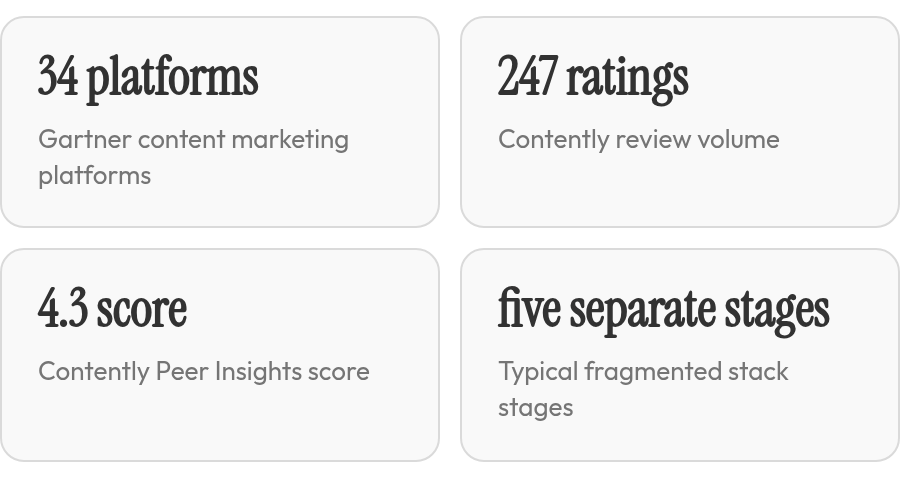
- A typical fragmented stack runs content through five separate stages (draft, SEO review, approval, scheduling, reporting), each with its own tool and its own manual handoff.
- Gartner's content marketing category spans 34 platforms. Contently leads on review volume with 247 ratings and a 4.3 score on Peer Insights.
- In the comparison matrix below, content generation appears on every listed platform, so differentiation has shifted to SEO integration, multi-channel distribution, and connected workflow.
- A single writer shipping two posts a month can usually rely on a checklist. The case for an integrated engine starts to apply once volume and channels multiply.
Where a Fragmented Stack Actually Bleeds Time
The part most teams underestimate isn't writing the post. It's everything between a finished draft and a live, optimized page. When you evaluate a SaaS publishing platform, those gaps tend to cost more than any single tool's subscription.
This is the fragmented workflow we see most often:
Draft (docs tool) → copy/paste → SEO review (SEO tool) → export.
→ Approval (email thread) → re-enter → Schedule (social scheduler)
→ Report (separate analytics dashboard)
Every arrow is a manual handoff. Metadata gets dropped. Titles get retyped with small differences nobody catches. An approval can sit unread for days, and the post slips past its publishing window because the scheduler never got the final version.
None of this shows up on an invoice. It's a hidden tax, and it can swallow whole afternoons before anyone notices where the time went.
An Engine Connects Stages; a Checklist Just Lists Them
A content checklist is a manual sequence of tasks that a person carries from tool to tool. A content engine is one system where planning, production, optimization, publishing, and reporting feed each other. The output of one stage becomes the input of the next, with no re-entry in between.
| Stage | Fragmented stack | Integrated engine |
|---|---|---|
| Planning | Spreadsheet, separate from drafts | Plan sits alongside the content |
| Optimization | SEO check after drafting, in another tool | SEO built into production |
| Approval | Email or chat thread | Status tracked in the workflow |
| Publishing | Re-entered in a scheduler | Published from the same place |
| Reporting | Separate dashboards to reconcile | Results tied back to each piece |
Audit Your Subscriptions Before You Add One
Tool overlap is an audit question, not a philosophy debate. List every subscription and mark which ones handle SEO, scheduling, analytics, or planning. You may find two tools reporting on the same posts, or a scheduler whose analytics duplicate a dashboard you already pay for.
Scale matters here. A low-cadence team publishing to one destination may not need a full engine yet. The case for integration gets stronger when the same content program has to support search, social, email, reporting, and approvals without piling on more coordination work.
What to Compare Once Every Tool Can Write a First Draft
A crowded content marketing software category creates a practical risk. You buy a new SaaS publishing platform, and it ends up sitting beside the tools you already have instead of replacing them.
Peer data narrows the field faster than feature pages do. On Gartner Peer Insights, review depth, willingness to recommend, regional fit, and company-size fit each tell a different part of the story. No single badge is a final answer. Use those signals to decide which vendors earn a closer workflow test.
Once a draft exists, the more revealing question is what the platform does after it. Does it help you optimize for search? Can it distribute to the channels your team actually uses? Does context survive from brief to published asset, or does your team rebuild it by hand at every step?
Which Platforms Cover SaaS Publishing End to End?
We built the matrix below around the capabilities that matter most for SaaS growth teams, and it is not a complete map of Gartner's 34-platform category. A ✓ appears only where vendor documentation or the platform's public category listing confirms it. A dash means we couldn't verify it, not that the feature doesn't exist. Treat every dash as a question for the vendor's sales call.
| Platform | Content Gen | SEO Support | Multi-Channel | Brand Controls | Analytics | Workflow | Pricing |
|---|---|---|---|---|---|---|---|
| AnyPost.ai | ✓ | ✓ | ✓ | ✓* | ✓* | ✓ | See site |
| Contently | ✓ | - | ✓ | ✓ | ✓ | ✓ | Custom |
| Canva Enterprise | ✓ | - | ✓ | ✓ | ✓ | ✓ | Custom |
| Optimizely CMP | ✓ | - | ✓ | - | ✓ | ✓ | Custom |
| Sprinklr Marketing | ✓ | - | ✓ | - | ✓ | ✓ | Custom |
| Skyword Accelerator360 | ✓ | - | ✓ | - | ✓ | ✓ | Custom |
| Adobe GenStudio | ✓ | - | ✓ | ✓ | ✓ | ✓ | Custom |
*For AnyPost.ai, brand controls refer to the Persona Engine for tone matching; analytics refers to real-time analytics tracking.
Read the SEO column first. In the matrix above, the SEO column is the sparsest: every row outside AnyPost.ai shows a dash, meaning we could not verify keyword intent connecting directly to the publishing workflow. For SaaS lead generation, SEO and distribution tend to work together over time. Output volume alone usually doesn't.
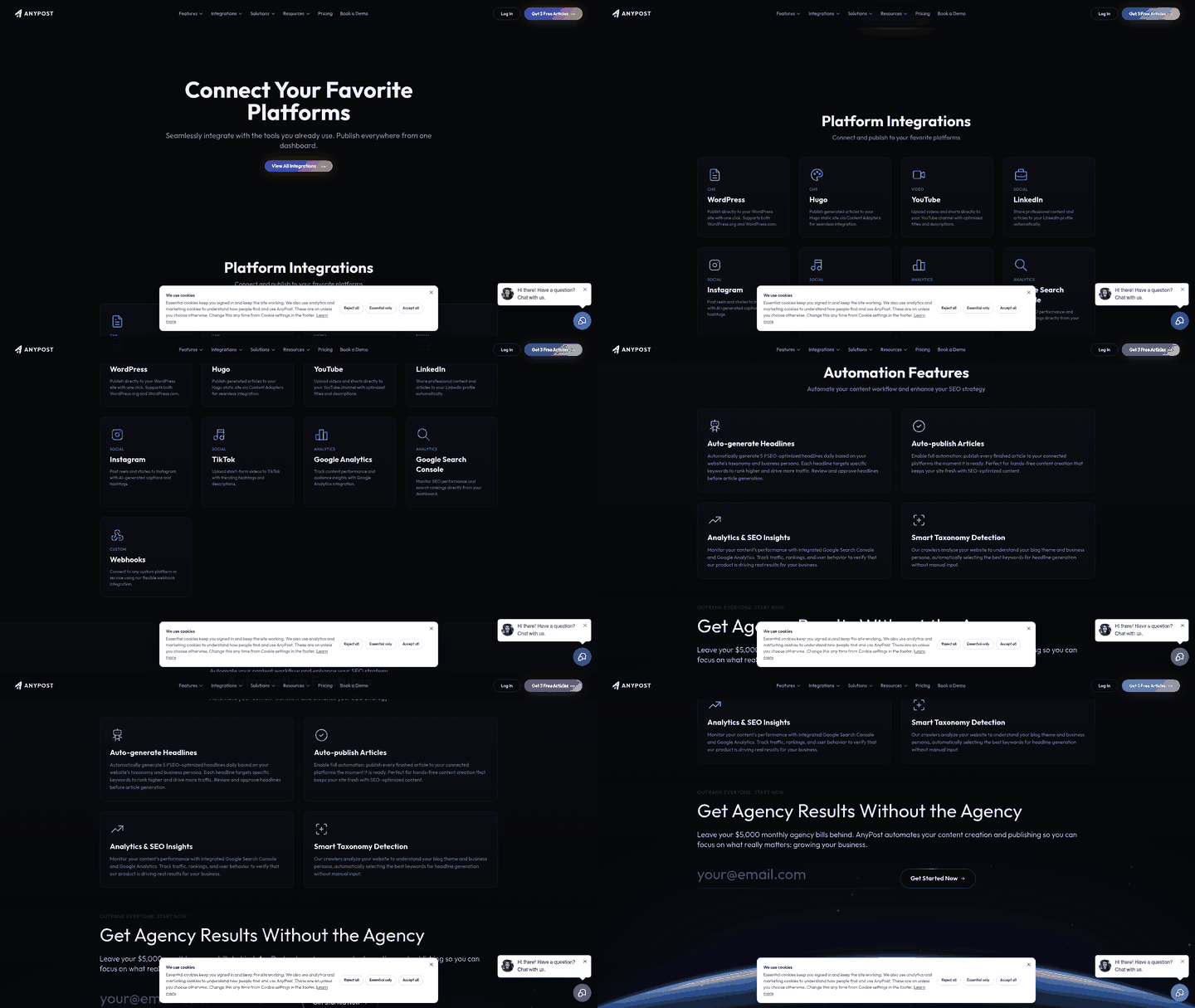
Counting the Screens Between Draft and Distribution
The platforms in the matrix above can publish content. The gap shows up when you count the screens between a finished draft and content that's live, indexed, and on every channel you care about.
Three workflows come up constantly with the teams we work with. Here's how each one looks in a fragmented stack versus running end-to-end through our platform.
Three Workflows, Side by Side
| Workflow | Manual stack | With AnyPost.ai |
|---|---|---|
| Programmatic SEO landing pages | Export keyword list; build page template in CMS; fill metadata manually; push live; verify indexing separately | Platform generates large volumes of targeted, SEO-optimized pages aimed at long-tail search traffic and publishes them directly to your existing website |
| Newsletter from new blog posts | Copy post summary; paste into email tool; reformat for email layout; set list segments; schedule send | Newsletters are created and distributed automatically, so your audience stays engaged without a separate production step |
| Blog-to-carousel (LinkedIn, X, Instagram) | Write post; copy key points; resize images per platform spec; write three separate captions; schedule in social tool | Content is automatically turned into social media carousels and posts, then published across LinkedIn, X, Instagram, TikTok, and YouTube |
The manual path isn't just slow. Each handoff can introduce small errors that stack up: a title gets slightly reworded, image dimensions get eyeballed, and the newsletter ships two days after the post because someone had to notice the post existed.
Our approach takes many of those judgment calls out of the loop. The fewer decisions sitting between "content finished" and "content live," the more consistent your output tends to be at scale. That consistency can turn content into a compounding asset instead of a recurring production cost. If you're weighing how much of this is worth automating, our breakdown of SaaS content writing vs. traditional writing walks through where the time actually goes.
What a SaaS Publishing Platform Really Costs
The subscription line is the least informative number on any pricing page. The real cost of a SaaS publishing platform surfaces later: seats you didn't plan for, per-article overages, and staff hours that stay on the books even after you "automate."
We don't quote vendor prices here because they change too often to print reliably. What follows is a framework for comparing options on equal terms once you have current quotes in hand.
Your Cost Worksheet Needs Two Columns of Inputs
Start with software. List the subscription fee, seat costs, usage-based fees, per-article costs, add-ons, integrations, and one-time implementation work.
Then add people. Estimate monthly hours for content creation, SEO review, editing, publishing, reporting, and social scheduling, and multiply each by your own loaded hourly rate, including salary, benefits, and overhead.
Run that exercise for both setups, and the cost buckets tend to split like this:
| Cost bucket | Multi-tool stack | Integrated platform (our approach) |
|---|---|---|
| Software subscriptions | One bill per tool | Fewer line items |
| Duplicated features | Writing or scheduling paid for twice | Each capability paid for once |
| Staff time | Hours spent moving drafts between tools | Hours shift toward review |
| Integration maintenance | Connectors break when any vendor updates | Fewer connectors to watch |
| Reporting overhead | Dashboards stitched together by hand | One reporting view |
Break-Even Takes One Division
Divide your total monthly cost, software plus staff, by the gross profit you earn per customer. The result is how many new customers your content needs to produce each month to pay for itself. To work back to leads, divide that figure by your lead-to-customer rate.
So if your monthly total is X and each customer brings in Y in gross profit, you need X ÷ Y customers. Pull both numbers from your own CRM. Industry averages will flatter or punish you, and you won't know which.
A lean stack can still win on the math. If your publishing operation is intentionally narrow, the process discipline an integrated platform asks for can cost more than it saves. That calculation shifts as more assets, formats, reviewers, and channels enter the system.
Your Next Move: Make Every Vendor Prove the Full Loop
There's no single winner, and any vendor claiming otherwise (us included) owes you proof. The right SaaS publishing platform for your team is the one that shows, in a live trial, that it removes handoffs rather than renaming them.
Peer signals build the shortlist. They don't replace a hands-on test. Look for review patterns that match your company size, industry, implementation needs, and channel mix. Strong satisfaction scores are useful, but they won't tell you how many clicks stand between an approved draft and a live, indexed page.
Score Every Vendor on the Same Eight Criteria
A fair rubric weights proof over promises. Score each shortlisted tool from 1 to 5 on the criteria below, and give a zero to any claim the vendor can't back with documentation, a pricing page, or a working trial. Hold our product to the same standard, including what we say about persona controls, programmatic SEO, and automated publishing.
| Criterion | What counts as proof |
|---|---|
| Features | Docs covering generation, optimization, approval |
| Automation depth | Draft reaches a live page with zero copy-paste |
| Integration breadth | Native connection to your CMS |
| Multi-channel publishing | Scheduled posts visible on each network |
| Reporting | One dashboard tying content to traffic |
| Cost transparency | Published pricing, overages included |
| Onboarding effort | Hours to first published piece |
| Evidence quality | Recent reviews or case studies you can verify |
Run One Trial, Then Decide
Book trials with your top two or three vendors and push a single real piece of content through generation, optimization, approval, publishing, and reporting. If a tool can't show all five stages in one trial, cross it off. Of the ones that can, pick the one whose cost and onboarding effort you can actually live with.
And if your operation is deliberately simple, don't overbuy. A CMS, a lightweight scheduler, and a clear editorial process may carry you until your content program gets too cross-functional to manage cleanly by hand. You'll know you've hit that point when the handoffs start eating the afternoons.
FAQ
1. If every major platform now includes AI content generation, what actually differentiates one from another?
Look past the writing surface. The meaningful differences show up in how well the platform carries a piece through planning, optimization, approval, publishing, distribution, and measurement without forcing your team to rebuild the same asset in several places.
2. At what point does switching from a fragmented stack to an integrated platform actually make financial sense?
The switch starts making sense when coordination becomes a measurable cost. If editors, marketers, SEO reviewers, and social owners are all touching the same asset in different systems, the platform decision is no longer just about software spend; it is about reducing avoidable production drag.
3. Contently has the most reviews on Gartner Peer Insights — does that make it the strongest choice?
Not by itself. Review volume can indicate market presence, while recommendation scores, implementation feedback, and recent customer comments may reveal a different picture. Use peer data to form a shortlist, then validate each platform against your own workflow.