Build a Repeatable AI Content System That Ranks in 90 Days

In short: Most published pages earn little or no organic search traffic, and a growing share of searches never produce a click to any website. McKinsey research found that marketing and sales use cases delivered 40% of the generative-AI value companies captured in 2024. Companies that scaled AI across marketing and sales reported a median revenue increase of 15%, also per McKinsey. In the 90-day plan below, days 1-30 carry the highest effort, while the analytics and refresh work in days 61-90 is the hardest. Search results full of thin forum threads or outdated posts often reveal a ranking opening more reliably than keyword difficulty scores do.
Quick Summary: Where the 90 Days Go
Writing content is the part teams overestimate. Once you automate content creation for SEO, drafting gets cheaper fast. The expensive work is deciding what deserves a page and then proving that page earned its keep. Pump out more of the wrong thing and you've simply made the pile of zero-traffic pages taller.
The milestones below are planning checkpoints. They aren't a promise that you'll rank by day 60. Read the effort bands against your team's starting point, not someone else's.
| Phase | Milestone | Effort | Difficulty | Core outcome |
|---|---|---|---|---|
| Days 1-30 | Keyword research, brand and persona tuning, first AI drafts | High | Medium | A prioritized topic list and a voice guide your drafts actually follow |
| Days 31-60 | Steady AI drafting, human editing, consistent publishing | Medium | Medium | A weekly publishing rhythm with review built in |
| Days 61-90 | Analytics review, content refreshes, measured outreach and amplification | Medium | High | Clear signals on which pages earn impressions, plus a refresh and promotion plan for the rest |
- The opportunity: AI in content and SEO has moved past the experimental stage, and automation can lighten the load on small teams. The payoff tends to show up in the unglamorous work: research, outlines, refreshes, and consistency. Done by hand, those tasks swallow whole afternoons.
- The trade-off: Because clicks are so contested, put the time automation frees up into editing and analytics, not a heavier publishing calendar. If you can't review every draft, publish less until you can.
Why One Connected Loop Beats a Stack of AI Tools
The hidden tax in most content programs is handoffs. Keyword research sits in one spreadsheet. Briefs live in a shared doc. Drafts move through a third tool, and analytics wait in a dashboard nobody opens until the quarterly review. What you pay for is coordination drag: people lose momentum copying information from one place to another.
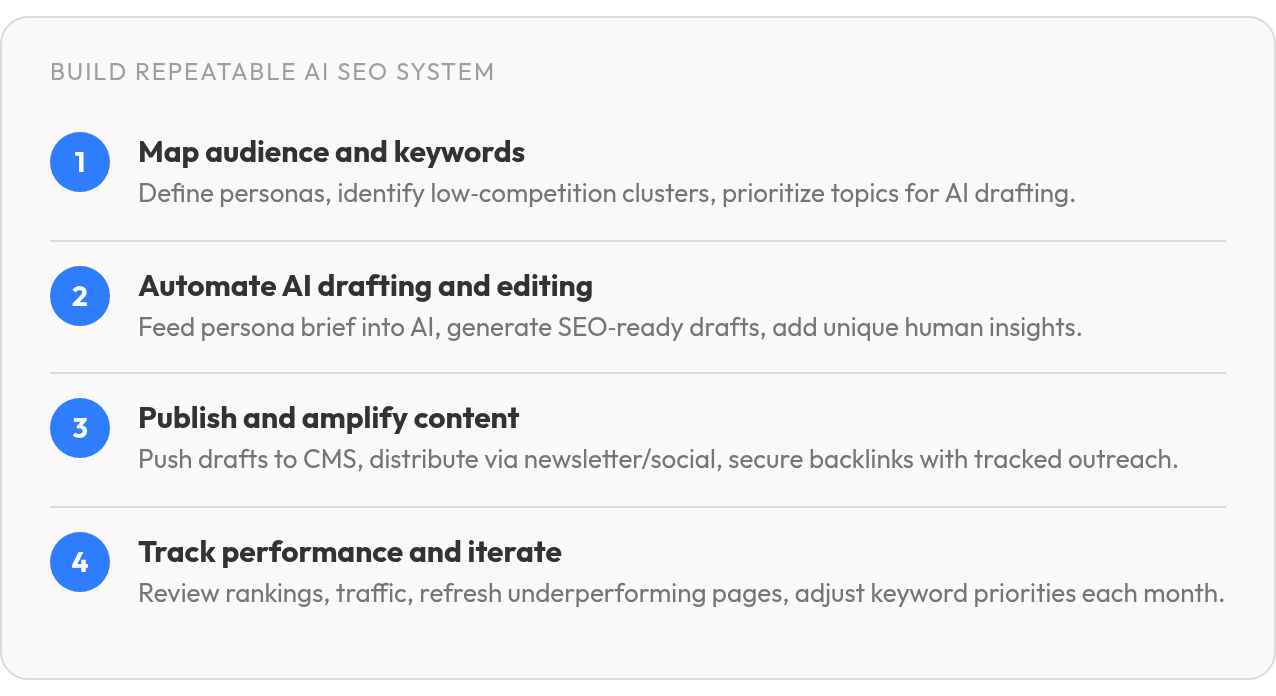
So we run this as an operating system rather than a sprint. When the workflow is one connected loop, research feeds the brief, the brief feeds the draft, and performance data feeds the next round of research. We judge any tool by whether it improves the whole loop, not one step in isolation. If consolidation is your first hurdle, we've written about replacing five tools with one content workflow.
Why does the business case hold up
It is strongest where content, demand generation, sales enablement, and customer education overlap. Those are the same jobs your content workflow touches every week. That's why a repeatable system tends to pay off where a one-off AI writing experiment fizzles.
What does waiting cost you
Organic visibility is limited. Every month spent juggling disconnected tools is a month a competitor can use to claim the topics you meant to cover.
There's an uncomfortable flip side, though. Faster drafting on its own just produces invisible pages sooner. The gain comes from pointing that speed at topics worth ranking for. Consistent, optimized publishing gives you more indexable pages and more shots at ranking, but search response still depends on authority, intent fit, competition, and crawl timing. Treat outreach and link-building as authority work you track, not a ranking schedule you can count on.
Skip this system if you publish only a handful of posts a year. At that volume, the setup overhead outweighs the gain.
Phase 1 – Map Your Audience and Low-Competition Keywords
Most teams start Phase 1 inside a keyword tool. We start with a person. If you can't say who's searching and what's blocking them, AI-assisted SEO production churns out drafts aimed at nobody.
Spend the first week defining that person. The persona brief becomes the instruction set your AI workflow reads before every draft. Vague briefs produce generic drafts, so be blunt.
A Persona Brief Your AI Drafts Can Actually Follow
Here's an illustrative brief for a B2B SaaS team:
- Persona: Marketing lead at a 20-person SaaS company. Owns pipeline, has no dedicated writer.
- Pain points: Publishing stalls during review. Leadership keeps asking whether blog posts ever produce demos.
- Tone and style: Direct, plain verbs, short paragraphs, second person.
- Jargon: MQL, pipeline, and churn are fine. Explain anything deeper in one clause.
- Taboo claims: Guaranteed rankings, "instant traffic," and invented statistics.
- Example phrasing: "Here's the step most teams skip."
Clusters Beat Isolated Keywords
Pick one pillar topic your product has earned the right to cover. Under it, list the long-tail questions buyers actually ask. Then sort those questions by intent: learning, comparing, or ready to act. Each intent group gets one page, and near-duplicate questions fold into it rather than spawning their own thin posts.
For gap analysis, list the terms competitors rank for that you don't cover yet. Prioritize the ones where the current top pages leave a visible gap in depth, freshness, format, or intent match. A results page that only half-answers the searcher's question tells you more than a difficulty score viewed in isolation.
Leave two things out. Skip high-volume head terms during these first planning weeks, because you won't win them yet. And drop any cluster you can't back with genuine expertise.
Phase 2 – Automate Content Creation and SEO-Ready Drafts
Once the keyword map feeds your drafting workflow, drafting stops being the slow step. Review takes its place. Automation can save hours that used to vanish into outlining and first-pass writing, but those hours only pay off when you spend them on what a model can't fake.
Use this production window to draft, publish, and watch for early indexing or ranking movement. That's a progress check, not a finish line. Turn each keyword cluster into a brief, and each brief into an SEO-ready draft that meets this on-page baseline:
- A title tag and meta description that match the query's search intent
How Do You Keep AI Drafts in Your Brand Voice?
Load the Phase 1 persona brief and write explicit voice rules. Generate one sample and compare it line by line against two or three published pieces you're proud of. When the sample misses, fix the prompt instead of the draft, so the next fifty drafts improve too. Every piece still gets a final human review.
What Human Insight Should You Add Before Publishing?
Add one thing per draft that only your team could supply. That might be a sharper point of view, a customer objection your sales team hears often, a workflow screenshot, or an example from your own process.
Keep opinion-led thought leadership out of this pipeline entirely. Those pieces deserve a human first draft. We cover where that line sits in automating the repeatable parts without automating the decisions.
Phase 3 – Publish, Backlink, and Amplify Across Channels
Publishing is where most automated pipelines lose time. The draft gets approved, then sits waiting for someone to paste it into the CMS, write a newsletter blurb, and resize images for social. Automate content creation for SEO but leave distribution manual, and you've only moved the bottleneck downstream.
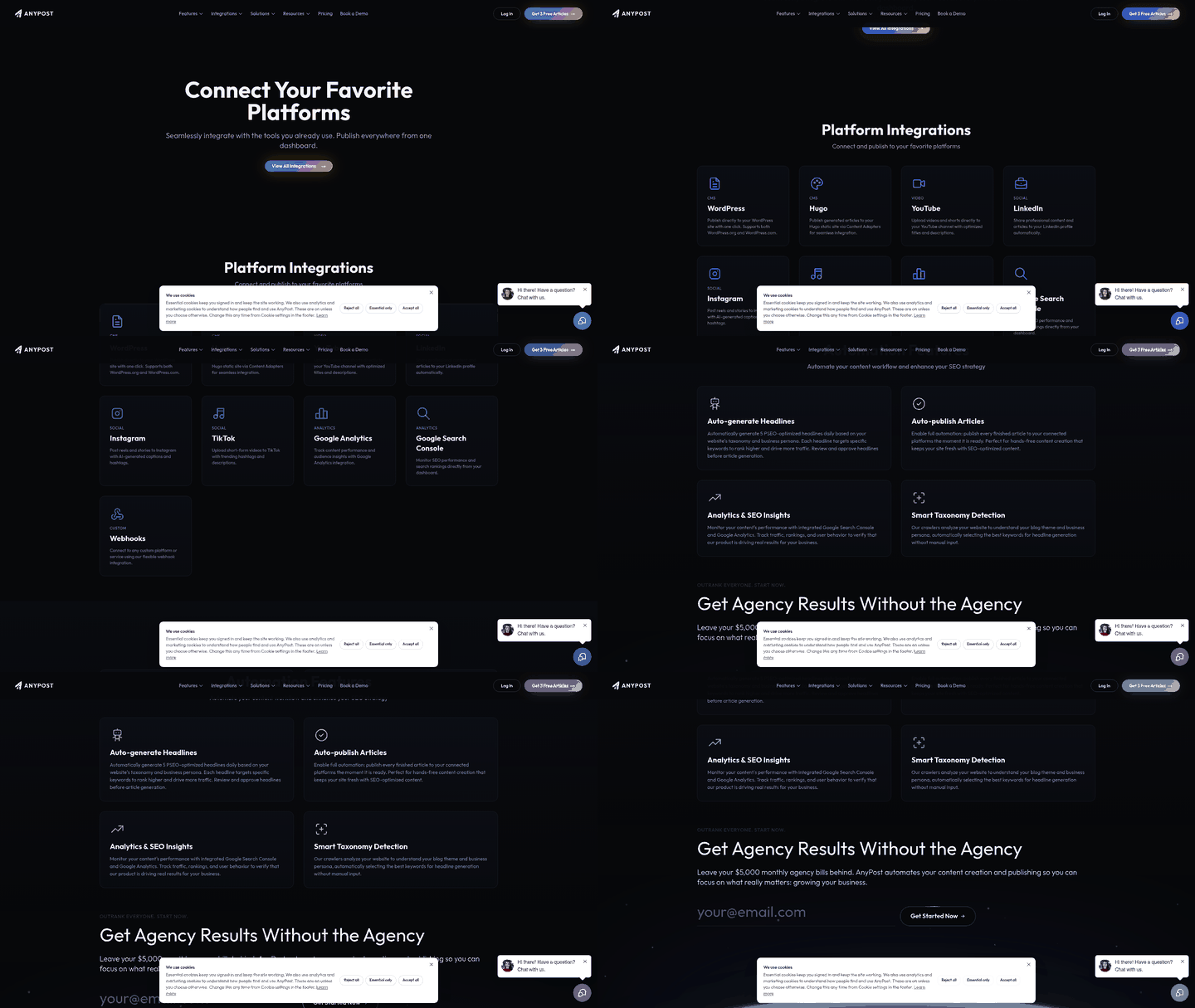
We treat each published page as raw material for every channel your buyers search, not just Google. Before connecting anything, check how your CMS, email, and social tools actually talk to each other: a native integration, a direct API connection, or Zapier-style middleware. Middleware tends to break silently when someone renames a field, so test it with a dummy post first.
What Should a Templated Page System Include?
If you're scaling similar pages, such as use-case or location pages, build the template before you build pages. Lock in these pieces:
- Canonical tags on near-duplicate variants, so search engines know which version to rank
If you only need a handful of these pages, skip the template. Writing each one by hand will serve you better.
How Do You Run Outreach Without Losing Control?
Run backlinks as a tracked pipeline: prospect, personalize, follow up, check link quality, and report. Automation can handle the reminders and the logging. The pitch still needs a human, and rankings get measured as an outcome, not promised as a deadline.
For amplification, turn each post into a newsletter issue and a social carousel. Then track newsletter click-through rate and carousel engagement month over month. We walk through the mechanics in our one-draft, five-channel workflow.
Phase 4 – Track, Iterate, and Scale Without Flooding the Index
The measurement problem appears the moment production speeds up. A stronger AI content workflow can help a team ship more consistently than it ever did by hand, but visits don't automatically follow. Search behavior, SERP features, intent mismatch, and weak authority can keep a published page from turning into meaningful traffic.
So set goals against your own baseline, not a borrowed benchmark. Your analytics stack should show rankings, traffic, impressions, click-through rate, leads, conversion paths, and each page's content status in one view. If the review means checking four tabs, it won't happen.
The 30-Day Review Loop Keeps Automation Honest
Every 30 days, run the same checklist:
- Compare rankings and traffic to baseline.
- Compare pages shipped to pages planned.
- Refresh pages stuck on page two.
- Add internal links from your strongest pages.
- Reorder keyword priorities and rewrite the next sprint backlog.
Scale in Batches, Not Floods
Expand in small batches and keep your editorial QA gates in place. Confirm a batch is indexed before you ship the next one. Watch for cannibalization, which is two of your own pages competing for the same query. Prune pages that never earn impressions.
Before each batch, score the risks the last round surfaced. Unindexed pages, cannibalization, and pages with no impressions are the usual suspects.
And if nobody can own the review, slow the cadence. Publishing fewer pages beats automating decisions you haven't checked.
Questions People Ask
Does the system fail if my pages aren't ranking by day 90?
No. Treat day 90 as the point where you should have enough evidence to make better decisions, not as a pass-fail date. Look for directional signals: pages getting impressions, pages close enough to improve, and pages with no traction at all. Then decide whether each URL needs a refresh, stronger internal links, a different angle, or removal from the plan.
Will publishing more AI-generated pages bring more traffic?
Not by itself. A faster drafting process helps only when the added speed is paired with editorial judgment. Without that, volume can create overlapping pages, weaker intent match, and more URLs for your team to maintain. Use the time you save to improve briefs, tighten examples, review performance, and decide which pages deserve another pass.
Should I pick topics by keyword difficulty score alone?
No. Use the score as a first filter, then inspect the results manually. Look for whether the ranking pages fully answer the query, match the searcher's intent, and come from competitors you can realistically challenge. The best early targets are usually the ones where your expertise can make the page clearly more useful.