Content Automation Tools Ranked by Multi-Channel Distribution Speed

In short: Most teams now use AI for drafts but still publish content manually across platforms. Multi-channel launches get feedback faster by putting the same content in front of several audiences at once instead of waiting through sequential tests. AmpiFire's syndication reaches news outlets and podcasts from a single piece without handoffs. Opus Clip's AI spots viral moments in long videos and generates captions for social repurposing. Missinglettr turns published posts into long-term social drip campaigns.
Quick Summary
The real test of content automation isn't the writing interface. It's what happens after the draft exists: how fast can you turn that asset into channel-ready outputs and publish them without another coordination round?
We ranked three approaches based on distribution speed, because most vendors don't publish clean end-to-end latency numbers. The comparison focuses on where each tool removes work between content approval and audience reach.
| Tool | Primary Speed Mechanism | Documented Reach | Key Automation Feature |
|---|---|---|---|
| AmpiFire | Multi-platform syndication | Third-party publishing and media-style placements | Automated content distribution across owned and external channels |
| Opus Clip | Short-form video repurposing | Short-video and social feeds | AI-assisted segment selection, captioning, and social formatting |
| Missinglettr | Social media drip campaigns | Major social platforms | Automated long-term social scheduling from blog posts |
Three speed accelerators stand out. First, syndication breadth changes the economics of a single asset. When one approved piece can adapt into several publication formats and deploy from the same workflow, you skip rebuilding the campaign channel by channel.
Second, short-form repurposing removes one of the slowest steps in video content operations. Instead of watching a full recording, choosing clips, writing captions, and exporting every variation, automated systems convert long-form material into a stream of social-ready assets.
Third, Missinglettr's drip campaigns automate long-term social scheduling from blog posts, so the post keeps working without manual rescheduling.
One gap worth noting: we couldn't compare AnyPost.ai's distribution speed using sourced, independently verifiable specifics from the current research set. Backlink-quality claims and platform-reach numbers would need stronger outside confirmation before being ranked alongside the tools above.
Why Multi‑Channel Distribution Speed Matters
Most teams pour hours into production, then publish once, share twice on social, and move on. That approach wastes reach. When you automate content creation for SEO and distribution, the larger gain isn't saved labor. It's a shorter gap between approval, publication, and measurable response.

Speed matters because search performance often benefits from fresh, actively promoted content. The longer distribution takes, the longer you delay the signals that establish relevance. A blog post that reaches social, email, and syndication partners soon after publication starts building engagement while the topic is current. One that sits in a manual queue for days may miss the early traffic window that helps determine traction.
The biggest distribution gap shows up in teams using separate tools for SEO, social, and email. According to CoSchedule's 2025 State of AI in Marketing report, AI-assisted creation has become mainstream, but many teams haven't given the same attention to post-production workflow. That's where time disappears, and distribution speed becomes a competitive advantage.
Faster distribution also tightens your optimization loop. When content reaches several platforms at roughly the same time, you can compare reactions side by side instead of treating each channel as a separate campaign. A headline that works on one professional network but falls flat on another gives you a useful signal while the piece is still fresh enough to adjust. Automated multi-channel distribution turns the launch into a coordinated test instead of a slow sequence of disconnected posts.
Tool 1: Fragmented Stack (Separate SEO, Social & Email Platforms)
Before you compare AmpiFire, Opus Clip, and Missinglettr, check whether your current stack is fragmented: blog editor to SEO plugin to social scheduler to email platform, with people moving copy, images, links, and metadata between systems.
We see this stack in various combinations. A typical workflow might use WordPress or HubSpot for drafting, Yoast or Clearscope for SEO optimization, Buffer or Hootsuite for social scheduling, and Mailchimp or ConvertKit for email campaigns. Each tool solves one problem well but creates friction at the boundaries.
Where the Handoffs Happen
The bottleneck locations vary more than most guides admit. For one team, it's the approval queue before publishing. For another, it's resizing graphics for each platform's spec. For a third, it's rebuilding the content structure in the email editor after the blog goes live.
Ask where copy, metadata, links, or images move between systems by hand. That's your audit starting point. Does your social scheduler pull Open Graph tags automatically, or does someone retype headlines? Does your email platform import featured images at the right dimensions, or does the design team export multiple versions?
Diagnosis matters more than adopting a universal solution. One team's worst time sink, like newsletter assembly, might be another team's quick task if its email tool integrates tightly with its CMS. The goal isn't to eliminate every specialized platform. It's to find which transfer points consume enough time to slow the whole publishing operation.
Tool 2: All‑In‑One Competitor Suite (e.g., HubSpot + Social‑Scheduler Add‑On)
The appeal of an integrated marketing platform is straightforward: write once in a single editor, then let the system push your content to social, email, and SEO channels without leaving the dashboard. In theory, this should move faster than the fragmented stack because the work happens inside one ecosystem rather than across disconnected logins.
We see this promise in platforms that bundle blog publishing with scheduling and email automation. The consolidation reduces some friction. You draft in the platform's CMS, optimize with built-in SEO recommendations, schedule social posts from the same interface, and trigger email sequences when the post goes live. There's less duplicated asset uploading and less chance that a timezone, link, or image version gets changed during transfer.
The Distribution Speed Reality
The speed advantage shows up most clearly in the first-publish window. Once a blog post is approved, an integrated platform can queue social updates and subscriber notifications from the same campaign setup. That's a cleaner workflow than rebuilding the same launch manually in several separate tools, especially when multiple channels need to go live together.
The learning curve matters more than most teams expect. These platforms pack dozens of features into nested menus. Teams often spend time mapping their existing workflow onto the new system before they reach the gains the sales demo promised. If your team already knows the platform, setup shrinks considerably. If you're migrating from standalone tools, budget for training time and workflow redesign, not just a plugin swap.
Tool 3: AnyPost.ai – The Speed‑Focused Automation Engine
We built our platform around a different premise than the stacks most teams patch together. When you automate content creation for SEO across multiple channels, the bottleneck usually appears after the idea is approved: optimization, format conversion, scheduling, and the internal review loops between each step.
Our workflow compresses that chain. As noted in the Quick Summary, we couldn't compare AnyPost.ai's distribution speed using sourced, independently verifiable specifics from the current research set, so treat this section as a product-fit note rather than a ranked comparison.
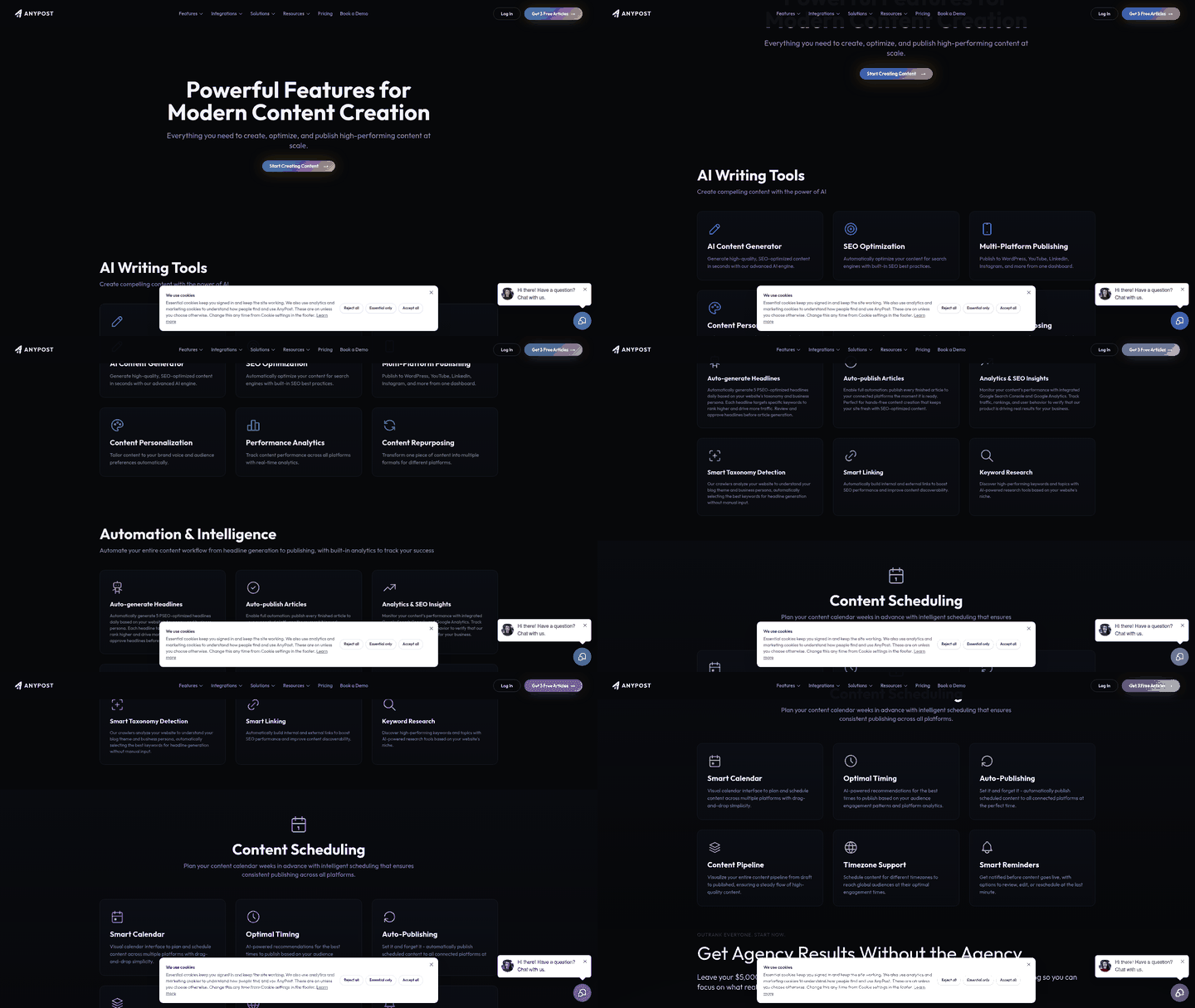
How Distribution Speed Compares
Independent distribution-speed and reach documentation for AnyPost.ai isn't available in the current research set, so we're not including a side-by-side speed table here. Treat the earlier AmpiFire, Opus Clip, and Missinglettr comparison as the ranking.
The workflow is most useful when the bottleneck is repeated review and reformatting between draft and final assets. Treat that as a product-fit observation rather than an independent speed result.
We see the biggest impact for agencies and SaaS companies managing multiple client voices or product lines. The persona system lets you maintain distinct tones without recreating the workflow each time. The automation covers SEO-optimized articles, social carousels, and newsletter content from a single input, keeping the campaign coordinated as it moves toward publication.
Which Approach Actually Fits Your Team
The choice between these tools comes down to where your distribution bottleneck sits. If your real problem is platform-specific reformatting, the right tool compresses that step rather than simply producing drafts faster.
Here's how the three ranked tools map to common team constraints:
| Tool | Primary Speed Gain | Best For | Trial Availability |
|---|---|---|---|
| AmpiFire | Multi-platform syndication | Teams that want one asset to reach news outlets, podcasts, and social placements | Varies by tool |
| Opus Clip | Short-form video repurposing | Teams with long video that needs social-ready clips and captions | Varies by tool |
| Missinglettr | Long-term social drip from blog posts | Teams that want automated scheduling from existing blog posts | Varies by tool |
We built our platform for the scenario where operational drag slows everything down: you need a blog post, matching social content, and newsletter copy prepared together instead of routed through separate platforms. The workflow removes reformatting steps and shortens the distance between content creation and distribution.
Getting Started with Multi-Channel Automation
If you're moving to our platform, the fastest path is a three-week pilot. Audit your current handoff points in week one. Run a parallel publishing test in week two with five pieces of content. Scale to your full publishing calendar in week three once you've confirmed the output matches your brand standards.
The fragmented stack still works if you have the team capacity to manage several specialized systems. The all-in-one suite makes sense if you're already paying for the CRM and want tighter campaign management inside that ecosystem. Our platform is built for teams where publishing velocity determines whether the content program can keep up with traffic goals.
Frequently Asked Questions
At what content volume does manual distribution become impossible to sustain?
The breaking point varies by team capacity. A useful warning sign is when distribution work starts delaying approved content even though the content itself is ready. If every new article requires separate formatting, image preparation, metadata checks, and social scheduling, the workload grows with every channel you add. At that point, the issue is no longer writing speed; it is operational throughput.
How do you measure whether faster distribution actually improves performance?
Track the delay between content approval, channel publication, and the first useful engagement data. Look at which platforms respond fastest, which headlines attract clicks, and where the content needs a different angle. The goal is to learn from the launch while the asset is still current, then apply those findings to the next piece rather than waiting until the campaign is effectively over.