
Content Marketing Automation as Workflow: Mapping Triggers, Handoffs, and Quality Gates

Quick Answers
- Teams running marketing automation tend to see a 14.5% lift in sales productivity and a 12.2% drop in marketing overhead once routine coordination moves into the workflow.
- The coordination work around approvals, reformatting, and status pings eats more hours than writing the content ever does.
- Workflow complexity scales with triggers, roles, integrations, and gates, from a low-effort single blog refresh up to a high-effort five-channel launch with compliance review.
- Quality gates can magnify flaws at scale when they sit on inconsistent references, the same way a scoring model trained on messy data spits out junk.
- Each trigger ties to a specific owner and output, from a traffic drop prompting a writer refresh to a product launch confirming SEO target terms.
Quick Summary
Content marketing automation earns its keep when you treat it as an operating system for production, not a faucet for more copy. The highest-leverage decisions happen before a draft exists: what should start the workflow, who owns each call, what gets checked, and how results loop back into planning.

The table below lays out the moving parts of a workflow built around triggers, handoff owners, configurable quality gates, and the kind of tool that tends to carry each stage.
| Trigger | Handoff Owner (Decision) | Quality Gate | Tool Type | Setup Complexity |
|---|---|---|---|---|
| Keyword or traffic decline | Writer (refresh vs. Rewrite) | SEO completeness | Work-management + connectors | Medium |
| Editorial calendar date | Editor/content manager (approve brief) | Brand-voice alignment | Work-management | Low |
| Product or campaign launch | SEO specialist (confirm target terms) | Readability + channel-format readiness | Lifecycle/email automation | High |
| CRM or user-behavior signal | Social/email manager (choose segment) | Compliance flag | Lifecycle/email + connectors | High |
| Seasonal or competitive event | Legal/compliance reviewer (clear claims) | Factual/source review | AI-agent automation | Medium |
| Asset ready for publish | Designer (format for channel) | Channel-format readiness | Work-management + connectors | Low |
A compact workflow might handle one refresh, from alert to assignment. A heavier build has to coordinate several channels, review paths, and publishing destinations without dropping accountability anywhere along the way.

Two things worth holding onto:
- The payoff depends on the process you encode. Automation strips out manual routing and follow-up, but only after the team has made the workflow explicit.
- Gates protect quality when they rest on clean, agreed standards. If the rubric underneath is vague or contradictory, the system will enforce that confusion with impressive consistency.
The real cost is in the handoffs, not the writing
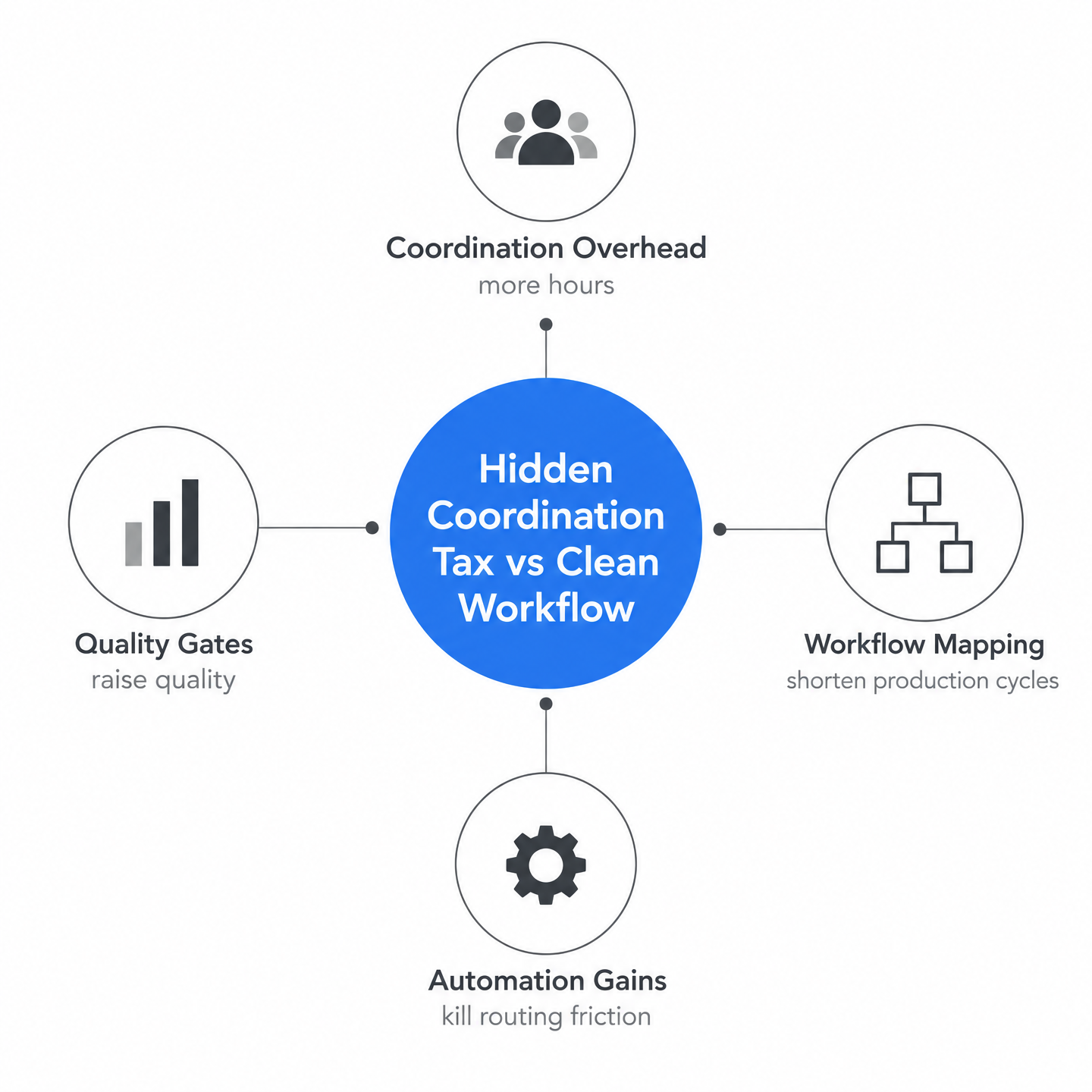
The strongest case for automating a content marketing strategy has almost nothing to do with writing faster. It's the handoffs. Every time a draft moves from writer to editor to SEO to legal, someone has to notice it, route it, and chase a reply. That invisible coordination tends to swallow more hours than the writing itself.
Mapping the flow first is what separates a working system from a faster mess. Teams that chart their workflows before automating them tend to shorten production cycles and move work across functions with far less friction, because the automation handles logistics while people focus on strategy and craft. The gains come from killing routing friction, not from generating more drafts. That's the same idea behind an engine like ours: create, edit, publish, and distribute from one dashboard, so coordination overhead stops piling up between stages.
Each role feels the pain differently. Founders want predictable output they can plan around. Content managers juggle deadlines and dependencies. Writers need briefs that don't leave them guessing. SEO specialists need an optimization checkpoint before anything ships. Legal and compliance reviewers need early visibility, not a last-minute surprise. A mapped workflow hands each of them a trigger and an owner, so handoffs stop slipping through the cracks. And if you're deciding where to begin, picking the right stage to automate first matters more than picking the tool.
A gate is only as good as the standard behind it
Built-in checkpoints help because they make expectations visible before work moves downstream. A gate can check whether the brief is complete, whether the piece matches intent, whether claims need review, or whether a channel-specific asset is missing. The catch: the rule has to be clear enough for a system to apply and narrow enough for a human to override when judgment is needed.
Naming the events that should start a piece
A trigger is any event that should kick off a piece of content. Before you automate a content marketing strategy, the real work is naming those events and tying each one to a business goal. Skip this step and you automate noise.
Start with the signals your team already reacts to. A keyword rank or traffic drop. A competitor publishing on your topic. A seasonal calendar date. A product launch, a campaign kickoff, a CRM lifecycle event, a spike in a specific search intent, or a question your support inbox keeps fielding.
Each signal points to a different output. That mapping is what makes the automation useful.
- Rank or traffic drop → refresh or rewrite the affected article
- High-intent CRM segment → nurture email sequence
- Product launch → landing page plus a social sequence
- Seasonal demand → campaign brief
- Repeated support question → help doc or thought-leadership piece
Detection usually spans three systems: search-performance tools for rank alerts, your CRM for lifecycle events, and social listening for audience signals. Connectors route those events into whatever work-management board owns the queue.
Score triggers before you automate your content strategy
Not every signal deserves a draft. Rank each trigger on business objective, audience value, expected impact, urgency, data confidence, and production effort. Low-confidence signals get filtered out before they fire.
This is where data hygiene earns its name. Automation projects tend to stumble when they run on messy, poor-quality data, and duplicate or stale records can quietly undermine the signals you lean on. A trigger wired to dirty data just manufactures busywork. Audit the source first, then review trigger performance on a set cadence.
Where drafts flow or quietly die
A handoff node is the exact moment one owner passes content to the next, plus the decision that enables the move. When you automate a content marketing strategy, these nodes are where drafts either flow or quietly die. An orphaned draft almost always traces back to a node with no named owner.

Map ownership as a chain, not a committee. The strategist or content manager sets the brief. The writer drafts. The editor shapes. An SEO specialist checks structure and intent. Legal or compliance reviews only when the topic warrants it. A designer handles assets, the channel owner formats for CMS, social, or email, and analytics closes the loop. Every arrow between those roles is a node, and each node needs one person who owns the yes.
Where do handoffs break down?
Four failure points show up again and again: no clear owner, legal pulled in too late, SEO rework after the draft is written, and missing assets at publish time.
You can defuse each one inside the workflow. Required fields stop a brief from moving until it's complete. Due dates and SLA timers chase late reviews so nobody has to. Escalation rules bump a stalled item to a manager on their own.
Once those rules are visible, the team can tell which delays are process problems and which are capacity problems. That distinction matters: automation can route work and surface bottlenecks, but it can't make an overloaded reviewer magically available.
Give every owner a short gate checklist: brief completeness, audience and goal fit, factual review, SEO requirements, brand-voice alignment, compliance, asset readiness, channel formatting, and publishing metadata. The voice gate is the one node that holds a single tone across every channel before anything ships. Let it auto-flag drift and escalate borderline calls to an editor, rather than signing off on creative by itself.
Building gates that catch problems early
A quality gate is just a checkpoint with a rule: content clears it or it doesn't move. When you automate a content marketing strategy, these gates are what keep speed from sliding into sloppiness. The automation routes the draft; the gate decides whether it's good enough to pass.
Set each gate to pass or fail on criteria your team can actually name. Vague standards breed endless back-and-forth, which is the exact coordination tax automation is supposed to kill. Teams that bake these checks in tend to catch problems earlier and spend less time cycling drafts through rework.
The brand-voice gate enforces one tone across every channel
This is the node most guides skip. Define voice as a config: approved tone attributes, your audience persona, preferred and forbidden terms, plus a few example passages that show the style in action. The gate auto-validates tone and flags drift. Borderline cases escalate to a human editor instead of getting rubber-stamped.
One caution. A voice gate trained on an inconsistent reference corpus will amplify the drift, not fix it. Clean your style samples before you scale the gate.
SEO and compliance gates carry hard checklists
The SEO gate checks target keyword and intent alignment, title and meta completeness, heading structure, internal links, readability, and schema or Core Web Vitals where web content needs them.
The compliance gate matters only for regulated or sensitive topics: required disclaimers, claims substantiation, privacy language, restricted terms, and mandatory sign-off before publish. Skip it for routine blog posts. Set thresholds by channel and risk, not by some universal score.
Wiring the whole loop together
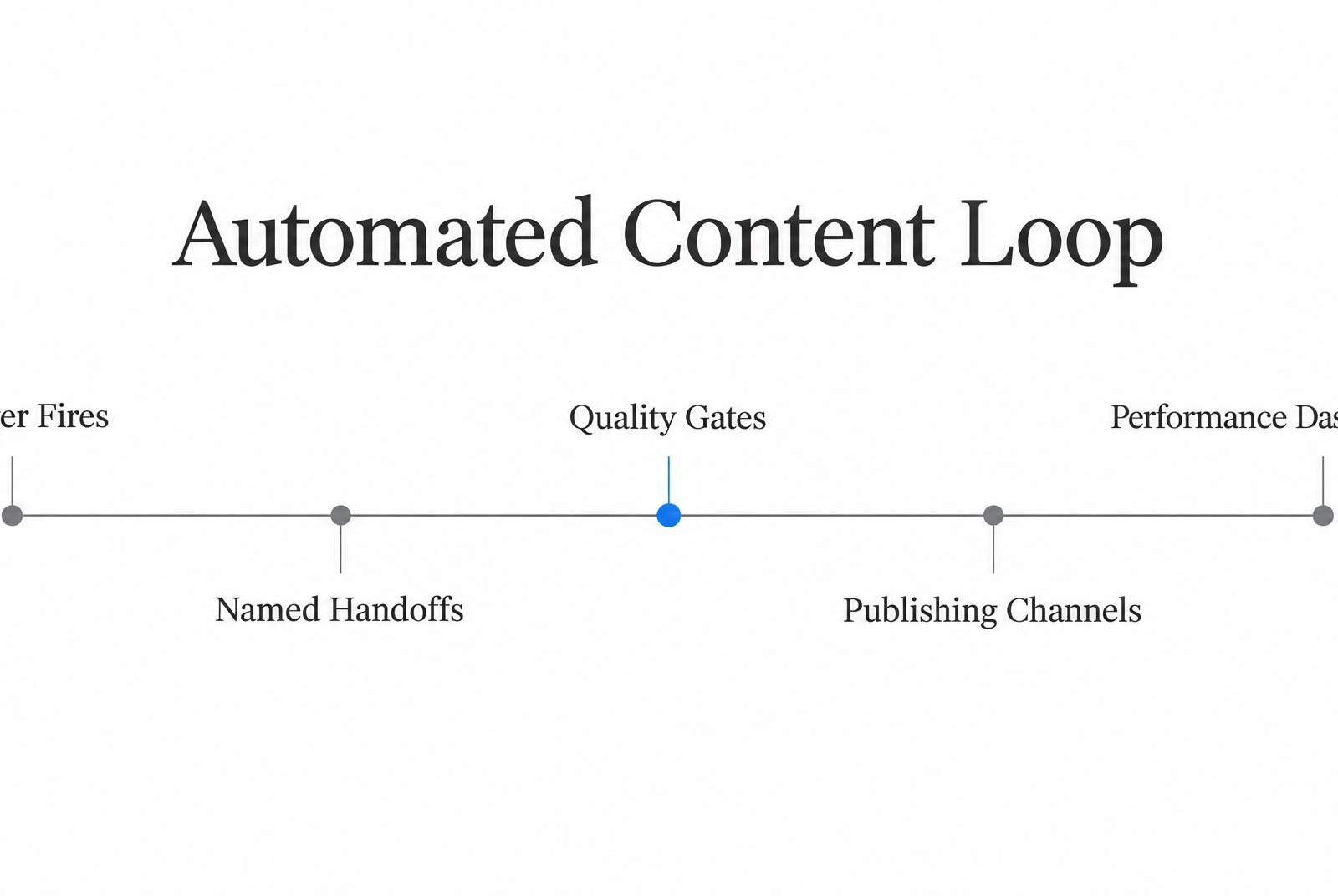
Here's where the pieces click into one loop. A trigger fires, a draft moves through named handoffs and quality gates, publishing fans out across channels, and performance data flows back to spawn the next trigger. When you automate a content marketing strategy end to end, that final arrow matters most. Results have to feed the trigger pool, or you're just running a one-way assembly line.
The connective tissue is your existing stack. Content automation wires into a CMS, design tools, social platforms, and asset libraries, not the deep CRM and lead-scoring hooks that general marketing automation leans on. APIs, webhooks, and connector apps link each trigger source to your content engine. One practical pattern: flip a blog post's status to Published and the workflow auto-schedules social posts to LinkedIn and X, handling the format transform in transit.
How do you close the loop?
Publishing isn't the finish line. A performance dashboard watches each asset, and an underperformer becomes a new refresh trigger. That round trip is what closes the loop instead of leaving drafts to pile up.
The loop carries a risk worth naming. Automation tends to fail less from a weak platform and more from the data you feed it. If your dashboard pushes stale numbers back into the trigger pool, the automation just reruns bad calls faster. Automating a broken process doesn't fix it; it scales the mistake.
So split the labor. Let automation handle detection, routing, and chasing. Keep a human on the yes for anything with real consequence.
FAQ
1. Which stage should we automate first if we can't tackle the whole workflow at once?
Start with the bottleneck that creates the most avoidable waiting. That might be incomplete briefs, stalled reviews, asset delays, or late optimization checks. The best first automation is usually a routing fix: required fields, ownership rules, reminders, and escalation paths that keep work moving without adding another meeting.
2. How is content automation different from general marketing automation?
Content automation is organized around producing, improving, approving, and distributing assets. General marketing automation is usually organized around contacts, lifecycle stages, lead scoring, and campaign responses. The distinction matters because a content workflow needs tight connections between planning boards, editorial review, publishing systems, design assets, and channel formatting—not just audience segmentation.