Do LSI Keywords Still Matter in 2026? A Simple Semantic SEO Workflow That Maps Terms to Articles, Newsletters, and X Posts

Why LSI Keywords Still Earn Their Keep in 2026
The part most teams get wrong isn't the workflow. It's the name. "LSI keywords" is a label that's been technically inaccurate for decades. Yet the practice behind it—finding co-occurring terms that signal topical relevance—still guides content decisions.
Latent Semantic Indexing dates to 1990, when Bell Labs researchers built it to handle small, static document sets using a mathematical process called Singular Value Decomposition. That original technology has nothing to do with how modern search engines process the web. When you reach for an LSI keywords generator today, you're pulling semantically related and co-occurring terms that help search engines understand context, not running a 1990s retrieval algorithm.
That distinction changes how you build content. The old approach counted keyword density—how many times your focus phrase appears. That habit produced stuffed, unreadable pages and, eventually, penalties. The modern signal is co-occurrence: which related terms consistently appear on pages that rank well for your target topic.
What a Semantic Workflow Actually Fixes
Most teams we work with hit the same wall: keyword research done once for one channel, then repeated as exact matches until the copy reads like a robot wrote it. A semantic workflow addresses four specific problems — over-dependence on one keyword list, restarting research for every content format, keyword stuffing that kills readability, and no structured way to organize related terms into briefs.
The table below is an editorial planning template, not a benchmark. Use it to scope work before writing.
| Topic | Related-Term Bucket | Target Pieces | Est. Creation Effort | Difficulty |
|---|---|---|---|---|
| Social scheduling | content calendar, post cadence | Article + newsletter | Medium | Low |
| Content clusters | pillar page, topic authority | Article + X thread | High | Medium |
| Lead generation | conversion funnel, CTA | Article + newsletter | Medium | High |
For term discovery, free LSI keyword tools can surface related phrases for a single cluster. Each step in the workflow draws on a different skill: research through SERP pattern recognition, semantic grouping through editorial judgment, brief-writing through structural thinking, and brand-voice review through domain knowledge. Free tiers tend to cap daily usage, so they work fine for scoping one cluster but can run out fast if you're researching several topics at once.
Quick-look checklist: seed term → related-term expansion → pruning → clustering → article brief → newsletter angle → X-post angle → editorial review → brand-voice review → publish → measure
Where teams tend to recover the most time is in clustering and brief-writing, not the research itself. A workflow like this pulls three content formats from one term set without duplicating research effort. For a practical walkthrough, see how to generate LSI keywords and turn one term into three content formats.
Building a Semantic Keyword Network
Finding candidate phrases is the easy part. The work begins when you turn those phrases into a publishing system. Running an LSI keywords generator gives you a raw list, and that list is useless until you bucket it by entity relationship, search intent, and where each term will live in your content system.
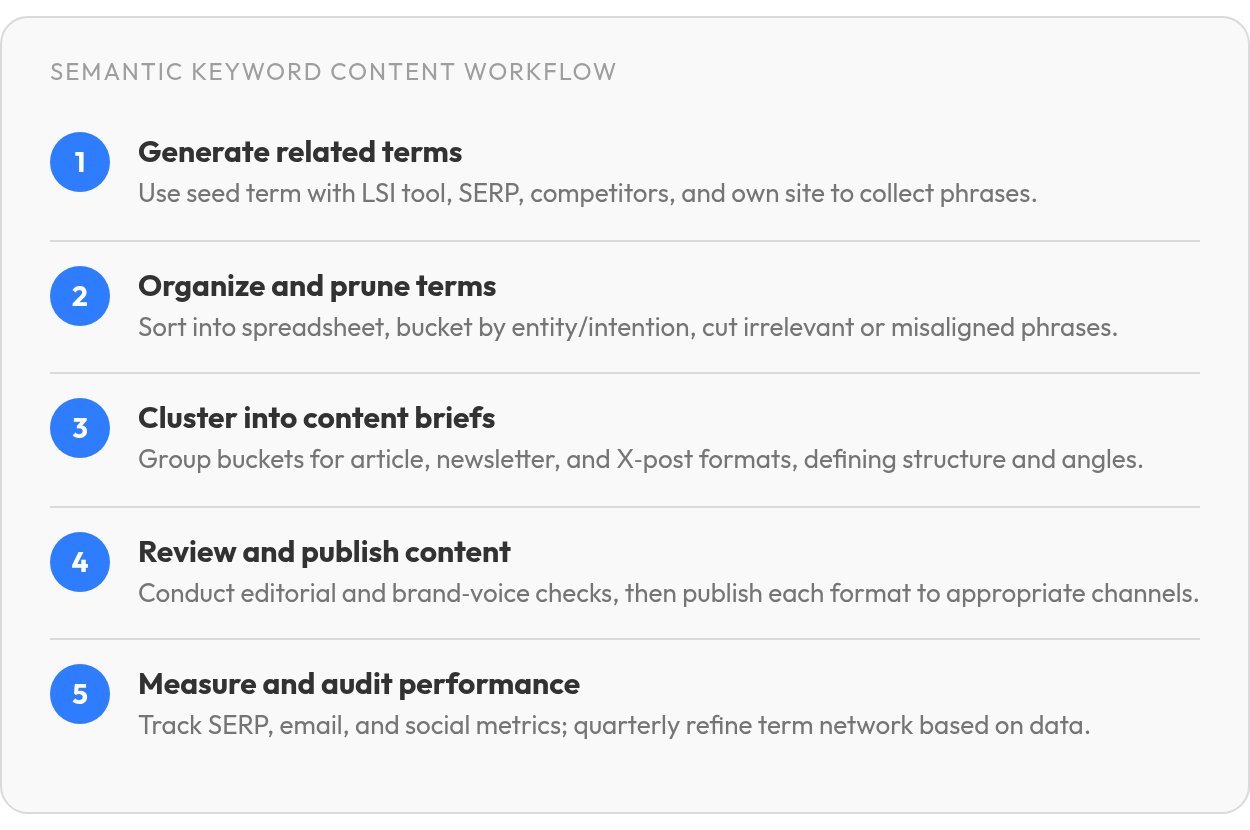
Our approach starts with one seed topic and pulls from three sources: the live results page, competitor content, and the context already present on your own site. Those inputs do different jobs. The search results show the current shape of the topic. Competitor pages reveal the language that already has traction. Your existing pages keep the final network grounded in products, messaging, and audience language your business can credibly own.
From Seed Term to Working Spreadsheet
We sort everything into a spreadsheet with columns for the phrase itself, its priority level, its entity group, the intent behind it, and the content destination. The closest phrases drive the main article. Adjacent phrases usually become subsections, examples, or supporting paragraphs. More distant phrases often make better newsletter prompts or social post angles than pillar-page copy.
The bucket column matters more than people think. If your seed term is "email automation," your buckets might be "workflows," "integrations," "deliverability," and "pricing." Terms that don't fit a bucket go to a separate cluster or get cut. LSI Graph can help as a starting point; it lets you search a limited number of terms daily on its free tier, which is enough to seed a first draft before you cross-reference against the SERP.
Which Terms to Cut and Why
Most raw lists include phrases that look useful until you inspect what they would actually do for the page. We filter for topical fit, intent alignment, commercial relevance, attainable demand, and the likelihood that a searcher will click through instead of getting everything they need from the results page.
A phrase can belong to the topic and still be wrong for the assignment. If the page is meant to support buying decisions, a purely educational query may distract from the job. If a term points mainly to another company's brand, it may bring visibility without any meaningful opportunity.
The point isn't volume. It's building a network where every term earns its place.
One Term Set, Three Formats
The common mistake is treating every channel as if it needs fresh keyword research. Once you've run your generator and organized the term network, that same cluster drives your article, your newsletter, and your X posts. One term set, three formats. The research stays the same; the editorial lens changes.
For a long-form article, you're using the broadest slice of the network. The closest terms shape the page architecture, while supporting phrases help fill out the body copy without sounding forced. Entity terms and modifiers add topical depth. The goal isn't hitting a density percentage. It's making sure the vocabulary pattern in your piece matches what already appears in top-ranking content.
For a newsletter, choose a narrow set of anchor phrases that capture the article's core argument. Open with a hook, then a short topic-anchor paragraph that frames the problem the article solves. The newsletter isn't trying to rank. It's converting subscriber curiosity into a click, so choose terms your reader uses when they're already interested in the topic, not the ones Google needs to see.
For an X post, the selection criterion shifts entirely. You want terms that are conversational, specific, and slightly surprising — ones a real person would say out loud, not type into a technical query. Strip out navigational and transactional phrases; they don't carry at 280 characters. What tends to land: a counter-intuitive claim, a question that surfaces a real tension, or a one-line observation that makes the longer article worth reading.
The efficiency gain matters. Our team makes one term decision upfront, then asks which slice of that network belongs where. The article gets depth. The newsletter gets relevance. The X post gets personality.
Before publishing, check for channel fit. The article should cover the topic deeply enough to satisfy search intent. The newsletter should lead with familiar audience language. The X post should read like a sharp standalone idea, not a clipped keyword brief. That last pass catches most mismatches before they reach readers.
Measuring Whether the Map Actually Worked
The workflow only improves if you revisit it after publishing. Many teams build the map, ship the content, and immediately start a new cluster. That creates a quiet tax on semantic SEO: you accumulate planning documents without learning which buckets actually helped.
A 2025 preprint on LSI-based SEO effectiveness exists, but the full text isn't accessible and the hosting site hasn't resolved its citations or references. We mention it because you'll encounter it if you go looking for proof that LSI keywords move rankings. The research hasn't delivered results you can act on, and the strongest critic of the "LSI" label compared its scientific credibility to keyword density counting. Your own performance data is the evidence that counts.
Metrics Worth Tracking
Your dashboard needs separate layers for each channel. For blog content, pull SERP position, impressions, clicks, and query coverage from Google Search Console-style performance exports. Query coverage is the one most teams overlook: it shows how many of your bucketed terms actually appear in queries that generated impressions. If whole groups never show up in those exports, they may not deserve space in the next brief.

For newsletters, track open rate and click-through rate per send, noting which term cluster the content drew from. For X, pull impressions, engagement rate, reposts, replies, and profile clicks. The pattern that matters isn't any single number; it's whether certain term buckets consistently outperform others across channels.
Quarterly Term-Network Audits
Every quarter, compare your performance data against the original buckets. Add emerging entities that Search Console queries reveal but your map didn't include. Merge overlapping buckets that cannibalize each other in the SERP. Retire terms that generated zero impressions across all channels after 90 days.
Human review is non-negotiable here. Automated suggestions can flag a term gap, but only a person can judge whether a newly surfaced query fits your brand voice and whether the content ranking for it genuinely serves your audience. Skip the quarterly audit if you publish fewer than ten pieces a month; at that volume, the signal-to-noise ratio doesn't justify the time.
Frequently Asked Questions
Does every related term in your semantic network need to appear in the main article?
No. Treat the article as the home for the terms that strengthen the main search intent, not as a dumping ground for every adjacent phrase you found. Some related language belongs in body sections; looser associations often work better as email or social angles. If adding a phrase makes the article feel padded, leave it out of the page and use it elsewhere in the campaign.
What actually happens to high-traffic terms that don't survive the pruning step?
They get parked, split into another cluster, or removed from the plan. High demand is useful only when the query can support the page's job. If a phrase attracts the wrong searcher, points toward a competitor, or is unlikely to produce a click, keeping it usually adds noise rather than opportunity.
If LSI technology dates to 1990 and doesn't apply to modern search, why does the term still have any practical value?
Because the phrase has become industry shorthand. Most SEOs using it today are not talking about the original information-retrieval method; they're talking about the surrounding vocabulary that helps a page cover a topic naturally. The label is imprecise, but the editorial practice behind it is still useful.
At what publishing volume does a quarterly term-network audit actually become worth the time?
It becomes worthwhile once you publish enough content for patterns to appear in your performance data. If output is light, check results informally instead of forcing a full audit cycle. When you have a steady publishing cadence, the review helps you spot missing entities, overlapping clusters, and terms that never earned visibility.
