Generate LSI Keywords for SEO Automation: A Simple Workflow From One Term to Blog Posts, Newsletters, and X Posts

LSI keywords: the facts before the workflow
Google's John Mueller said in 2019 that LSI keywords don't exist. That means a cluster of related phrases works as topic coverage, not as a ranking signal. Latent Semantic Indexing itself came out of 1980s information-retrieval research on how words relate to each other, and Google doesn't treat it as a ranking factor.
The tools sold as "LSI generators" can still cause trouble. Forcing their keyword variants into copy can lead to page demotions under Google's Helpful Content Update.
A "coffee beans" search shows how much a single seed term can splinter. It returns phrases like "best coffee beans" and "chocolate covered coffee beans," which share the seed but typically attract different audiences. The filtering workflow below rests on three checks: topical relevance, search intent, and practical fit within the formats you plan to publish.
One caveat up front. The newsletter-per-phrase and X-post-per-phrase mappings in this article are workflow assumptions, not benchmarked results. Cross-format attribution is still hard to measure.
Where we land: one cluster, three formats
Finding related phrases is the easy part. The part most teams underestimate is deciding which format each phrase belongs in. When you generate LSI keywords from a seed term, you're really collecting semantically related phrases, and our recommendation is to treat that list as a content plan. Run one research pass, then split it deliberately across a blog post, a newsletter, and an X post.
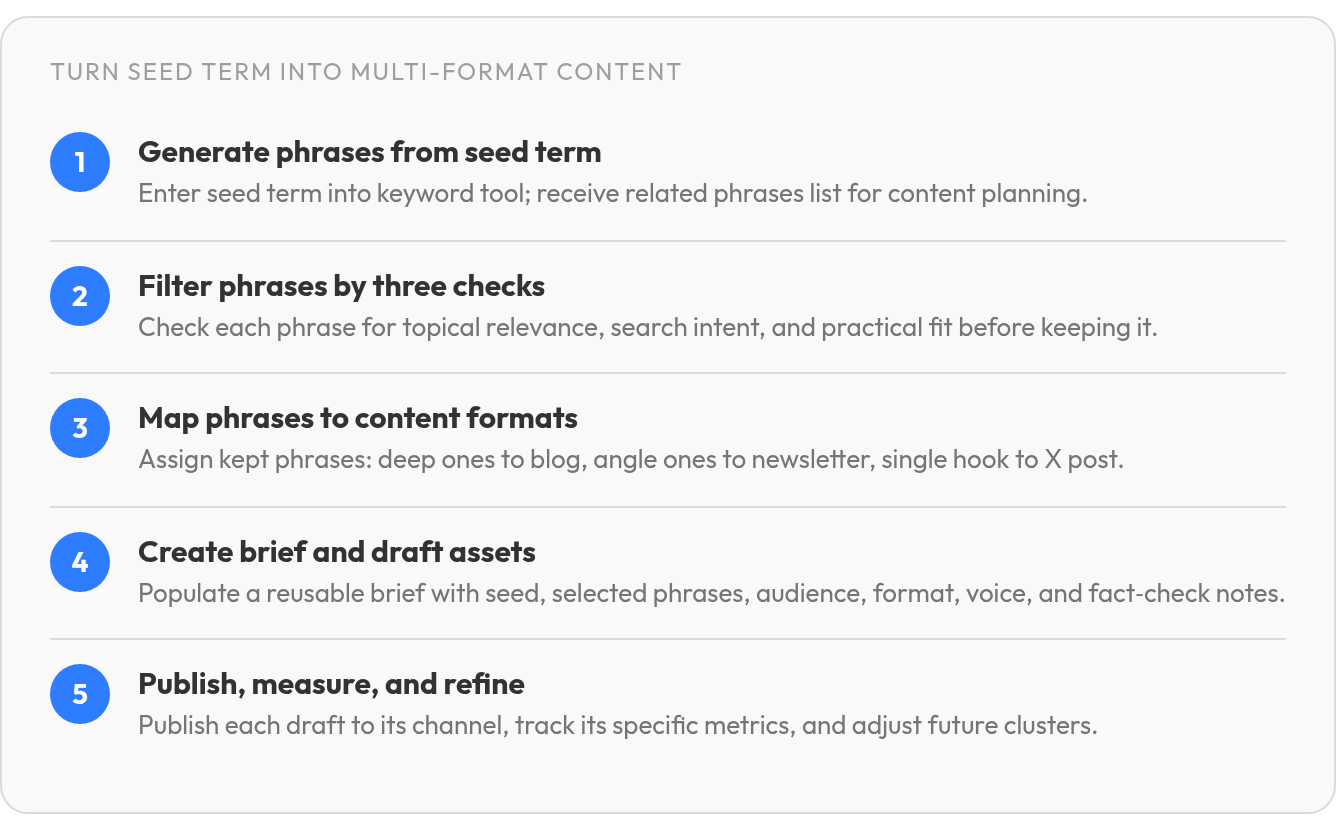
Below, one seed term moves through all three formats. We've labeled what the evidence supports and what is our own workflow assumption.
| Seed Term | Related Phrases | Content Applications | Evidence or Example | Workflow Caveat |
|---|---|---|---|---|
| coffee beans | caffeine content, fair trade certification, espresso blends | Cluster map | Documented: non-synonyms that add breadth | Check volume and intent first |
| coffee beans | roasting profiles, grind sizes | Blog post sections | Documented: related subtopics signal depth | Forced phrases read as stuffing |
| coffee beans | fair trade certification | Newsletter angle | Example: one phrase, one issue | Assumption, not benchmarked |
| coffee beans | espresso blends | X post hook | Example: one phrase, one claim | Short posts can't carry the cluster |
| Publish and measure | Full cluster | Track queries per format | General workflow, not verified automation | Cross-format attribution stays fuzzy |
| Main benefit | Full cluster | One research pass feeds three formats | Consistent topic coverage | Difficulty: moderate; editing stays manual |
How each stage tends to play out:
- Seed: One term can surface related phrases that feed several formats.
- Blog: The long format absorbs the widest slice of the cluster.
- Newsletter: One strong phrase usually makes a focused issue.
- X post: Pick a single phrase. Drop the rest.
- Measure: Watch which phrases earn queries, then refine the next cluster.
Why LSI keywords still matter for SEO automation (even with the wrong label)
The name is outdated. The planning job behind it isn't. In most SEO conversations today, "LSI keywords" just means related phrases that help an editor see how wide a subject really runs.
That distinction changes how you use the output. A keyword tool can suggest subtopics, but it can't tell you whether each one belongs in the same article. So treat its suggestions as editorial inputs. Keep the phrases that help answer the reader's question, and park the rest for another asset or a later brief.
Related phrases map intent, not density
Every related phrase hints at a different reason someone searched. Group phrases by search intent (what the searcher is actually trying to get done), then give each group a job: a section, a format, or a separate piece. You end up with a cleaner information architecture than you'd get by sprinkling disconnected variants into existing copy.
Pet-friendly travel makes the point. A stuffed sentence lists "dog-friendly hotels, cat-friendly accommodations, and pet airlines." A useful one names concrete subtopics: California's dog-friendly beaches, London's cat-approved hotels, Europe's pet passport requirements. All three sit near the same subject. They answer very different questions.
Automation follows the same rule. A phrase that explains a process may belong in a blog section. A timely recommendation can work better as a newsletter angle. A short question might suit X. The assignment should follow the reader's need, not whatever character count the channel allows.
Spreadsheets are where clusters stall
Phrase lists tend to sit in spreadsheet tabs nobody ever assigns to a format. For founders, small agencies, and SaaS marketers, that's a hidden tax that compounds every time someone reopens the file and starts over. One fix is to give each intent group a home channel: the deepest group goes to the blog post, a practical angle to the newsletter, one sharp question to an X post.
Once those calls are made, the repetitive work of drafting, scheduling, and posting is the part automation handles well. It's far less useful before the editorial decisions exist.
This won't guarantee every asset is fully distinct. It does give each piece a defined purpose. If you're comparing tooling, our breakdown of semantic SEO automation tools covers the options.
From one seed term to a shortlist you'll actually use
The tool output takes seconds. The judgment afterward is what tends to swallow whole afternoons. You type one seed term into a keyword-research tool, it returns a long scroll of phrases, and someone has to decide which ones earn a place in the plan.
Start broad, then cut hard. Enter "coffee beans" into a related-keyword tool and you may see clusters like "best coffee beans" and "chocolate covered coffee beans." Same seed term, different buyers, different decisions.
How do you filter related phrases for intent?
Every phrase should pass three checks before it stays:
- Topical relevance: Does it stay inside the subject your post promises?
- Search intent: Is the searcher comparing products, looking for instructions, researching a concept, or trying to reach a specific site?
- Practical fit: Can you cover it honestly in the formats you actually plan to publish?
Look at volume alongside intent. If a phrase forces you to twist the outline to fit it in, pull it from the current brief. That isn't wasted research. It may just belong on a different page.
What does a working list look like?
Short and sorted. A simple approach is to split survivors by format: core phrases for the blog post, angle phrases for the newsletter, and one sharp hook for X. That keeps a long keyword export from turning into a shapeless writing prompt.
Don't delete the leftovers. Move them to a "later" column. A phrase about chocolate-covered coffee beans, for instance, could carry its own article instead of becoming an awkward paragraph in a general buying guide. If your list runs long, our guide to automating keyword grouping in n8n covers sorting at scale.
Mapping related phrases to content pillars and formats
Building the cluster is no longer the bottleneck. Assignment is. After you generate LSI keywords, every phrase still needs a home, and pouring them all into one post tends to produce a page with no clear reading path.
Sort by broad search intent first. Pick the format second. Intent decides the container, never the other way around.
Which format fits each intent group?
This is how we'd map a "coffee beans" cluster. The phrases are illustrative, not real tool output.
| Intent group | Example phrases | Best-fit format | Depth |
|---|---|---|---|
| Informational (deep) | how to store coffee beans, arabica vs robusta | Blog post | Full coverage |
| Informational (quick) | why beans go stale | X post | One claim |
| Transactional | whole bean subscription, buy single-origin beans | Newsletter snippet | One angle, one link |
| Navigational | another roaster's brand + beans | Skip | Low fit |
The table also shows why one cluster doesn't have to become one article. Some phrases need explanation. Some work as a quick observation. Others only make sense next to a commercial recommendation.
How do you keep the topic intact across formats?
The blog post carries the weight. It has room for definitions, comparisons, examples, and context. Top-ranking pages often cover a broad spread of related ideas rather than exact-match phrases.
The newsletter shouldn't replay the article. It can pull out one useful subtopic, give readers a reason to care, and point them to the longer piece. The X post has an even narrower brief: make one point clearly enough that it lands without the rest of the cluster.
Skip navigational phrases tied to someone else's brand. That searcher already knows where they're headed, and wedging the phrase into unrelated content only weakens your outline.
Turning the shortlist into drafts with AnyPost.ai
The prompt matters less than the brief behind it. Weak drafts usually trace back to a vague brief, not a weak model. Once you've cut your related phrases to a shortlist, that shortlist becomes the backbone of a single brief you reuse for every format.
What goes into a draft prompt?
A reusable brief tends to hold up best with six slots:
- Seed topic: the single term the piece covers.
- Selected related phrases: five to eight, never the full scroll.
- Audience: who reads it and what they already know.
- Format: article outline, newsletter passage, or X post.
- Voice: two or three rules, like "short sentences, no hype."
- Factual review: "flag every claim that needs a source."
Change only the format slot and the same phrase pool can support three drafts without pasting identical copy into every channel. The outline turns the deeper phrases into H2s. The newsletter builds around one selected angle. The X post isolates the sharpest point and stops before it becomes a mini article.
Who checks the draft before it ships?
Ideally, someone on your team. Our Persona Engine can match your tone, but a human read still catches what automation misses. Read for tone first, then accuracy, then phrase use. A forced phrase reads like a list, the way the pet-travel example did earlier. A natural passage gives each entity a reason to be there, such as comparing what different trips require you to plan.
Skip drafting automation for posts with legal, medical, or pricing claims. Source checks and approvals there can easily outweigh the time automation saves. To connect drafting to publishing, see how we wire keyword research into distribution without switching tabs.
Publishing without the copy-paste scramble
Publishing is where a tidy cluster tends to fall apart. The drafts are done, but each one needs a different destination, and every copy-paste between tabs chips away at the phrases you chose so carefully.
We treat the shortlist as metadata, not just draft fuel. With multi-platform publishing, you can push the blog post to your existing site and the short-form version to X from one place, with each asset leading with the language that suits its channel.
The seed term belongs in the tags, not just the body
For the blog post, the seed term and one related phrase go into the meta title, meta description, and URL slug before the post leaves draft in your CMS. Schema markup (the code that tells search engines what a page contains) should describe the page honestly. Don't pad it with variants.
The newsletter skips on-page tags entirely. Its subject line can borrow the most curiosity-driven phrase from the cluster. The X post uses one quick-intent phrase and links back to the blog. Each channel keeps its own conventions instead of being treated like a web page.
Each asset gets measured against its own job
In our experience, each format earns a different signal: impressions and rankings for the blog, opens and clicks for the newsletter, link clicks for the X post. Judge all three on one metric and you'll tend to reward whichever channel is loudest.
A written checklist is plenty for occasional publishing. Teams shipping weekly may get more out of a connected workflow, especially when one approved brief has to reach several destinations.
The bottom line on LSI keyword workflows: measure, then re-cluster
The stage most teams skip isn't publishing. It's the review a few weeks later, when the numbers are in and nobody checks which related phrases actually earned their spot. Without that loop, the next cluster starts from assumptions instead of audience evidence.
How do you test one variable at a time?
Change one thing per test: the headline, the angle, or the related phrase you lead with. Keep the audience and channel as steady as you can. A subject-line test, for example, goes to comparable segments of the same list at the same send time. Swap the phrase and the send day together, and you can't tell which change moved the result.
Judge each format by its own signal:
- Blog post: search visibility, meaning impressions and rankings for the seed term and its phrases.
- Newsletter: opens tell you whether the subject landed. Clicks tell you whether the passage earned the visit.
- X post: replies, reposts, and link clicks, not raw impressions alone.
What should change in your next keyword cluster?
Feed what you learn back into phrase selection. A phrase that drew newsletter clicks but no search visibility may belong in email rather than on the blog. A phrase that went quiet everywhere may mean its intent was misread, or that the topic simply lacks a clear audience.
Keep expectations proportional to your reach. Small lists and modest followings rarely produce enough data for elaborate experiments, so let results build across several sends and posts before you draw conclusions. Refining each cluster from how real readers responded tends to pay off more reliably than chasing a promised traffic lift.
FAQ
Should you stop using LSI keyword tools if LSI isn't a real ranking factor?
No. These tools can still serve as phrase-discovery sources. Their value lies in the questions and subtopics they surface, not in the “LSI” label or in a special ranking mechanism. Review the suggestions manually, assign useful ones to a content format, and set aside anything that does not support the reader's main task.
When is a one-seed, three-format content workflow not worth setting up?
It is least useful when a topic has only one narrow intent and a single page can answer it completely. The process is also a poor fit for work that requires extensive legal, medical, or pricing review, because approval may take longer than the initial drafting.
For occasional publishing, a simple editorial checklist can be sufficient. A fuller workflow becomes more valuable when one research pass regularly feeds several assets and distribution channels.
Will reusing one keyword cluster across a blog post, newsletter, and X post make them compete?
Not necessarily. Competition depends on how similar the assets are and where they are published. A blog page can explain the subject in depth, an email can focus on one practical angle, and an X post can point to a single observation. Those roles give the audience different entry points rather than three copies of the same page.
AnyPost.ai can publish the blog and X versions from one place, but distribution automation does not replace editorial review. Check that each asset has a distinct purpose before it ships.