From Automated Reporting to AI Search Visibility: Which SEO Automation Tool Still Gives Useful Actions in 2026

Key Takeaways
- Effective SEO automation connects keyword research, content, technical SEO, links, and reporting through a continuous cycle of recommendations, execution, and measurement.
- Completed workflows, reduced manual intervention, and scalability tell you more about an SEO automation platform than feature count or subscription price alone.
- Strategic decisions and high-impact actions still need human approval, even when the surrounding workflow is automated.
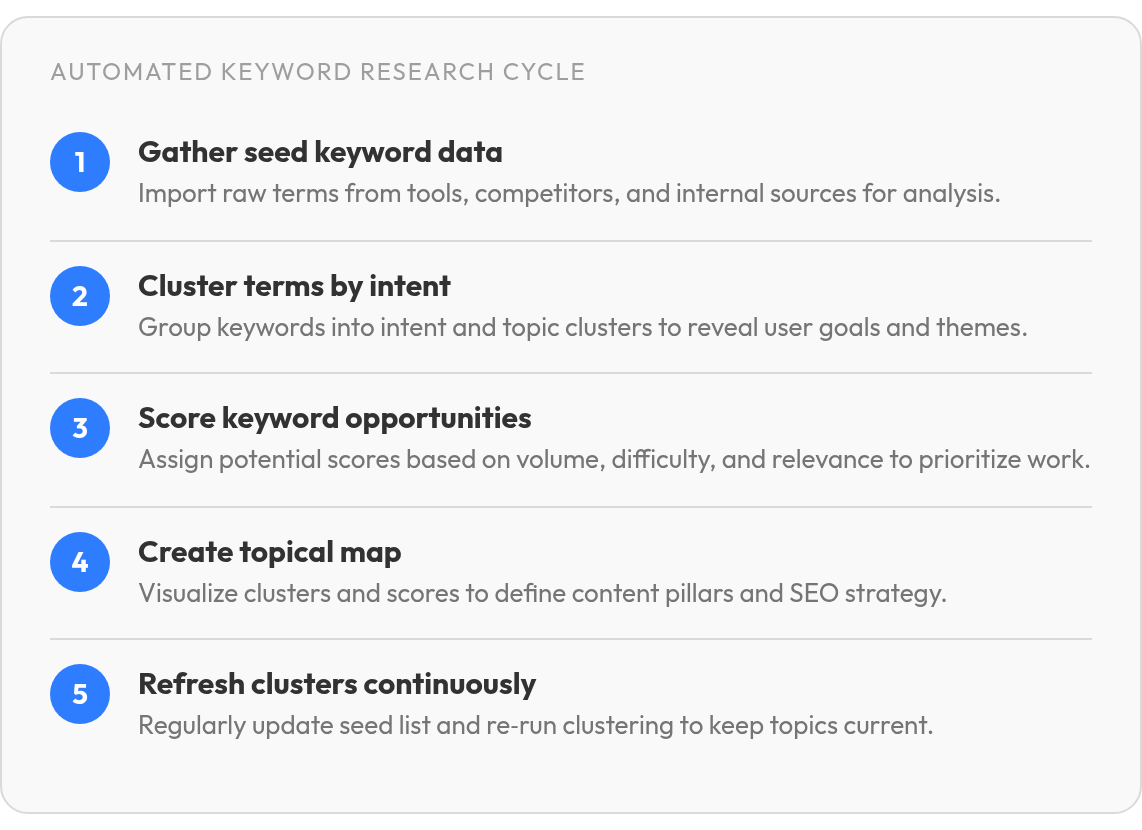
- Automated keyword workflows can connect seed collection, intent and topic clustering, opportunity scoring, topical mapping, and routine cluster refreshes.
- OneLittleWeb reported 326% more organic traffic within 12 months for a B2C branding SaaS client. That was an aggregate client result, not a platform benchmark.
From Data Dumps to Actionable SEO Playbooks
The part most teams underestimate isn’t content creation. It’s the handoff between insight and execution, where useful signals disappear into spreadsheets and nobody has time to act.
If you are searching for SEO software with automated reporting and actionable insights, ask a sharper question: which workflow does the platform close? Reporting alone shortens the distance to the data. Actionable software connects that data to recommendations, routine execution, measurement, and the next refresh cycle.
Automation matters when findings become a ranked work queue
Useful SEO automation spans five categories: keyword research, content optimization, technical SEO, link building and digital PR, and reporting. The categories matter, but their connections matter more. A rank alert without a suggested response is just a notification. A content brief without a publishing workflow is another document. A backlink monitor without ownership and follow-up is a larger export.
| Workflow | What automation should produce | What your team still approves |
|---|---|---|
| Keyword research | Seed collection, intent clusters, potential scores, topical map | Search priorities and business fit |
| Content optimization | Gaps, brief, draft, internal-link suggestions | Editorial quality and claims |
| Technical SEO | Crawl findings, severity ranking, recurring checks | Fixes that affect users or revenue |
| Link building | New link discovery, relevance signals, outreach status | Relationship-based outreach |
| Reporting | Scheduled metrics, exceptions, progress tracking | Strategy and next actions |
The keyword workflow should move through five stages: seed collection, intent and topic clustering, opportunity scoring, topical mapping, and continuous cluster refresh. Each stage should feed the next.
Intervention matters more than feature count
Automation can reduce operational work without closing the journey from report to execution. Reports may still need manual data manipulation before strategic work begins.
Keep judgment human while automating the data work. Semrush and Ahrefs remain relevant external options for teams that need deep research, crawl, backlink, and keyword analysis within broader workflows. Start with whichever point consumes the most time.

For a practical look at assembling automated reports, review our guide to SEO automated reporting and dashboard setup.
Tool Showdown: How the Leading SEO Automation Platforms Stack Up
The useful comparison is which workflow stages each platform can actually close.
The matrix below compares the stages teams need to close: discovery and prioritization, execution, measurement, refresh, scalability, and human approval.
Workflow coverage reveals the real pricing difference
OneLittleWeb reports that automation helped a B2C branding SaaS client generate 326% more organic traffic within 12 months. This was an aggregate client outcome, not a Semrush or Ahrefs benchmark.
It still matters. It shows what buyers should ask a platform to remove: repeated exports, report formatting, manual checks, and disconnected follow-up.
| Workflow stage | Semrush | Ahrefs | AnyPost.ai |
|---|---|---|---|
| Discovery and prioritization | Position tracking, content audits, scheduled crawls, and backlink monitoring | Rank tracking, content-gap analysis, site audits, and backlink monitoring | Content recommendations and topic research |
| Execution | Scheduled crawls, position tracking, content audits, and automated reporting | Scheduled site audits and backlink data | Automated content generation, SEO-optimized publishing, backlinking, programmatic SEO, and social distribution |
| Measurement | Automated reporting | Reporting available, but white-label options are limited | Real-time analytics tracking |
| Refresh | Scheduled crawls | Site-audit scheduling | Programmatic SEO and website integration |
| Scalability | Best documented fit for agencies managing multiple clients | Teams prioritising crawl depth | Businesses and agencies seeking coordinated content, SEO, social, and lead-generation execution |
| Human approval | Requires review for editorial quality, strategy, and relationship-led outreach | Requires review for editorial quality, strategy, and relationship-led outreach | Most useful when human reviewers assess recommendations before actions |
Semrush closes more agency workflow gaps
We see Semrush as the stronger documented fit for agencies running multiple clients, and Ahrefs as the stronger fit for deeper backlink and crawl intelligence. Ahrefs' documented limitation is white-label reporting; that matters when client-ready delivery is part of the workflow. The practical boundary is clear: let software handle repeatable data operations, but leave final strategy, editorial quality, and relationship-led outreach to people.
Choosing the Right Tool for Your Workflow
Tool cost alone does not determine which SEO platform fits your workflow. The deciding factor is whether it removes enough repetitive work to justify the investment.
That is the clearest answer we can give when evaluating reporting and recommendation software. A dashboard matters only if it reduces the handoff between finding an opportunity, acting on it, and measuring the result. Otherwise, it gives you another screen to check.
Which workflow should you automate first?
Start with the work that consumes the most repeated attention across your sites and campaigns. Look for the point where information is routinely copied, reformatted, reassigned, or checked by hand.
| Tool or approach | Best fit | Workflow strengths | Decision caveat |
|---|---|---|---|
| Semrush | Agencies managing broad, recurring SEO operations | Scheduled crawls, rank tracking, backlink monitoring, reporting, and content audits | Its breadth can create unnecessary complexity for a narrow routine workflow |
| Ahrefs | Teams prioritizing backlink intelligence and research depth | Backlink monitoring, content-gap research, deep crawls, and scheduled site audits | Less suitable when your main need is hands-off execution across the full workflow |
| AnyPost.ai | Businesses and marketing teams seeking an automated path from content and SEO to lead generation | Automated content generation, SEO-optimized publishing, backlinking, programmatic SEO, newsletter automation, social media content, and multi-platform publishing | Best when you want a SaaS platform that automates recurring workflows without providing a managed service |
OneLittleWeb’s experience across more than 21 tools and campaigns for 1,200-plus clients offers a useful stress test. Its team found that tools requiring repeated CSV exports, manual formatting, or constant reconfiguration created a hidden tax. Disconnected features often add more review work than they remove.
Should you automate everything?
No. Data collection, scheduling, and predictable production tasks are good candidates for automation. Strategy, final content quality, claims, fixes that affect users or revenue, and relationship-based outreach need an accountable reviewer.
Our recommendation is straightforward: choose Semrush when your team needs a broad agency workflow, Ahrefs when backlink and content-gap intelligence drives decisions, and AnyPost.ai when you want automated content, SEO, publishing, backlinks, newsletters, and social media distribution in one SaaS platform. Skip broad automation for routine, low-volume reporting. The labor savings will not justify the setup or subscription.
For reporting mechanics, see our guide to SEO automated reporting, dashboards, and faster ranking workflows.
Quick Takeaways & Next Steps
OneLittleWeb says SEO automation tools can reduce manual work by handling rank tracking, site audits, backlink monitoring, report generation, and content scheduling. That is the real promise: fewer manual checks, technical audits, and report assemblies swallowing whole afternoons.
The tools with the biggest time savings are not automatically the right choice. A platform earns its place when saved time becomes a connected operating cycle: find, prioritize, act, measure, and refresh.
Which capabilities should you compare?
| Evaluation area | What to test | AnyPost.ai fit |
|---|---|---|
| Keyword research | Seed terms, topic clusters, prioritization | Supports content recommendations and topic research |
| Content workflow | Creation, optimization, publishing, refresh | Generates and publishes SEO-optimized content |
| Reporting | Scheduled outputs, meaningful changes, action guidance | Provides real-time analytics tracking |
| Distribution | One workflow across owned channels | Supports publishing and social distribution |
| Human control | Approval points for quality, strategy, and outreach | Relevant for teams balancing automation with oversight |
This table does not establish AnyPost.ai as the leading option, and the available evidence does not support one winning dimension. A content-focused SaaS may prioritize topic clustering and publishing, while an agency may place greater weight on branded reporting, multi-site controls, and export options.
How should you test a tool before committing?
Begin with a defined business goal and a narrow workflow. Connect the relevant site and data sources, build a seed-keyword set, cluster and prioritize the topics, then schedule an initial audit or reporting workflow. Measure the time saved and whether recommendations reach a clear owner.
A reviewer should approve the resulting response, particularly when it affects positioning, published claims, technical changes, or an external relationship. The test should show more than a polished dashboard. It should demonstrate how an observation becomes assigned work and how the outcome is recorded.
Price deserves the same scrutiny. A higher monthly price can make sense if it removes substantial manual work, while a cheaper tool can lose to a pricier one if it still depends on CSV exports, report formatting, or constant reconfiguration. Skip any trial that cannot show you how an opportunity becomes an action and how that action is measured afterward.
Review your current SEO workflow, identify the most repetitive task, and test an automation tool against it. Your decision should be simple: fewer handoffs, faster decisions, and a visible line from insight to result.
Still Wondering?
Is full SEO automation worth it for a small team, or are scheduled reports enough?
Full automation is often unnecessary for routine, low-volume reporting. Scheduled exports can work when your main need is visibility rather than execution. A broader system becomes more valuable when several recurring activities need to move between research, audits, content updates, follow-up, and measurement. Before subscribing, identify the workflow consuming the most time and test whether the tool reduces manual handoffs rather than simply adding another dashboard.
Which SEO automation platform is the best fit for agencies versus backlink-focused teams?
The strongest fit depends on where your team loses the most time. Semrush is the better-documented option for agencies managing multiple clients, scheduled crawls, rank tracking, backlink monitoring, reports, and content audits. Ahrefs suits teams that prioritize backlink intelligence, content-gap research, and deeper crawl analysis, though white-label reporting is more limited. Compare platforms by completed workflow and intervention reduced, not feature count alone.
Should AI be allowed to approve SEO strategy, publish content, or conduct outreach without review?
AI can prepare information, rank routine tasks, schedule work, and support production. People should retain approval over strategic direction, editorial quality, claims, fixes affecting users or revenue, and relationship-based outreach. AnyPost.ai can support automated content generation, publishing, backlinking, programmatic SEO, newsletters, and social distribution, but its workflow is most useful when human reviewers can assess recommendations before they become actions.