How Smaller Publishers Can Beat Big Brands in AI Search

The Short Version
- Publishers faced steep, uneven referral traffic losses this past year. The core problem is a broken distribution pipe, not a shrinking audience.
- Getting cited inside an AI Overview can lift click-through rate compared to uncited pages, but cited links still receive only about 1% of clicks. Citation is a starting point, not a traffic rescue.
- AI search systems draw heavily from third-party sources like review sites and aggregators rather than owned pages. Citation strategy is largely an off-site problem.
- Big publishers survived algorithm shifts by diversifying into direct traffic, email, apps, and push notifications. Smaller ones bet almost everything on search.
- The hardest E-E-A-T signal to earn is trust. AI engines reward credibility patterns across the content you publish, not single pieces.
- A consistent brand voice, built through repeated perspective, vocabulary, and editorial standards, is one advantage a big brand's content volume cannot outspend.
Why Your Traffic Isn't Coming Back the Way You Expect
The part most small publishers miss isn't that search referrals are falling. It's how unevenly the losses are spread.
Big brands tend to absorb algorithm shifts with less damage. Smaller sites take the harder hits. Teams using an AI blog post generator to maintain keyword volume are finding something uncomfortable: volume didn't close that gap.
AI Overviews now appear across a growing share of searches, and their presence hits click-through rates across the board. The coverage focuses on traffic loss, but it misses a meaningful distinction: this looks far more like a distribution collapse than an audience collapse. People haven't stopped consuming content. They've shifted where they find it. That difference changes everything about how you respond.
What getting cited in an AI Overview actually does for clicks
Getting cited inside an AI Overview can lift your click-through rate compared to uncited pages in the same results. The available click data suggests cited links still receive only about 1% of clicks, so citation is an opening, not a ranking replacement.
The harder reality sits underneath that. Research into how LLMs source brand reputation suggests that AI search draws heavily from third-party sources: review sites, aggregators, industry publications. These systems assemble a picture of your brand from more than your owned pages. Your content is one input among many, so citation strategy is largely an off-site problem.
Why chasing visibility isn't enough on its own
AI search referrals to publishers have grown steadily, yet chatbots still account for a modest slice of overall publisher referrals. AI search can send readers your way, but a single chatbot-referred visit rarely becomes a return reader without something to hold onto.
The publishers that absorb these traffic swings most effectively treat each referral as an entry point into a direct relationship. Segment the follow-up by the topic that brought the reader in, offer a related guide or newsletter invitation, and make that next step a visible continuation of the page. Chasing visibility without that plan leaves you exactly as exposed as before.
The Trust Signal Most Teams Optimize Wrong
Google's E-E-A-T framework treats trust as central, but many teams optimize for expertise signals alone. That's exactly where small publishers tend to leave credibility on the table.
An AI blog post generator that produces well-researched content can contribute to expertise signals. Trust requires something more durable: a recognizable point of view, consistent vocabulary, and a tone that doesn't shift between topics. Those qualities tell readers, and the systems evaluating them, that a real perspective sits behind the content.
What most E-E-A-T guides underplay is how far those signals extend beyond traditional search. As AI-powered answer engines take on a larger share of how people find information, credibility becomes less a single-page score and more a pattern built across publishing decisions. The question is not which tool wrote the draft; it is why the content was created and whether it provides genuine value.
Put those two points together: AI answer engines reward consistency across the content you publish, not one-off claims. A consistent brand voice isn't decoration. It is evidence of intent.
Voice as credibility infrastructure
Tone guidelines tell readers what to expect from you, issue to issue. Vocabulary choices signal depth or its absence. Style rules keep the prose consistent enough that returning readers recognize the publication before they see the byline.
None of this works if you treat each piece of content as a standalone unit. The signal that builds trust with both readers and AI systems is repetition: the same perspective, the same language range, the same editorial standards applied consistently. Authority doesn't come from one well-crafted piece. It accumulates slowly and visibly across everything you publish.
Publishing More Isn't the Answer — But Publishing Smarter Might Be
Programmatic SEO, building pages systematically from templates and datasets to address repeatable, narrowly defined search intents, remains a sound way to establish topical coverage. Teams using an AI blog post generator to scale that footprint are thinking about it as an efficiency play. The mistake is treating publication as the finish line when publication alone no longer reliably delivers readers.
A scalable publishing system should give every useful idea more than one route to an audience. That means deciding in advance which parts belong in search, which deserve a subscriber-facing format, and which can become a concise social explanation. The system creates leverage without assuming another page automatically creates another visit.
More pages alone won't earn AI citations
Small and niche brands show up far less often in AI-generated answers than established names in the same categories. Publishing more pages doesn't bridge that gap on its own. The content format that tends to earn AI citations isn't the longest or most keyword-dense piece. It's the one that positions a brand squarely inside a category conversation, framing it as a recommended answer rather than just a matching result.
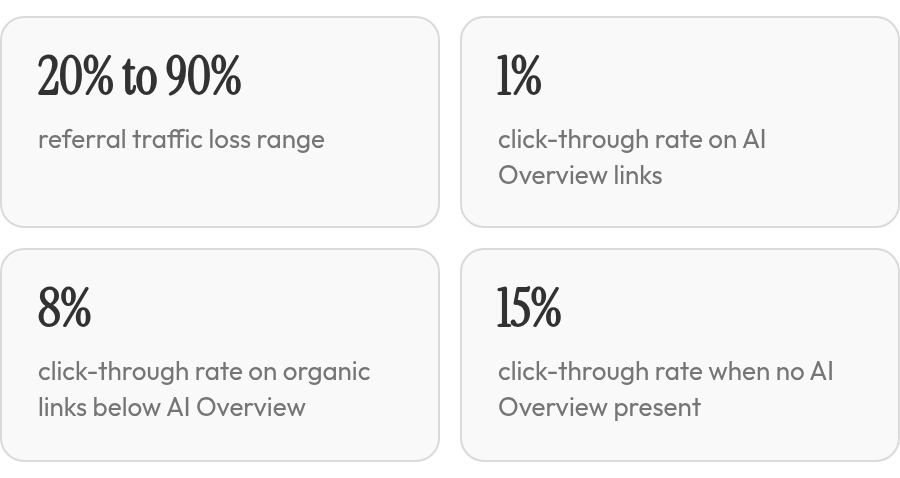
The deeper issue is that decision-stage traffic increasingly moves behind the AI answer layer. When an AI Overview appears at the top of a Google results page, just 1% of users click the links it cites, and organic links below the AIO earn clicks from roughly 8% of users — about half the 15% who click through when there's no AIO present, according to Pew Research. Readers doing purchase research are less likely to click through to your site unless they already know and trust you enough to seek you out directly.
One article, four touchpoints
Each published piece should seed a sequence, not just a ranking attempt. The article serves as the primary search and citation asset. A social post and short-form video clip condense the key finding and a concrete recommendation. An email newsletter adaptation frames the same core insight for subscribers, and the next step should be segmented by the topic that brought each reader in. Our SEO automation guide covers what the publishing workflow can automate end to end.
The newsletter is the retention layer. It keeps readers inside a direct relationship before they issue their next commercial query to an AI engine. Search gets a reader once; email brings them back.
Where to Start This Week with AnyPost.ai
The gap most teams underestimate isn't drafting the post. It's the distance between what an AI blog post generator produces and what earns reader trust over time.
Our approach starts with content generation at scale: we pull from your business context to align every article with your voice and the search intents your audience uses. That's the efficiency argument, and it's real. But Google's quality evaluation doesn't reward volume. Generic content without a genuine point of view can quietly erode the signal your site needs most.
The tell that generic AI content leaves behind
Generic AI content has a tell: it sounds as though it could have come from anyone. No first-hand experience, no specific angle, nothing a reader couldn't already get from the AI Overview at the top of the results page.
That's the problem our Persona Engine is built to address. Rather than generating from a blank slate, it works from your business context—products, messaging, audience—to match your tone and shape content around a real point of view. The tool can't supply editorial judgment by itself, but it gives that judgment a consistent foundation across the publishing workflow.
Turning every article into a distribution system
We push content across channels that reduce dependence on search clicks: newsletters, social carousels for LinkedIn and Instagram, Google Business Profile updates, and direct website publishing. The goal isn't flooding every channel. It's creating several reliable ways for readers to encounter the same useful idea and choose the format that suits them.
Automation handles the repetitive conversion work: turning each article into a newsletter, a social post, or a GBP update. Your team stays focused on the judgment calls no automated system can make for you.
FAQ
If AI search draws mostly from third-party sources, should I stop investing in my own website content?
No. Your site remains the place where you establish the full context behind your work: your methods, editorial standards, products, and point of view. Third-party references may introduce your brand to an AI system, but owned content gives readers somewhere substantive to assess that introduction.
What's the most effective way to keep readers who arrive through an AI search citation?
Give the first visit a clear next step that matches the reader's intent. Segment the follow-up by the topic that brought the reader in: a relevant newsletter invitation, a useful related guide, or a simple way to follow future updates. Make that next step a visible continuation of the page, not an interruption.
How does a persona-based content tool differ from a standard AI blog post generator for building trust?
A standard generator begins with a prompt and often produces broadly competent copy. A persona-based system starts with the publisher's existing context, including its messaging and audience, so the resulting draft has a defined editorial direction. Human review still determines whether the piece is accurate, useful, and worth publishing.