How to Automate Drafting, On-Page SEO, and Internal Linking in One Pipeline

The bottleneck isn't writing. It's the handoffs.
Content teams now face a constraint hiring can't fix. The question is no longer "how do we get more writers?" It's "how do three people ship the output of ten without quality falling apart?" That shift changes what you automate.
When automation compounds across the pipeline
The strongest ROI usually comes from automating content creation for SEO as one workflow, not from bolting AI onto disconnected manual steps. Research time improves when keyword data, SERP analysis, and topical context flow into the brief template instead of being assembled from scratch. The brief that once took an afternoon can come together quickly. Draft generation shrinks when a brand-trained model writes from that brief. On-page validation stops being a separate QA pass when optimization rules run before publish.
This isn't about swapping one ChatGPT prompt for another. The difference is architectural. One team pastes prompts into ChatGPT and edits the output. Another routes keyword opportunities through an automated brief builder, feeds the brief to a fine-tuned drafting agent with brand voice enforcement, runs on-page checks for title tags and meta description lengths, and queues internal link suggestions based on semantic similarity. The first approach saves time on each article. The second shortens cycles and catches metadata errors before they reach production.
Internal linking shows why integration matters more than tool speed. Running a standalone linking tool after publication treats links as cleanup. Embedding contextual link suggestions into drafting means writers see relevant anchor opportunities while the draft is still editable. Then reverse-linking jobs update older posts automatically when new content goes live.
Governance is what keeps the speed from turning into a liability. Teams that automate successfully usually build review gates before scaling volume. Drafts sit behind fact-checking logic that verifies claims against source material. Brand voice scoring flags drift from editorial standards. Without those controls, you produce faster garbage. With them, speed becomes a competitive advantage because quality is embedded in the pipeline instead of inspected after the fact.
The levers that actually matter
- Treat drafting, on-page checks, and link discovery as connected stages with shared inputs and review gates.
- Structure handoffs so each stage makes the next one easier, not another isolated tool.
- Keep a human in the loop for factual claims, brand standards, link relevance, and exceptions.
- Measure by publishing quality and site performance. Output volume is not the point.
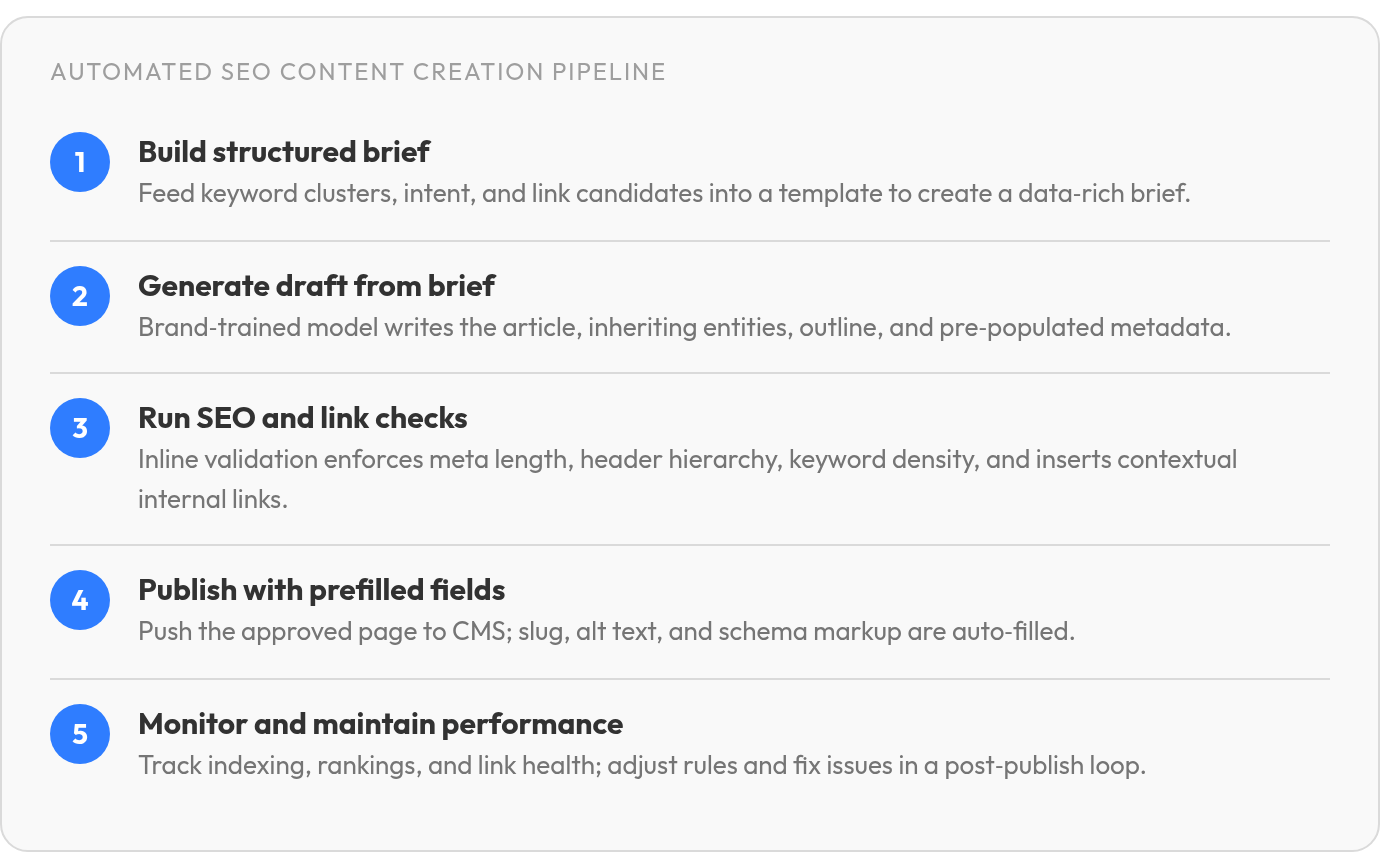
Designing a pipeline that hands off structure, not documents
The part most teams underestimate isn't writing the content. It's designing the workflow that makes every piece consistent before a word gets drafted. When you automate content creation for SEO as an integrated pipeline, the brief defines what the draft inherits. The optimization stage validates what the brief promised. The publishing stage measures whether the promise held.

What a six-stage pipeline actually hands off
A unified workflow moves structured data, not loose documents. The opportunity stage feeds a prioritized keyword cluster with search volume and difficulty into brief creation. The brief outputs a structured document: target entities, internal-link candidates from existing posts, search intent classification, and the outline. Research appends a source pack with competitor SERP analysis, factual anchors, and quote blocks. Drafting consumes all three inputs and produces a first draft with metadata fields pre-populated.
Optimization checks then run inline: meta description length, header hierarchy, keyword placement density, and readability grade. Internal-link targeting scans the draft for anchor opportunities, matches them to a topical map of existing URLs, and inserts contextual links under diversity rules that prevent repeated exact anchors. The approved page moves to publishing with pre-filled slug, alt text, and schema markup. Measurement starts immediately. Search Console can track indexing and early impressions; Google Analytics 4 records engagement and conversion events.
Why the architecture decision compounds speed gains
Time-to-publish accelerates when brief creation compresses manual research into minutes using data-populated templates. The bigger compounding effect happens when drafting, on-page validation, and internal linking stop being separate review cycles. A workflow that hands a writer a completed brief, then runs optimization checks and link insertion after draft approval, eliminates multiple handoffs. Review cycles shrink when feedback moves from email threads to centralized comments in the same platform that holds the brief and the draft.
Maintenance is the hidden tax. Custom automation stacks built on n8n or Python carry technical debt every time an API changes. All-in-one platforms absorb that overhead but constrain the logic gates you can build for quality control. We balance governance first: define the right mix of human review and machine output for E-E-A-T compliance (experience, expertise, authoritativeness, and trustworthiness), then accelerate production inside those rails. Speed follows controls, not the reverse.
Internal linking is where automation leaks value
The linking engine is where content automation usually leaks value. When drafting, on-page SEO, and internal linking run as one pipeline, every new draft needs a home in a library that may hold thousands of pages. Keyword overlap alone misses semantic bridges between "revenue architecture" and "profit scaling" that share zero literal terms but belong in the same cluster. Manual linking decisions tend to collapse exactly where volume gets interesting.
Matching pages through embeddings and similarity bounds
Embedding models such as OpenAI's text-embedding-3-small convert each page into a vector, a numeric map of meaning that lets you measure closeness with cosine similarity instead of counting shared keywords. Chunk content into segments so a long-form guide can yield multiple embeddings, each representing a distinct subtopic. That gives the engine paragraph-level context instead of forcing whole-page associations.
Similarity thresholds are the control dial. Set them high and only near-duplicate topics clear the bar. Those links read as natural extensions of the same idea. Set them low and noise enters: pages that share a peripheral term but diverge in intent, which can dilute topical focus when linked. Too many outbound links to unrelated pages signals dilution rather than depth, so bounded matching keeps the engine from flooding a draft with low-confidence suggestions. The ceiling usually needs tuning per cluster, not once at setup.
AnyPost does not ship a documented embedding-based link matcher, so treat the layer above as the pattern to configure, not a feature we hand you pre-tuned. One automation platform's workflow demonstrates how keyword-triggered search followed by vector filtering surfaces pages that both mention the target term and align semantically. That cuts false positives while preserving recall.
Safeguards that reject noise and maintain link health
Think of the guardrails as a three-layer link filter: semantic similarity scores surface candidates, authority/demand prioritization from the brief ranks destinations, and topical-map boundaries block off-cluster links. Rule-based filters catch weak suggestions before they reach the draft: a similarity floor that rejects thin matches, a cap on how many new links any one page absorbs in a pass, and a check on anchor text so the same exact phrase doesn't point at the same target repeatedly. Repeated exact anchors tend to look manufactured. Automation can't guarantee the elimination of orphan pages, since new content may intentionally stand alone during review. Matching against a vector index does surface isolated posts that lack incoming links and prioritizes them for connection.
Post-publish monitoring runs broken-link checks and orphan-page scans as part of link-health maintenance. A reverse-linking workflow updates older posts when new content is published, so authority flows bidirectionally rather than piling up on recent articles. Quattr's system incorporates newly published content into the site-wide link graph through approved linking rules, with coverage and exceptions monitored in real time. Those checks give editors a queue of structural issues to review instead of asking them to inspect the entire site manually.
Publishing, measurement, and the post-publish loop
An approved draft can move into publishing through WordPress APIs or headless CMS connectors; measurement starts once the URL is live.
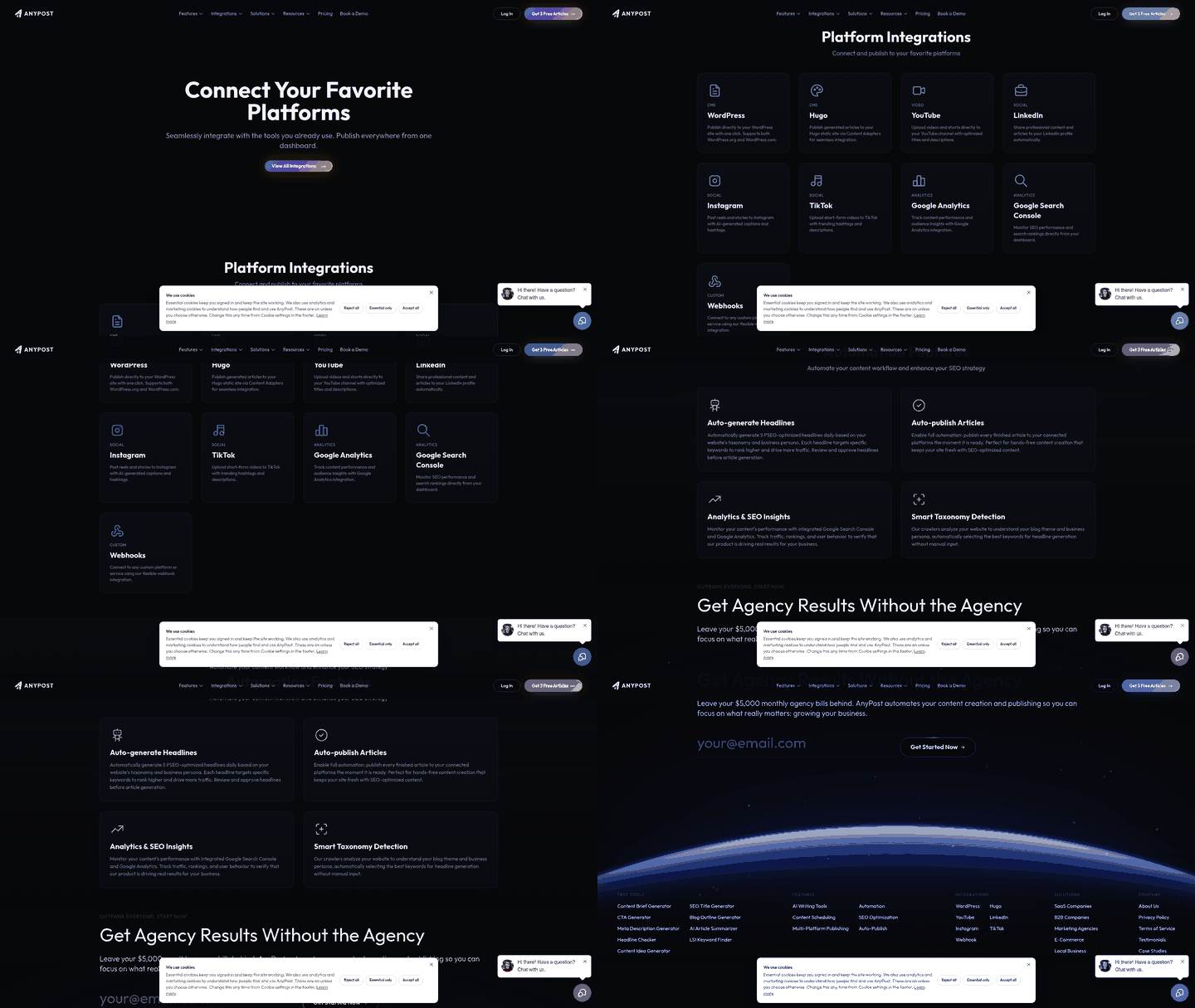
What post-publishing measurement actually catches
Search Console reports crawl status, index coverage, and Core Web Vitals (Google's page-experience metrics) for every published URL. Google Analytics 4 records user behavior, goal completions, and traffic sources. Monitoring can show when a page loses visibility or traffic patterns shift. Broken-link checks run on a schedule (weekly for high-traffic pages, monthly for the rest) and flag 404s, redirect chains, and links pointing to pages that moved or merged.
Rendering and indexing verification matters because JavaScript-heavy frameworks sometimes block search crawlers. Monitoring tools can help confirm that pages render correctly and that structured data parses as intended. If a rendering error or missing schema markup shows up, flag it before rankings suffer. Conversion tracking ties published content to revenue or lead-generation goals. When a page ranks but doesn't convert, review it for content refresh or CTA adjustment, which closes the loop between SEO performance and business outcomes.
Why ongoing review and rule maintenance matter
Publishing automation benefits from periodic validation and expert oversight. Automated suggestions can become less relevant as your site evolves. Internal link recommendations that worked for an early content cluster may need adjustment once you've published dozens of related pages. Regular review cycles help ensure that new content clusters integrate properly and that anchor-text patterns still match search intent. All-in-one platforms reduce the burden of maintaining integrations but lock you into their feature set and pricing.
When a pillar page gets a major refresh, the pipeline can scan related cluster pages and suggest reciprocal links. That keeps the architecture coherent as the site grows. This addresses a gap most competitors overlook: few ranking pages explain how to automate the detection of performance decay or the systematic refreshing of automated content once it loses rankings. Automation accelerates content creation and distribution, but human oversight prevents the most common failure mode: automated links that ignore topical context and send users to pages that share keywords but miss the user's intent. Across the full pipeline, governance determines whether efficiency gains remain useful as the site changes.
A 30-day rollout without the usual mess
The rollout works when you prepare the system before you run it at scale. That means cleaning up your existing link graph, training the drafting model on brand examples, and locking down validation checkpoints before the first automated draft moves into review.
Prepare approved inputs and configure workflow stages
Start by assembling structured briefs that feed the drafting stage with keyword clusters, search intent classification, and internal-link candidates from your existing content library. Many sites struggle with broken internal links and orphaned pages that never receive inbound connections, so your first task is auditing what already exists. Use a site crawler to map every current link, flag broken targets, and identify pages without connections. Those orphan pages either need links or pruning. Automation only magnifies what's already there, so fixing the foundation prevents scaled dysfunction later.
Then configure the brief-creation stage to output entity lists, target questions, and a prioritized list of pages that should link into the new draft. Brand guidance goes in at this stage too: approved terminology, tone examples, and topic boundaries that keep the drafting model aligned with editorial standards. Pre-populating briefs with keyword and link data removes the research bottleneck that slows human editors, letting you move from brief to draft without the back-and-forth that typically stretches timelines.
Next, set up optimization checks that run inline with drafting. Configure rules for keyword density, header hierarchy, meta-description length, and internal-link caps. Excessive internal linking can deliver diminishing returns, and relevance can decline when systems over-suggest connections. Your automation should stop suggesting links once it hits a reasonable threshold, preserving readability instead of stuffing every possible connection. Define logic gates for factual validation: if the draft references a statistic, the system should flag it for human verification. If it links to a product page that no longer exists, the workflow should halt until the broken target is fixed or replaced.
Pilot the workflow with human approval and measure technical outcomes
If pages already rank but don't convert, start with a content refresh before adding net-new posts. Launch the pipeline on a small batch of ten to twenty posts so you can catch validation failures before they multiply across hundreds of pages. Watch for over-linking, where automated suggestions connect pages that share keywords but serve different intents, causing keyword cannibalization (two pages competing for the same query). Embedding-based matching can improve the connection, but the first batch still requires editorial review to verify that the suggested destination genuinely helps the reader.
Track draft-to-publish time, rendering speed, and indexing status rather than chasing unsupported SEO-score benchmarks. Structured workflows can speed up manual research, and centralized comment systems tend to move review cycles faster than email handoffs. When total time-to-publish falls, the efficiency gain compounds across every new post. If your pilot shows longer cycles or declining suggestion relevance, roll the changes back to the previous rules, then adjust link-depth rules, tighten entity filters, or add a second human checkpoint before links go live.
Measure link health after publishing. Use Search Console to monitor indexing movement for newly linked pages. If a batch of automated links doesn't move target pages in rankings, check for over-dilution (too many outbound links from low-authority sources) or semantic mismatch. Balance automation with expert editing so the content retains authority and relevance. Scale only after the pilot passes those checks.
Frequently Asked Questions
How do you handle automated linking when you already have hundreds or thousands of existing posts?
Begin by deciding which parts of the library deserve attention first. High-traffic pages, important pillar content, and recently updated URLs are useful review groups because changes there are easier to observe. Once those groups have been checked, the same workflow can process the wider archive and route exceptions to an editor rather than forcing a full manual audit.
Why does embedding-based matching work better than keyword overlap for internal links?
Keyword matching treats shared vocabulary as evidence of relevance, even when two pages address different intents. Vector similarity provides another signal: the surrounding subject matter and meaning of a passage. That makes it possible to find a useful destination when the wording differs, while thresholds and editorial review still prevent a broad conceptual relationship from becoming an inappropriate link.
When does automated internal linking need human review to prevent relevance decay?
Review is especially important after a content cluster changes substantially. New pages can alter the best destination for an anchor, and a refreshed pillar page may make older recommendations less useful. Editors should also inspect exceptions generated by low-confidence matches and any group where anchor patterns begin to look repetitive. This keeps the rules aligned with the site’s current structure rather than preserving decisions made when the library was smaller.