How to Automate the Full Content Pipeline From Keyword Research to Rank Tracking

Quick Answers
- A language model asked for search volume hands back a guess wearing a number's clothes, and every brief, draft, and priority call downstream inherits that error.
- Filtering Search Console for high impressions and low clicks gives you a seed list that often beats a competitor gap list, because relevance is already proven.
- A writer waiting a day and a half for a handoff burns the budget the draft was supposed to save before typing begins.
- Review routed through email stretches a piece across days — comments pinned to the draft itself tend to settle it in an afternoon.
- Forty-four percent of G2 reviewers name automation as their keyword tool's main draw, while keyword research scores 87% feature satisfaction.
Automated keyword research: the list breaks before the writing does
The stage that fails first in an automated content pipeline is not the writing. It is the list.
Most teams show up with a hand-built spreadsheet and a research habit that swallows whole afternoons: open a tool, pull a list, check metrics, sort by intent, cluster, repeat. The reviewers who rate keyword tools highly tend to praise them for removing the repetitive part of that loop, not for replacing strategic judgment.
Not every operation should automate. At four posts a quarter, keep the manual pull. The plumbing costs more than it saves, and you pay the difference in pagination and dedupe logic.
Start with the queries you already own
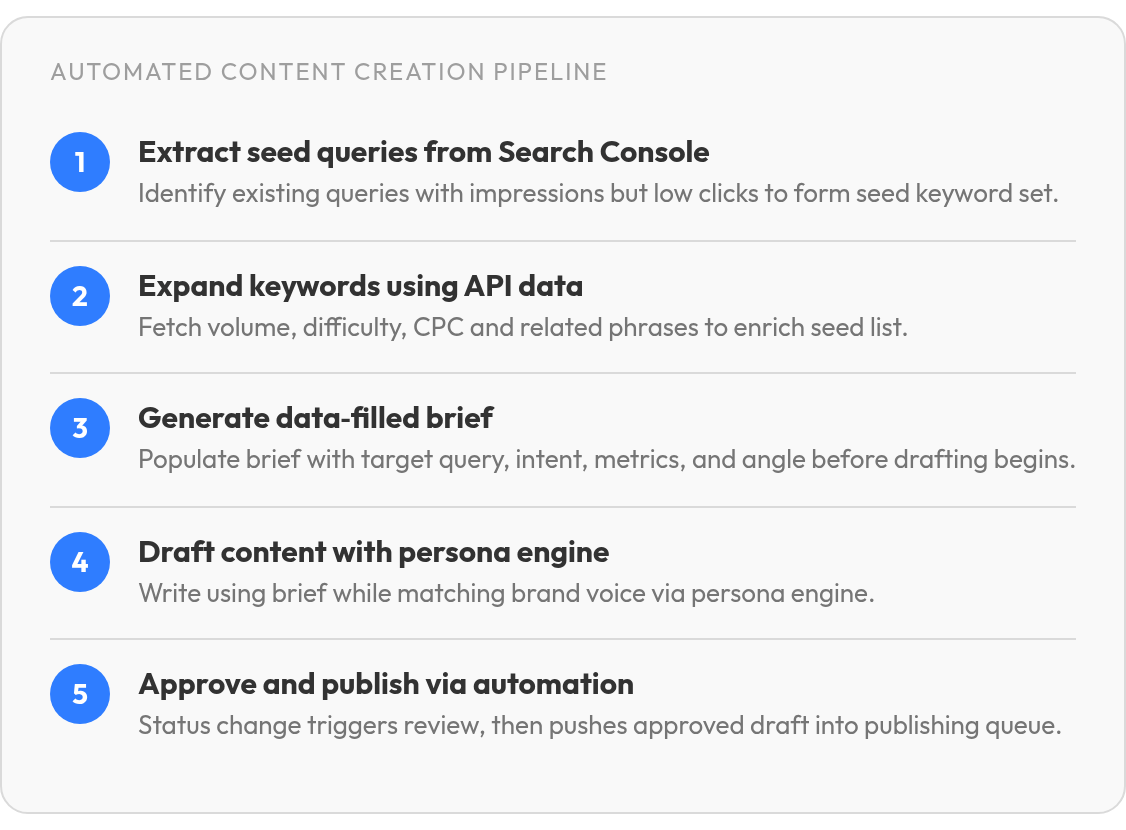
Open Search Console before you buy anything. It already holds the queries where your property has a footprint, meaning the terms Google has tested your site against in the results. That makes it a better starting point than a cold list: you're improving an existing signal instead of guessing where relevance might exist.
The early filter is simple. Find the queries that already surface your pages and fail to earn the visit. Those terms carry demand, partial fit, and a problem worth diagnosing. Sometimes the page needs a stronger title. Sometimes the intent is mismatched. Sometimes the page ranks for a query it only answers in passing.
That becomes your seed set. A keyword API can then expand each seed into related phrases, long-tail variations, and autocomplete suggestions. Market data attaches in the response.
Metrics come from the API, not the model
Volume, difficulty, and CPC belong to a live API response. Ask a model for search volume and you get a guess with a decimal point. Every later stage inherits the error: brief, draft, and priority order.
Our approach keeps those layers apart. Keyword work comes from data. The Taxonomy Researcher reads your business context and surfaces the low-difficulty, high-intent terms actually worth chasing. Drafting starts only once a brief is populated with real numbers instead of estimated ones.
Then people add what no API supplies: business relevance and intent grouping, whether informational, commercial, transactional, or navigational. Clustering logic varies by tool, so group conceptually. One cluster, one target URL, one brief.
The payoff lands at volume. A brief arrives with the target query, intent, competitive shape, and internal logic already framed. That compresses the slow parts: blank-page research, repeated SERP checks, and the back-and-forth over what the article is about.
Set rank tracking at publish. Pages that pull impressions without clicks become next cycle's seed list, and that loop is what makes a five-stage pipeline compound instead of reset.
AI briefs, drafts, and brand-voice matching: where the hours actually go
The brief, not the writing, is where automated content creation loses time. A handoff that arrives late has not saved the draft anything. It moved the delay one step upstream.
Brief creation is the stage teams under-budget when they buy automation, and it's the one that can swallow the hours the draft was supposed to return: research from scratch, SERP reading, volume checks, angle selection, outline decisions. Hand the same writer a template that arrives pre-populated and they start at the argument instead of the lookup. The saving comes from data arriving filled in. A model typing faster is a rounding error next to that.
The brief should arrive already filled in
We populate the brief from the query and intent the research stage surfaced, so the target, the angle, and the coverage the page needs sit in the document before drafting begins. Your writer's attention goes to the argument.
Watch the failure mode, though. If the drafting model invents its own search metrics instead of receiving them, the brief looks complete and is quietly wrong. That isn't cosmetic. A false metric moves priority, intent, and editorial confidence at the same time. Live data belongs upstream of the drafting layer. Brand-voice matching belongs below the template, never above it.
Voice matching runs through the Persona Engine
Hand a model a blank page and hope it picks up your cadence, and it usually will not. We match tone from your website and the channels you already publish on, so drafts sound like the business rather than like a content tool. The same voice carries across articles, carousels, and newsletters, which helps a brand sound consistent.
The tradeoff is real. A persona match gets close on cadence and vocabulary; it does not out-argue a writer who has sat in front of your customers. Where a piece has to carry a sharp point of view, keep a person on the thinking, not the typing.
Approval is a status change, not a pause
Dropping a draft into an inbox stalls it. Centralized review works better when the conversation lives on the draft. The editor resolves comments, the writer answers objections in context, and approval fires the next step without a separate chase.
Two credible arguments pull against each other here. One holds that a fully automated pipeline is the wrong goal and final quality stays human. The other says the waste is all in the waiting between steps. Both survive if human approval is modeled as a status change that triggers the next automated step. Judgment stays human. Idle time doesn't.
If one writer and one editor share a desk and talk all day, skip the comment layer. It buys you nothing there.
Publishing, programmatic pages, and backlinks: the handoff nobody budgets for
The handoff is where a pipeline stalls. A draft sits approved in a shared doc, waiting for someone to open the CMS, paste it in, set the slug, fill the meta description, and click schedule. That wait is where a content calendar quietly loses a week.
Publishing is its own stage, not a footnote to automated content creation. Approved drafts should move into a publishing queue through an integration or API, on a date set in advance. A person approves the piece. Software handles the trip to the CMS.
Dead time between stages carries the cost
Most automation advice splits the work along one fault line: hand the repetitive data chores to software, keep strategy, final quality, and relationship-based outreach with people. That is directionally right, and too broad to manage. What matters is finding where work stops moving.
The most expensive delay usually isn't the writing. It's the quiet stretch after approval, when a finished asset waits on formatting, metadata, image placement, categorization, internal links, UTM conventions, or a slot on the calendar. None of that is strategic in isolation. Together it decides whether the piece ships this week or next month.
Some platforms bundle the whole loop. We're in that category: drafts written in your voice, then published on a schedule into your existing site or out to LinkedIn, X, Instagram, TikTok, and YouTube, with the queue advancing whether or not anyone remembers to nudge it.
Under a post a week, skip scheduled publishing. Manual upload costs minutes at that volume and the integration work costs a sprint. Our five-stage breakdown covers where automation pays off sooner.

Programmatic pages batch the long tail, not the judgment
Programmatic SEO works when the pattern is real. A location page, comparison page, integration page, or industry page can share a structure because the searcher is asking a similar question with one variable changed. The template keeps the answer consistent while the data, examples, and proof points change.
That doesn't mean every keyword deserves a page. Programmatic publishing tends to fail when teams use templates to multiply thin variations instead of answering distinct intent. The question isn't "can we generate this page?" It's "would a searcher notice if this page didn't exist?"
A workable workflow separates the reusable parts from the judgment calls. Page type, metadata rules, internal-link pattern, schema fields, and publishing cadence can be automated. Positioning, source data, offer fit, and the threshold for whether a page should exist at all stay with editorial.
Automated backlinking deserves the same split. Prospect collection, CRM updates, reminders, and status tracking are reasonable software jobs. Relationship-based outreach, negotiation, and any message that depends on trust stay human. The goal is removing administrative drag, not turning outreach into a mail merge that damages the brand.
Repurposing and rank tracking: what a published post is actually worth
The publish button is the least informative moment in the pipeline. Automated content creation gets counted there, in posts shipped and words delivered, and that number says nothing about whether the work did anything.
Distribution is where the loop closes. The pattern is extraction, not reinvention: one finished article becomes a handful of social snippets, a thread, a newsletter blurb, and a short-form script outline pulled from the same argument. Templates carry the shape, and a person reads the output before it ships. We do not claim to clone a founder's voice, and you should be skeptical of anyone who does.
How do you turn one article into five?
Take the argument, not the sentences. Snippets work when each one stands alone with a claim and a reason. A thread works when it walks the steps in order. A newsletter blurb works when it earns the click without spoiling the answer.
The repurposing layer should hold the core point while changing the unit of attention. A blog post can afford setup. A social post needs a sharper first line. A newsletter needs context for an audience that may not be searching right now. A short-form video outline needs a spoken hook and a sequence someone can follow without skimming.
The scheduling half is easy. In a recent tool comparison, at least one entry automates keyword research, writing, and publishing on a daily or weekly rhythm. That is the boring part. The interesting part is what the schedule hands back to you.
What should you track once it ships?
Track the signals that change the next decision. Rankings matter, but as one layer. Impressions show whether Google is testing the page. Clicks show whether the title and meta promise are earning attention. Engagement and conversions show whether the visit matched the offer.
The loop is diagnostic. Rankings with weak clicks can point to a better title, a stronger intent match, or a clearer meta description. Traffic with no conversion can point to a sharper CTA or a different internal link path. Impressions with no movement can point to more topical support or a stronger answer to the query.
Real-time rank tracking is a routing system, not a scoreboard. It tells you which page to refresh, which cluster needs another supporting asset, which query deserves its own brief, and which social angle is worth reusing because the search audience already validated the topic.
Questions People Ask
Do I still need a paid keyword tool if my site already has Search Console data?
Usually, yes, if you want to build a repeatable pipeline rather than run a one-off audit. Search Console is excellent for finding existing demand around your own domain, but it is not built to be a full keyword discovery engine. A paid tool or API becomes useful when you need expansion, normalization, sorting, and repeatable exports that can feed briefs without manual copying.
Does automating briefs and drafts mean we can drop the human writer?
No. It changes what the writer spends time on. Automation can assemble the inputs, enforce the template, draft in the right general voice, and move the asset through the workflow. The writer still owns the argument, the judgment calls, the examples, and the final decision about whether the piece is worth publishing.
Is a full pipeline worth setting up for a solo operator or a low-volume blog?
Only in pieces. A solo operator usually gets more value from automating the repetitive bottleneck they feel every week than from wiring the whole system at once. That might mean keyword exports, draft templates, scheduling, or rank alerts. If volume is low, keep the workflow light and add automation only where the same task keeps recurring.
