How to Fix the Handoffs Between Research, Generation, Publishing, and Analytics

Quick Summary
The part most teams underestimate isn't writing the content. It's the handoffs between each stage that quietly swallow whole afternoons and stretch timelines far beyond what the work itself requires.
When we look at how SMB content teams actually operate, the friction lives in the seams between research, generation, publishing, analytics, and iteration. AI content automation can handle each stage reasonably well. The breakdowns happen when one stage's output has to become another stage's input, and nobody owns that transition.
| Stage | Handoff | Friction | Fix | Benchmark |
|---|---|---|---|---|
| Research | Generation | Findings scattered across tabs; someone re-searches what a teammate already found | Shared brief that generation pulls from automatically | Fragmented workflows waste valuable time as teams duplicate work across disconnected systems |
| Generation | Publishing | Drafts stall in review; formatting breaks on CMS import | Direct publish with editorial checkpoints built in | Each tool switch taxes attention and momentum, compounding mental fatigue across the day |
| Publishing | Analytics | No link between what shipped and how it performs | Unified view surfacing performance against published content | Fragmented teams miss market windows while faster workflows capture attention first |
| Analytics | Iteration | Insights sit in a separate tool from where content gets created | Feedback loop routing signals back to research | Each app switch costs attention and momentum |
| Iteration | Research | Lessons stay in one person's head, never informing the next cycle | Structured handoff where findings seed the next brief | Repeated gaps compound invisible costs over time |
Two things to set expectations:
- The biggest wins come from fixing handoffs, not upgrading any single stage. Your content can be solid at every step and still arrive late because the seams between stages are broken.
- Analytics-informed refinement only works when reporting feeds back into research without a manual relay. If your analytics live in a separate tool from where content gets created, you pay the context-switch tax on every iteration.
Key Takeaways
- Content teams lose more time to broken handoffs between stages than to the content work itself, since nobody owns those transitions.
- The publishing-to-analytics gap creates a recurring manual burden: copying metrics from several tools into a spreadsheet no one maintains consistently.
- Most teams treat analytics as a monthly reporting task rather than a continuous input that shapes what comes next.
- Consolidating publishing and distribution into one step eliminates the copy-paste handoff across six platforms including LinkedIn, X, Instagram, and TikTok.
- Real-time dashboards can surface pageviews and click-through rates within days rather than at the next planning cycle.
Why the Publishing-to-Analytics Handoff Is the Hidden Tax
Most content teams treat publishing as the finish line. It isn't. The moment content goes live, a second shift begins: pulling performance data, cross-referencing it against what you published, and figuring out what to do next. For teams using AI content automation to speed up the front end of the workflow, the back end tends to be the part that never got automated.
The gap shows up as a predictable daily tax. Someone opens four browser tabs: the CMS, the analytics dashboard, a social scheduler, and a spreadsheet they're maintaining by hand. They manually copy session counts, click-through rates, and scroll depth into a doc, then try to connect those numbers back to the content decisions that drove them. An afternoon disappears.
What makes this painful isn't the data itself. It's the absence of a closed loop. When research, writing, and publishing stay in one place but analytics live somewhere else, the team can't act on what they learn fast enough to matter. By the time someone notices a post from three weeks ago is picking up traction, the editorial calendar has moved on, and the follow-up content that would have captured that momentum never materializes.
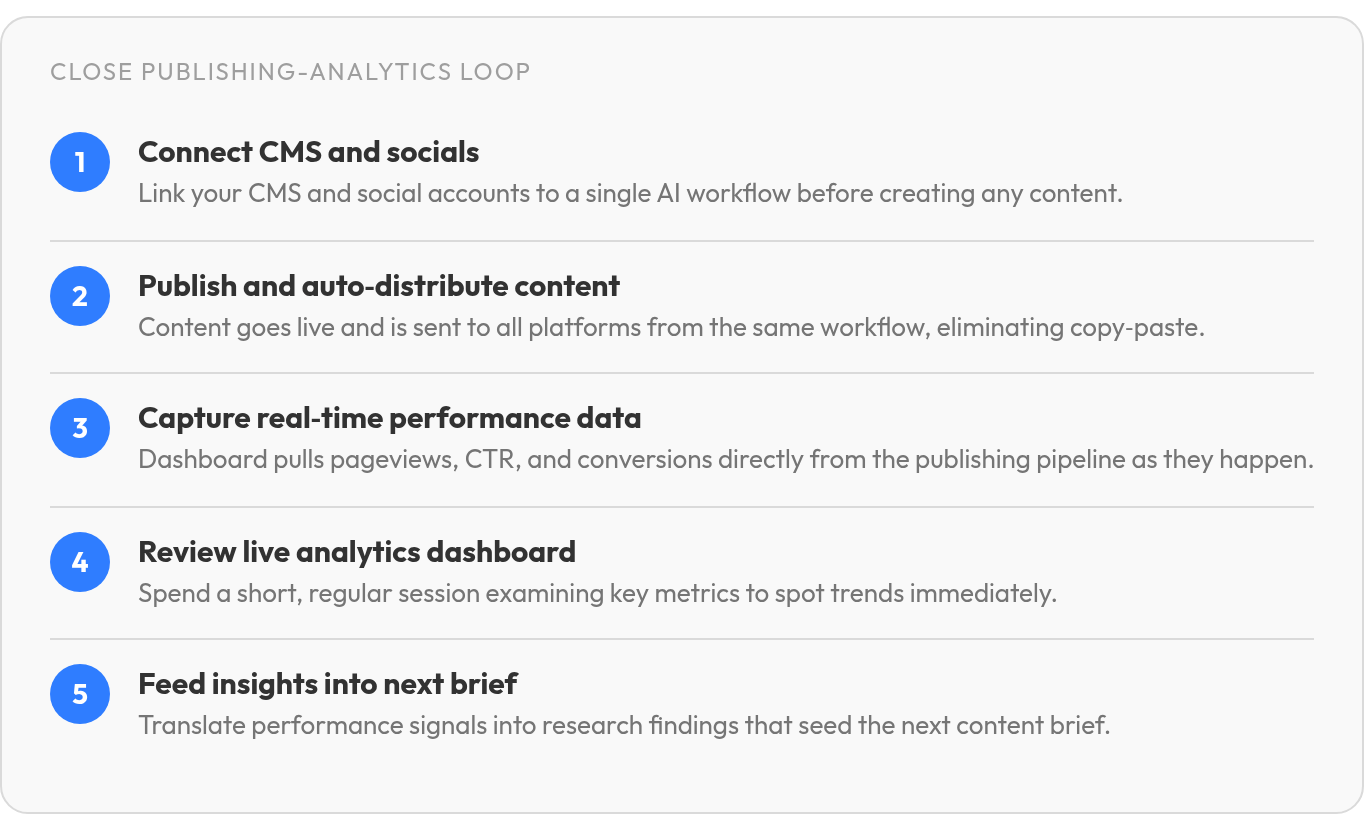
The most common misconception is that analytics are a monthly reporting task, not a continuous input. Teams check performance after the fact, use it to justify decisions that already happened, and miss the feedback signal that should be shaping what comes next. That's the hidden tax — not just the hours spent hunting data, but the compounding cost of decisions made without it. We've mapped out how this pattern repeats across five critical handoff points for teams running at scale.
How AnyPost.ai Closes the Publishing Loop
Publishing without a feedback loop is a one-way street. Most AI content automation setups treat "publish" as the endpoint, which leaves the most actionable half of the data sitting outside the workflow where nobody consistently checks it.
Our approach flips that. When a piece goes live, distribution is already handled. LinkedIn, X, Instagram, TikTok, YouTube, and your website all receive the content from the same workflow that generated it. There's no copy-paste handoff to a separate scheduler, no manual reformatting per platform. The publish step and the distribution step are the same step.
What the Live Dashboard Actually Changes
The dashboard surfaces pageviews, click-through rates, and conversion signals as they accumulate, not in a weekly export. That immediacy matters less for vanity and more for decision speed. When a piece starts outperforming on a keyword you expected to take months to move, you know within days, not at the next planning cycle.
The biggest time savings often come from the reverse-engineering problem. Most teams end up hunting through a separate analytics tool, then a separate content calendar, to figure out what to write next based on what's already working. Keeping performance data inside the same platform as content creation cuts that context-switching considerably.
One important boundary: attribution signals are directional, not exact. Consent frameworks and cross-device behavior mean you're often reading trends rather than precise counts. That's still far more useful than a monthly report you're reviewing three weeks after the fact.
Turning Performance Data Into Your Next Brief
Once the numbers are in front of you, the real question is whether your team has a defined process to act on them — or whether the data sits there looking informative until someone finds time to manually interpret it.
In most AI content automation setups, the loop technically closes on paper, but translating performance into a usable next brief still requires someone to do the interpretive work by hand. Real-time analytics tracking helps by putting current evidence in front of the person making the next content decision, rather than leaving that decision dependent on a stale export.
How Real-Time Analytics Close the Research Loop
What real-time tracking gives you is the ability to see patterns as they form, not weeks after the fact. High dwell time with low CTR tends to signal an engaged audience that the headline or meta description isn't pulling in — so the next iteration focuses on framing rather than depth. Low dwell combined with low conversion often points to an audience mismatch at the keyword level, which feeds back into persona and targeting.
Programmatic SEO adds another lever here. We can generate large volumes of targeted pages to capture long-tail search traffic, which means the topics gaining traction in your analytics can inform where you direct that page-building effort next.
How the Persona Engine Keeps Your Voice Consistent
The Persona Engine's job is tone matching: making sure every article sounds like you wrote it, whether it's a long-form blog post or a short social carousel. We capture your brand's DNA during setup, so the voice stays consistent across every platform we publish to. That consistency matters because a fragmented voice across channels tends to erode trust faster than any single weak piece.
Skip this loop if your content volume is genuinely low. At that scale, the available performance signal may not justify building an automated interpretation process — a direct human review can be more efficient.
What Changes First When You Consolidate
A five-person marketing team at a B2B SaaS company was running keyword research in one tool, drafting in another, scheduling through a third, and tracking results in a spreadsheet nobody opened consistently. Every published piece required several manual handoffs before performance data reached anyone who could act on it.
When that team consolidated into a single AI content automation workflow, the publishing-to-analytics handoff effectively disappeared. The platform already held the content data, so reporting pulled from the same source without anyone copying numbers between tools.
Three Wins That Show Up First
In our experience, teams that consolidate tend to see three changes early.
Reporting accelerates because the dashboard reads from the same pipeline that published the content, not a separate export.
SEO signals stop falling through the cracks because keyword performance data sits next to the draft that produced it, not in a tab someone forgot to check.
Brand voice stays consistent because one workflow controls tone across every platform rather than letting each tool's defaults drift apart.
Initial setup takes longer than adding another standalone tool. You're configuring the full pipeline once instead of patching handoffs repeatedly. For teams publishing fewer than four pieces a week, that upfront investment may not pay back quickly enough.
Quick-start checklist:
- Connect your CMS and social accounts in one workflow before generating any content
- Confirm your real-time analytics connection so performance data from each published piece flows back into the same dashboard that created it
- Configure dashboard widgets for the three metrics you actually check weekly, not every available chart
- Set a recurring 15-minute review of the live dashboard before drafting new briefs
That final review is where data starts shaping what you write next. No spreadsheet bridge needed — the workflow already connects the evidence to the drafting process.
Quick Questions, Straight Answers
1. Does fixing handoffs still matter if our team only publishes a piece or two a month?
At low volume, full pipeline consolidation may not be the right first investment. Start by documenting who owns each transition and where the resulting files, decisions, and approvals live. Once the publishing rhythm produces a steadier stream of evidence, automation becomes easier to justify.
2. If we upgrade to a better AI writing tool, won't that solve most of the workflow pain?
Upgrading a single stage doesn't repair the connections around it. A stronger writing tool may improve drafts, but it will not automatically carry a research brief into the CMS or connect a published URL with the performance signals needed for the next assignment. The missing ownership and transfer rules remain.
3. What does treating analytics as a "continuous input" actually look like day to day?
It means reserving a place in the briefing process for newly observed performance patterns. A strategist might use an unusually strong search response to adjust a related topic, or use weak engagement to revisit the audience framing before commissioning another piece. The important change is that the signal enters planning while it can still influence the next decision.
4. The article mentions attribution signals are "directional, not exact" — what does that limitation mean for real content decisions?
Use attribution to compare patterns and prioritize experiments, not to claim that one asset caused every observed action. Consent frameworks and cross-device behavior can leave gaps in the trail. Teams can still make useful choices about headlines, audiences, topics, and distribution without treating the dashboard as a perfect accounting system.
5. With five handoff points to fix, where should a small team actually start?
Begin with the seam that creates the most repeated re-entry of information. For many teams, that is the connection between what gets published and what is learned afterward, because its failure affects every later iteration. Map the owner, source of truth, required fields, and next action for that transition before attempting to automate the entire chain.