How to Measure AI Traffic Quality for Real ROI

Before we get into it, the short version:
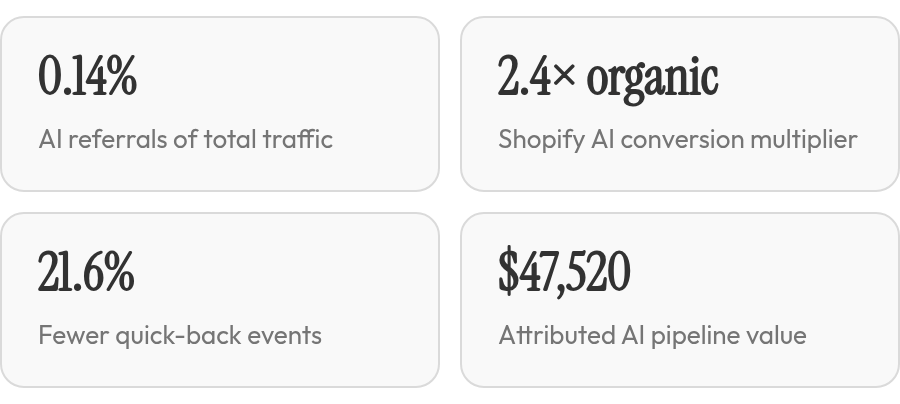
- AI referrals represented just 0.14% of total traffic in recent studies — you're measuring early-stage visibility work, not a mature acquisition channel.
- Reported AI traffic often includes bot crawlers and citation discovery, not just human sessions. Separate them before you report anything.
- High conversion rates can hide revenue problems. AI sessions may convert frequently while generating lower revenue per visit than organic search.
- Category differences matter more than channel averages. Shopify watches convert at 2.4× organic; apparel reaches only 1.6× organic rates.
- Published conversion benchmarks vary from 1.26× to 4.4× organic depending on vertical and study methodology.
- GA4 misclassifies substantial AI traffic. Google AI Overviews get tagged as organic search. Referrer-less clicks land in direct traffic.
- Default GA4 auto-tagging captures only narrow platform coverage. You need custom channel groups for major AI assistants.
Related Video
Watch: Episode 4: "How to Measure AI Search ROI and Citation Share" by beket ai AEO, GEO, SEO and AI Visibility
Quick Summary
The part most teams miss when automating content for SEO isn't whether AI platforms cite their work. It's whether those citations translate into qualified traffic that converts. A mention in ChatGPT or Perplexity means little if the visitor bounces, arrives for the wrong intent, or never moves into a measurable business outcome. This framework gives you a single view of AI traffic health, from initial referral through final revenue.
| Metric | What It Measures | How to Track It | Effort | Status Indicator |
|---|---|---|---|---|
| AI Referral Sessions | Human visits from ChatGPT, Perplexity, Claude, Gemini | GA4 custom channel group or "AI Assistant" filter | 🟢 Low | ↗️ Track weekly trend |
| AI/SEO Visibility | Citations, mentions, prompt coverage across AI platforms | Dedicated AI visibility tool (Semrush, Ahrefs, Profound) | 🟡 Medium | Monitor share vs. Competitors |
| Engagement Quality | Time on site, pages per session, scroll depth, quick-backs | GA4 engagement metrics filtered by AI source | 🟢 Low | Compare to organic baseline |
| Conversion Rate | Signups, demo requests, purchases from AI traffic | GA4 key events by acquisition source | 🟢 Low | Benchmark against your organic channel |
| Revenue/Cost per Acquisition | Actual dollars generated or pipeline value per AI visit | CRM integration + GA4 ecommerce tracking | 🔴 High | Calculate ROI only when attribution is solid |
Why measuring AI traffic quality matters
When you automate content creation for SEO, the temptation is to track how many AI platform visits you generate. That number tells you almost nothing about business impact. AI traffic can perform well in some categories, but volume, revenue per visit, and category differences determine whether it creates real value.
Volume alone hides the real picture
AI referrals still represent a small fraction of most sites' traffic. Organic search continues to drive the bulk of site visits, while AI-referred traffic remains in early adoption. Chasing AI visit counts without measuring what those visitors do creates a visibility metric that looks impressive in a deck but produces no pipeline.
That's especially true for automated content programs. A page can earn citations inside AI answers and still send only a handful of human visitors. Another page may send modest traffic but attract users much closer to a buying decision. The practical measurement question isn't "Did AI mention us?" It's "Did the mention bring the right person to the right page at the right point in the journey?"
Conversion rate doesn't always mean revenue
The published benchmarks are useful mainly because they show how wide the performance range can be. Some studies report AI visitors outperforming organic visitors for certain digital marketing topics. Other analyses show a more modest lift. Ecommerce data tells the same story — product category can change the outcome dramatically, even inside the same platform.
More importantly, conversion rate and revenue per session move separately. A site can see strong AI conversion rates, while revenue per visit lags behind organic search. A completed purchase is one signal. What the customer spent is another. For B2B teams, the same logic applies to lead quality. A form fill from an AI referral may look like a win until sales discovers the company is too small, outside the service area, or not ready to buy.
Identify and tag AI-generated traffic
The challenge with AI traffic isn't just spotting it in your dashboard. A meaningful chunk arrives without clean source data. Some AI-influenced visits inherit search attribution. Some arrive without a usable referring domain at all. When you're running automated content for SEO, those misclassifications hide whether your pages are actually pulling qualified AI visitors or just accumulating background noise.
Set up source grouping before you lose the signal
GA4 can identify some AI assistant traffic, but the default setup won't give most teams a complete view. Build a custom channel group using regex patterns for chatgpt.com, openai.com, perplexity.ai, claude.ai, and gemini.google.com as referrers. That catches identifiable AI traffic in one filter.
The harder part is flagging your own automated content so you can compare AI traffic on those pages against organic. Use Google Tag Manager or a data-layer variable to fire a custom dimension on every automated page: ai_generated=true, persona=, content_batch=. That page-level tag lets you segment by content type later, which matters when conversion rates vary across target audiences and topics.
Pair those tags with a consistent UTM convention. Include source, medium, campaign, and content-type fields for every automated post. When an AI platform cites your page and a visitor clicks through, the UTM can preserve campaign context even when the referrer is incomplete.
Score quality with persona matching and engagement signals
The engagement numbers from AI referrals often look strong: longer sessions, fewer quick-backs. But those signals only matter if the visitor matches what you're trying to sell. When you start pulling AI traffic, you need an internal quality score that combines audience fit, engagement depth, and conversion behavior instead of treating every AI session as equal value.
Build the persona-match layer first
Start by tagging each AI referral with a persona or intent signal based on the landing page they hit. If your content automation targets three buyer types, comparison shoppers, implementation teams, and budget holders, and someone lands on a product-detail page from ChatGPT, that session gets tagged as "comparison." The rubric isn't perfect, but it gives you a working filter before you measure anything else. Microsoft Clarity data shows AI referrals produce 21.6% fewer quick-back events and longer sessions, but that pattern holds across wildly different buyer journeys, so persona fit narrows the lens before engagement metrics mean anything.
Pull session quality from GA4 using engaged sessions, scroll depth, and downstream events like demo requests or file downloads. Layer in quick-back rates from Clarity if you're tracking those. The score formula can stay simple: persona match (0-3 points) + engagement quality (0-3 points) + conversion depth (0-4 points). A session that lands on the right page, scrolls past 50%, and triggers a lead event scores 8-10. One that bounces after 12 seconds scores 1-2. Set your quality floor based on historical session data from your top-performing organic search traffic, then track how AI sessions compare week-over-week. If your best organic sessions average a score of 6.5, flag any AI content pulling below 5.0 for immediate review — that gap signals either mismatched targeting or thin content that reads well to LLMs but fails actual visitors.
Calculate real ROI from AI traffic
The conversion rate story breaks when revenue enters the picture. Industry impact studies make one point clear: AI referral value depends heavily on vertical, content intent, and the conversion event being measured. A visitor who converts isn't automatically a profitable visitor, especially when you're pulling traffic across multiple intent stages.
That gap explains why the ROI calculation starts with attributed revenue rather than conversion counts. Take your monthly AI-referred conversions, multiply by your actual average deal value or order size, then subtract every cost tied to earning that traffic: content-automation subscription fees, production hours, measurement tools, and any platform-specific optimization work. Divide the result by total spend. The formula is straightforward: (attributed AI revenue - all AI-related costs) / total costs.
Build the formula using your own numbers
Skip the generic SaaS benchmarks. Use your lead-to-revenue rate, close rate, and actual deal size instead. If your team closes 18% of qualified leads at an average contract value of $12,000, and AI referrals generated 22 qualified leads last quarter, that is $47,520 in attributed pipeline. Compare that figure against what you spent to earn it.
The best signal comes from environments where attribution is connected end-to-end, not estimated. When you can trace an AI referral through your funnel to a closed deal, you know what that channel is actually worth — and whether the cost of earning more visibility makes sense for your business.
Compare first-touch and assisted attribution
AI content often contributes to a journey without closing it. A prospect reads an AI-cited comparison page, returns via branded search, then converts through a demo request. First-touch attribution credits the AI referral. Assisted-touch shows every channel that appeared before conversion. When you're running automated content, assisted attribution reveals whether your pages educated buyers who converted later through other channels — a signal that justifies continued investment even when direct AI referrals stay small.
This is also where revenue reporting becomes clearer. Direct attribution may undervalue AI-cited content if visitors use it for early research and return later through another channel. Assisted attribution prevents you from cutting useful content simply because it does not always get the final click.
Optimize and iterate the AI traffic engine
The gap between measuring AI traffic and improving it is where most teams end up stuck with a dashboard that updates weekly but no clear decision framework. You see AI referrals climbing, engagement holding steady, and conversion rates that match or beat organic. Then what? The optimization layer determines whether those numbers compound into revenue or stay flat while costs rise.
Set a practical review cadence
Check tagging accuracy and referrer classifications weekly. Direct traffic spikes, sudden drops in AI session counts, or UTM parameters that stop firing all signal tagging problems that corrupt your month-end conversion analysis.
Monthly reviews focus on what drives decisions: conversion rate by persona, revenue per AI session compared to organic, topic-level engagement quality, and whether your AI visibility coverage expanded or contracted. Track which content clusters generate repeat AI citations and which pages get consistent traffic but produce zero conversions. This reveals where your content answers the question but fails to move visitors toward a decision.
Use the monthly review to decide what to refresh, consolidate, or retire. Pages with strong AI visibility but weak engagement may need clearer opening answers, better internal links, or a stronger match between the AI-cited section and the page's actual offer. Pages with low visibility but strong conversion quality may deserve more supporting content, schema cleanup, or inclusion in comparison-style assets that AI systems tend to surface.
Test one variable at a time
A/B testing AI-generated headlines or meta descriptions works when you isolate the change. Pick one page cluster getting consistent AI referrals. Write two headline variants if your platform supports it. Measure qualified engagement and conversions for at least 14 days. Roll the winner forward. Test answer format adjustments separately: compare a standard paragraph introduction against a direct answer followed by supporting detail.
Keep tests tied to one hypothesis. If you change the headline, introduction, internal links, and call to action at the same time, you may improve the page but learn nothing about which element changed visitor behavior. A slower test plan creates cleaner decisions and helps your AI traffic engine improve without turning your reporting into guesswork.
FAQ
1. Should I wait to measure AI traffic ROI until my volume reaches a specific threshold?
Start tracking as soon as AI referrals appear, but wait until you have enough connected revenue outcomes before making budget decisions from ROI. Early data is still useful for spotting attribution gaps, persona mismatch, and engagement patterns; it just should not be treated as statistically stable.
2. What should I do if my AI traffic shows strong engagement but lower revenue per session than organic?
Audit which buyer personas your AI-cited content attracts versus organic. Strong engagement can indicate research-stage visitors who need nurturing. Use assisted attribution to see whether those sessions influence later conversions through branded search, email, retargeting, or direct return visits.
3. How do I separate actual human visits from bot crawlers when measuring AI referrals?
Build your AI reporting around engaged sessions rather than raw hits. Require signs of human behavior-such as meaningful time on page, a scroll, a click, or another interaction-before including a visit in conversion or revenue analysis. This keeps crawler activity out of the same bucket as real prospects.