How to Test AI SEO Content Generators on One Keyword Before Paying


The short version, without the demo call:
- Ahrefs data puts the share of pages earning zero organic traffic near 96%. Publishing more content mostly enlarges that unclicked majority.
- One commercial keyword, run through a generator once, tells you more about editing overhead than any feature comparison table.
- Test keywords need commercial-investigation intent and a tight four-to-seven-word scope. Broad head terms produce drafts that sound authoritative and commit to nothing.
- Trial limits are test-design problems, not disclosure fine print: one brand-voice tool wants a card before it shows output, another caps usage hard enough that you can't retry.
- A freelance quote for 1,000 words on the same brief gives you the per-article cost and deadline every AI draft gets measured against.
- Freeze your rubric weights before the first draft, because unfixed criteria let reviewer judgment drift and the comparison stops being auditable.
- Seasonal and trend-driven keywords look healthy on volume checks while representing demand a year-round content plan can't count on.
The part teams skip: one keyword, run once, graded hard
Load a keyword, hit generate, publish daily, watch traffic arrive. That's the loop nearly every AI SEO content generator sells, and it rarely survives contact with a site that already has pages on it.
Ahrefs found around 96% of pages get zero organic traffic from Google. Every post that fails to clear the indexing bar adds to that pile, which makes "publish more" a way to spend budget loudly and call it a strategy.
The one-keyword test: run a single commercial keyword through a generator once, then grade the draft on intent, accuracy, brand voice, and editing time before you pay for a plan.
Choose the keyword the way a buyer would. Real purchase intent, typed by someone close to spending money. Then judge what comes back. Does the draft land on the query, or wander into a neighbouring topic nobody searched? Does it hold your register, or flatten into the cheerful generalities every model defaults to? Can a reviewer fix the facts in twenty minutes, or does the piece need rebuilding from the brief up? We keep a short set of screening questions for exactly this stage.
One run measures three things at once: risk, editing overhead, and the only ROI signal that means anything before you sign a contract. A feature table measures none of them.
Where we push back on the volume argument is simple. Publishing more pays off only when each page clears the indexing bar. Otherwise you're paying to widen the 96%.
The keyword you pick decides what the test proves
Pick a weak keyword and every conclusion downstream of it is wrong. What we look for is a term that forces the tool to show two things in the same draft: decision-stage information and genuine conversion awareness. As a secondary read, it shows whether the generator pushes back with related terms or just runs with exactly what you handed it.
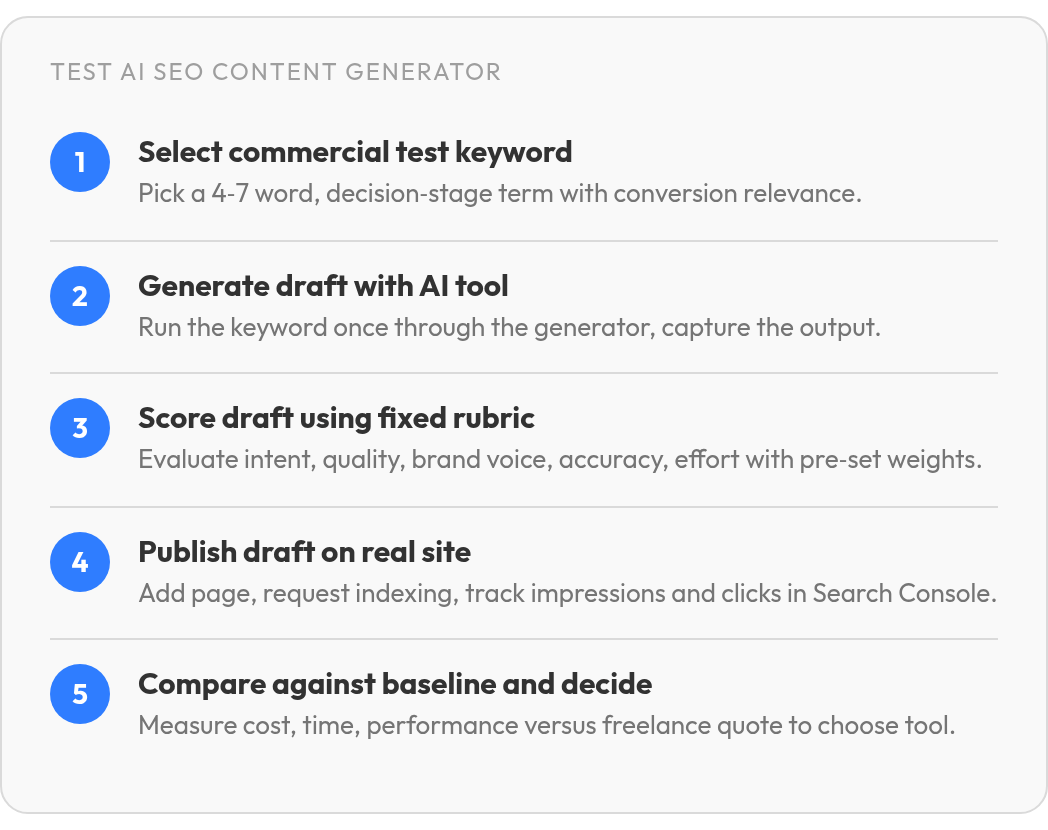
Three qualities separate a usable test keyword from a misleading one. It needs commercial-investigation intent, meaning the searcher is comparing options or close to a decision rather than learning a concept. "Best invoicing software for freelancers" qualifies. "What is invoicing" doesn't.
It also needs a connection to something you actually sell, so the draft has to handle the information job and the conversion job together. And the scope has to stay tight. Mid-tail phrases of four to seven words work well. A broad head term gives the generator room to wander, and it will use all of it.
The keywords to avoid teach as much as the good ones. Broad head terms produce drafts that sound authoritative but commit to nothing. High-volume terms without clear intent hand the model too much latitude. Any keyword whose intent your product can't satisfy gets you a technically clean draft that would never convert.
One caveat we flag every time: seasonal keywords and trend-driven phrases look healthy in a volume check but represent demand you can't staff a year-round plan against. Brand-adjacent terms distort competition in both directions. Run the test on a keyword with steady, representative demand.
Build a fair test bed before anyone generates a word
The part most teams underestimate isn't the writing. It's the setup. Run trials with no baseline and you're grading outputs against nothing.
Setting up the trials
Sign up across the documented options, and read the limits as test-design constraints rather than fine print.
One brand-voice-focused tool asks for a credit card before you see anything. An SEO-blog-focused tool may cap usage tightly enough that you can't retry the same keyword if the first run misses. A programmatic-SEO-focused tool can restrict trial access in ways that make meaningful scale impossible to test. An end-to-end research-and-draft tool offers a free tier with no card required. A general AI assistant is free, but its output is only as good as your prompt.
A tight output cap means you can't push the tool on a genuinely demanding keyword. Video-centric tools tend to add watermarks and credit restrictions before you've seen the thing operating anywhere near its ceiling. What looks like a trial is often a product demo in disguise, built to surface strengths once and move you toward payment before you've tested anything hard.
The manual comparator that anchors your numbers
Get a real quote from a freelance writer: 1,000 words on your keyword, the same brief you'll hand the AI tools, with a firm turnaround. Freelance and agency-scale content costs can climb faster than most teams expect, so what you need out of that quote is the per-article rate and a committed deadline. Pair it with a separate SEO optimization tool to replicate a human-first workflow. That combination is your cost, time, and publishing-effort baseline, and everything the tools produce gets measured against it.
Score the draft on five dimensions, not on feel
Scoring by feel is how you end up with a comparison nobody can audit. The research on rubric-based text evaluation makes a similar point: when judges work without fixed criteria, scores drift between reviewers and stop being traceable. Write the rubric down before you open the first draft.
Set the weights before you score anything and hold them for every tool in the test. A workable starting point is to treat SEO fundamentals and content quality as the heaviest dimensions, since they decide whether the draft is usable at all, then give brand voice and customization real weight, because that's where drafts quietly fall apart, and leave pricing as the lightest input. The exact percentages matter less than committing to them in advance.
How to score each dimension
Intent match (SEO fundamentals, heaviest weight). Score 1 if the draft answers a different query than the one you tested. Score 5 if it matches decision-stage intent and delivers specific, useful detail instead of word-count filler.
Content quality (heaviest weight). Score 1 for copy interchangeable with any top-ranking page on that keyword. Score 5 for a draft a reader would bookmark: specific, differentiated, skimmable.
Brand voice (heavy weight). Stack it against two approved writing samples and a short style brief. Score 1 if a colleague pegs it as AI output immediately. Score 5 if it holds your register with no editing. This dimension deserves the explicit weight, because in our experience it's where drafts fail quietly.
Factual accuracy (a gate, not a scored dimension). Verify names, numbers, and product claims before you score anything else. One published factual error voids the whole test.
Publishing effort (workflow, moderate weight). Time the actual export, cleanup, metadata, and CMS import. A draft that takes 75 minutes to make publishable isn't a 15-minute draft.
Publish it somewhere real, then read two reports
Publishing is where a tidy test gets messy. Put the draft on the page it would actually live on, inside your real site structure, not a throwaway subdomain nobody links to. Internal links from pages that already pull traffic matter more than any plugin button. Request indexing through Search Console's URL Inspection tool, and skip the shortcut some WordPress setups advertise; it tells you nothing about how Google will treat the page later.
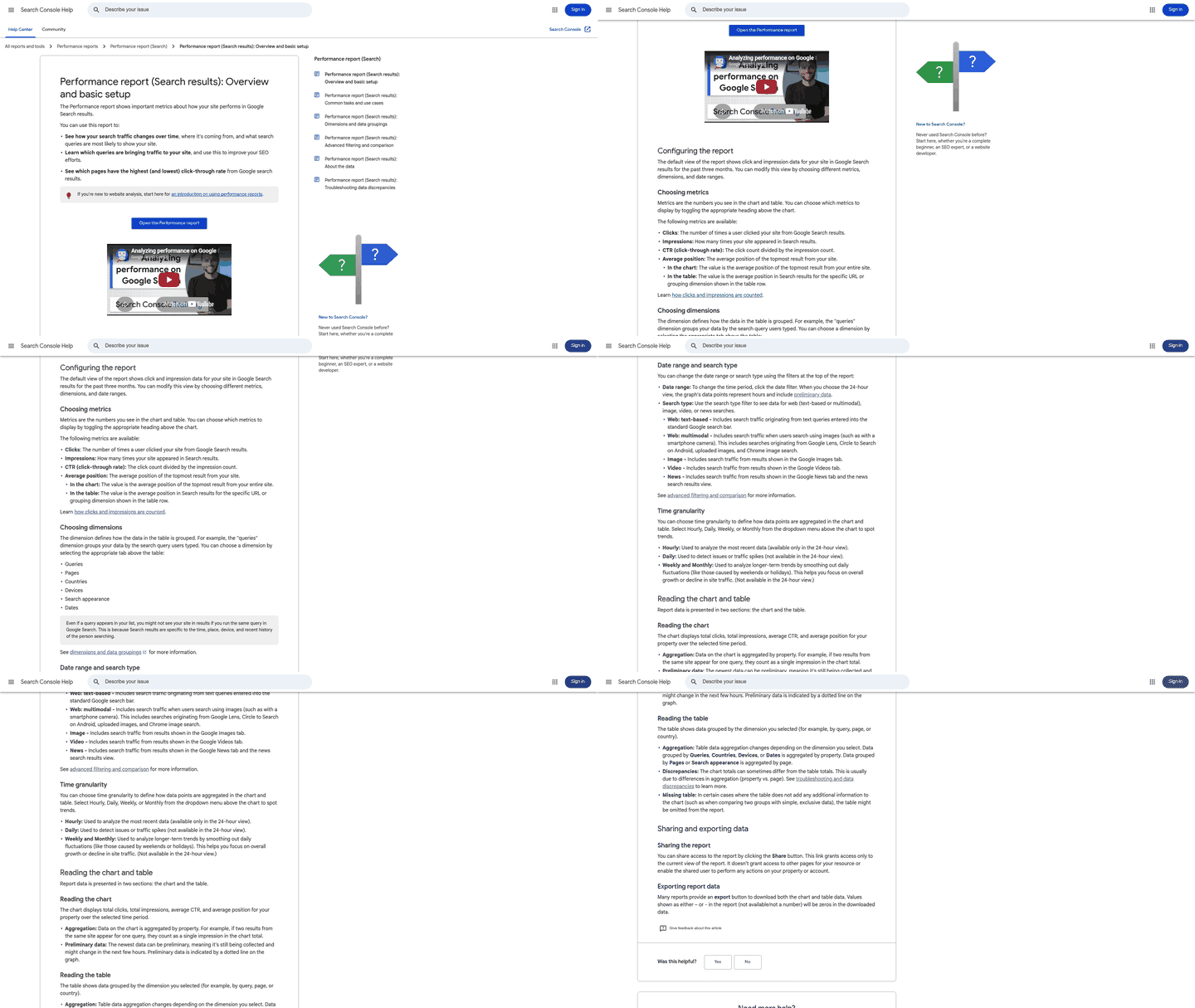
Then read the data in two places. URL Inspection answers whether the URL is indexed at all. The Performance report, filtered to the test page and your litmus query, gives you impressions, clicks, click-through rate, and average position. That's the dashboard an AI SEO content generator trial actually needs.
What 72 hours of rankings actually prove
Very little on their own. Personalization, searcher location, indexing delays, and a handful of impressions all bend the number. A draft that touches position 14 on day two and settles at 60 by week three was never ranking. It was being sampled. Watch whether impressions trend upward, not where position sits.
The comparison carries more weight than the rank anyway. Log the writer's hours on the manual baseline, log the editor's hours on the generated draft, convert both to a cost per finished article. That gap is the real output of the trial, and it stays readable long after the ranking data goes quiet. Keep the page live either way. Pulling a loser down discards the only durable evidence the test produced.
Decision matrix: when to buy, when to walk
The scores tell you who earned a second conversation. They don't tell you who to pay.
Run the grades through one matrix instead of averaging them into a single number and buying whatever sits lowest. We weight SEO features at 25% and content quality at 25%, because a draft that misses intent or carries an unresolved factual error is worthless at any price. Brand voice and customization take 20%, workflow and integrations 20%, pricing and scalability just 10%. That last weight is deliberate. Cost only breaks ties between tools that already cleared the first four bars.
What the sticker price actually buys
List prices in this category spread wide, and the shapes matter more than the digits: a free general assistant with no keyword database or SERP analysis, a low-cost entry plan, a per-seat plan, a brand-voice writer, mid-tier suites, enterprise tiers. Compare cost per publishable page, not per month. Seat pricing multiplies across a team of three, and a cheap plan with a tight article cap can quietly cost more per article than the expensive one. Open the pricing page and read the caps before you compare a single number.
When to walk away
Weak intent match. Factual errors you can't patch. Cleanup that swallows whole afternoons. Hard word or article caps. Watermarked exports. A card demanded before you see output. Single-user limits. Language coverage that stops at English when you publish in other markets. Ask how much setup the tool demands before you hand over a week of your time. Fine for a US blog. A dealbreaker for a German one.
If you publish fewer than four articles a month, skip the matrix entirely. A free assistant and a careful editor cover that volume, and automation solves a problem you don't have yet.
We won't argue that AnyPost.ai is the only platform generating content in your voice and publishing it across your site and social channels from one place. The weighting above is yours to run, and we'd rather you run it than take our word for it. The real test comes about a week after the drafts go live, when you check what actually got indexed.
Frequently Asked Questions
Can a free general AI assistant replace a dedicated AI SEO content generator?
It can cover light volume, but it isn't the same product. A general assistant carries no keyword database or SERP analysis, so output is only as good as the prompt you write. Research-and-draft tools such as AnyPost.ai offer a free tier with no card, which makes them testable before you commit.
What if my content calendar runs mostly on seasonal or trend-driven keywords?
Test on steady demand instead. Seasonal and trend-driven phrases look healthy in a volume check but represent traffic you can't plan around all year, so a strong score on one says little about the other eleven months. Run your litmus keyword somewhere demand is representative.
Does one factual error mean I should drop the tool outright?
Not automatically — it depends on whether the error can be patched. Accuracy works as a gate rather than a scored dimension, so you verify names, numbers, and product claims before scoring anything else. A single correctable slip is an editing task; errors you can't fix without rewriting are a walk-away signal.
Shouldn't I just buy whichever tool scored well and costs least?
Cost only breaks ties between tools that already cleared the other bars. Pricing carries the lightest weight in the matrix for that reason, and a cheap plan with a tight article cap can cost more per publishable page than a pricier one. Compare cost per finished article, not the monthly sticker.