Map Your Bottleneck First: Automation Tools by Content Production Stage

Before we get into it, the short version:
- Review stages often consume the most content cycle time, far exceeding drafting delays.
- Setting clear reviewer deadlines and streamlining approval chains shortens cycle time more than adding AI drafting capacity.
- Teams should track every asset for two weeks across all five stages to identify actual bottlenecks before purchasing tools.
- Rejecting weak ideas at intake costs minutes, while rejecting finished drafts after multiple review rounds wastes days of work.
- Complete briefs contain four fields: measurable outcome, target query with audience, must-cover points, and supporting context.
- Scannable briefs let writers begin without reopening the strategy discussion.
Related Video
Watch: How to Build a Partly Automated Content Workflow (Step-by-Step) by VeraContent
Where content actually stalls
The part most teams underestimate isn't writing the content. It's getting someone to approve it. Bottlenecks cluster at sign-off far more often than at drafting, and the delay compounds: production wraps up, then the piece sits in a queue waiting for review.
Content workflows typically break down across five stages:
| Stage | What Happens | Common Delay Pattern |
|---|---|---|
| Decide | Idea to firm commitment | Weak selection criteria or no clear business value |
| Brief | Decision to writer assignment | Vague instructions that generate follow-up questions |
| Draft | Assignment to first editable version | Waiting for briefing clarity, not actual writing time |
| Review | Draft submission to final approval | Multiple approvers with no deadline or clear workflow |
| Publish | Approval to live content | Manual CMS entry and formatting tasks |
Your bottleneck may sit elsewhere. Brief clarity, publishing handoffs, or distribution delays can all keep finished content invisible. The principle holds: audit before you automate.
Setting reviewer deadlines and streamlining approval chains shortens total cycle time more than adding AI drafting capacity. Audit before you automate: workflow orchestration handles repetitive technical work—metadata, formatting, distribution routing—but only after you've mapped where time and quality problems actually stack up.
Why measurement beats intuition
Speeding up content production without fixing the real constraint is like upgrading a car with rusty brakes. You can add a bigger engine, but if the brakes don't work, you're just crashing faster. Teams buy AI drafting tools when their real constraint sits three stages downstream in review queues. The diagnosis matters more than the tool budget.
Measurement typically reveals something unexpected. The most common mistake is blaming production when delay actually stacks up in handoffs, particularly waiting for sign-off. Review often consumes the largest share of cycle time in content workflows. Drafting might take two days, but a piece can sit in approval longer. Once teams tighten that handoff, the entire cycle can shorten without changing the writing process.
When you automate without mapping where work stalls, you often make the problem worse. Generating more drafts when review is already backlogged just lengthens the approval queue. The automation that helps is the kind that targets your actual constraint—whether that's formatting, SEO checks, distribution coordination, or sometimes drafting.
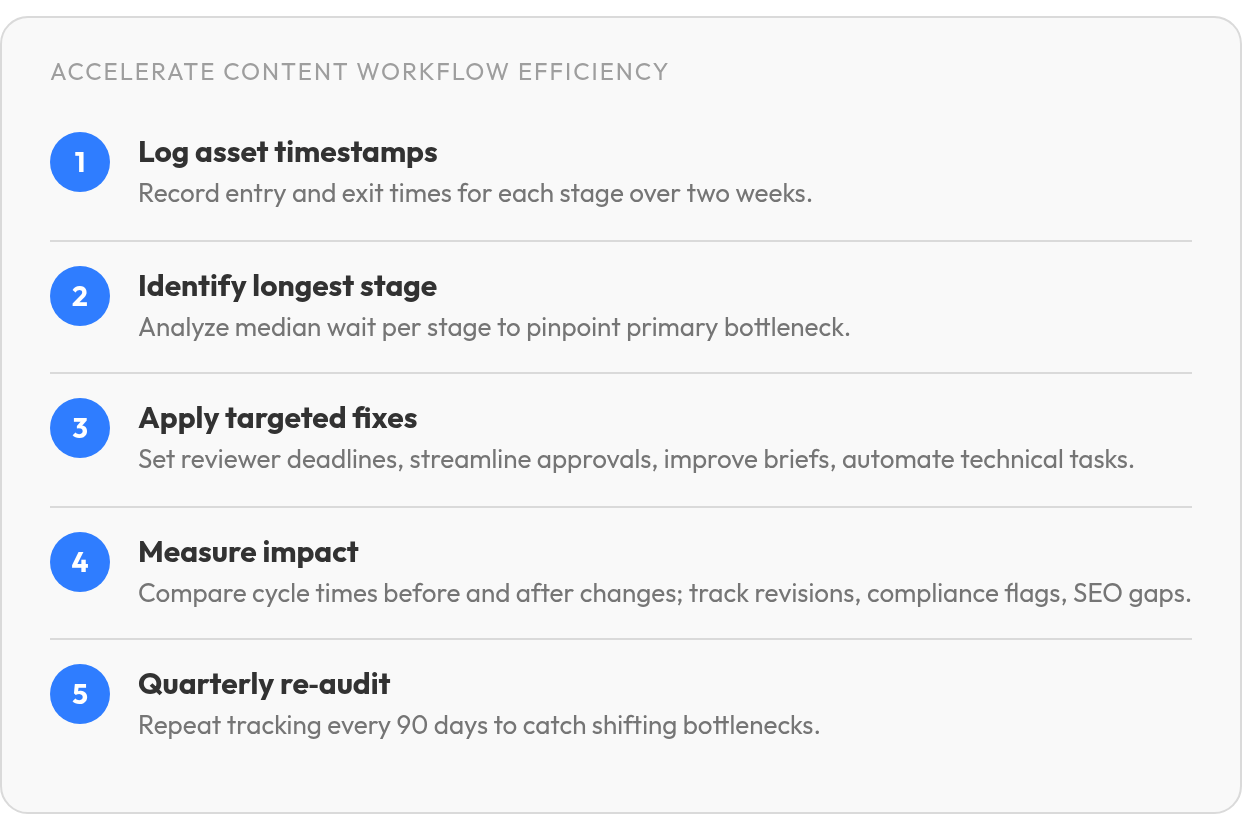
Track every asset for two weeks. Log when each piece enters and exits decide, brief, draft, review, and publish. Whichever stage shows the longest median wait is your target. Document quality issues, identify where revisions cluster, check whether throughput stays flat while queues grow, then revisit quarterly. Skip this diagnostic step and you'll spend money on tools that don't shorten your cycle at all.
Intake: where bad ideas cost the least
The gap between briefing and drafting often traces to unclear briefs. When a piece sits idle before the first paragraph appears, the brief was vague. Writers waiting for clarity aren't stalling—they're protecting themselves from building the wrong thing.
Weak ideas slip through when teams lack selection criteria, and that waste compounds. Rejecting a bad pitch at intake is quick. Rejecting a finished draft after multiple review rounds throws away days of work. The cheapest filter point is consistently ignored: intake. If an idea can't answer "what does success look like?" and "who needs this answer?" in sixty seconds, archive it before anyone writes a word.
What a scannable brief contains
A complete brief prevents follow-up questions that stall production. Four fields, with short bullets in each, keep briefing from becoming its own project.
The outcome defines success as one measurable metric with a timeframe—not three hopeful goals, one metric. The target query and audience documents a specific keyword or real user question pulled from Search Console, plus the persona and what they're actually trying to work out. Must-cover points lists three to five specific facts with direct links to source documentation. Supporting context gathers the relevant Search Console pages, analytics reports, and competitive examples.
The brief should also make the writer's first decision obvious: what to lead with, what evidence belongs in the piece, and what the reader should do next. A writer who can scan the document in two minutes can begin without reopening the strategy discussion.
Drafting: what AI actually accelerates
Who is this for, what question does it solve, what sources must it cite, what action should the reader take next, and what brand voice applies. A prompt that says "write a blog post about X" throws away the brief and forces your editor to rebuild it from scratch during review.
Route every AI-assisted draft through an editor who checks it against the brief's original requirements. That editor verifies facts, adjusts voice, confirms the call to action matches the brief, and ensures the piece answers the question your audience actually asked. Quality control built into every step catches errors early rather than surfacing them after publication, when fixing them requires republishing and redistributing the entire asset.
Review: where the longest waits hide
Review is the point at which pieces most often wait for a decision rather than receive active work. That makes it easy to overlook when teams try to automate, even though sign-off can determine the pace of every later stage.
The fix starts with separating what automation handles from what requires human judgment. SEO metadata checks, compliance scans, broken-link detection, and revision tracking are all repeatable technical work. Tools can flag missing alt text, surface readability scores, and confirm your piece covers the target query. Final brand-voice consistency, strategic angle verification, and legal review for regulated claims still need a person who understands context.
A review schedule works best when each approver has a defined window and knows who follows them. That visibility turns an invisible wait into an owned handoff. The goal isn't to rush thoughtful review—it's to prevent an approved draft from sitting untouched because responsibility was unclear.
Treat SEO optimization as a governed stage. Backlink planning belongs here, not after publication. Document your pre-approved partner list and outreach templates during SEO optimization so distribution can start the day you publish. Avoid tools that promise automated citation generation or guaranteed placements—the research doesn't support those claims. Plan the outreach pathway before the piece goes live, then execute manually with context your team controls, so backlink work stays measured instead of becoming a shadow process.
Publishing: the reformatting tax nobody tracks
Most teams mark a piece "done" when it clears final approval. The distribution tax starts there. Taking a single blog post and converting it into LinkedIn carousels, email newsletters, and Google Business Profile updates swallows hours that should feed the next asset. The reformatting stage accounts for much of that delay but rarely gets tracked in workflow audits.
Publishing bottlenecks don't feel like bottlenecks because the writing already finished. But when approved content waits for someone to resize images, rewrite headlines for character limits, and manually schedule across platforms, visibility delays compound. The asset launches on your blog Monday but doesn't reach LinkedIn until Wednesday.
Our platform treats the blog post as source material, not the final deliverable. One approved piece triggers automated reformatting into platform-native formats. We publish finished content to your website, turn content into social media carousels, generate and distribute newsletters, and manage Google Business Profile updates from a single publish action. Manual copy-paste creates the same handoff delays that plague earlier workflow stages.
The gain isn't just speed. When content reaches all channels within hours of approval rather than days, you capture search visibility and momentum before the news cycle moves.
Measurement: testing whether the fix worked
Measurement should test whether the intervention improved the workflow, not simply report activity inside a dashboard. Compare cycle time before and after the bottleneck fix. If review became faster but the overall timeline stayed unchanged, another handoff has taken its place.
Track the same workflow signals after an intervention that you logged during your initial audit. Record every revision request, every compliance flag raised late, every missing SEO element caught in review. Those patterns tell you whether the fix worked or whether the constraint just moved somewhere else. When organizations focus on fixing a single bottleneck—review queues, unclear briefs, or approval delays—and measure the impact on total cycle time, they often find that addressing one constraint exposes the next. That's the comparison that matters, not the vanity metric of how many drafts your AI tool generated this month.
Track the same signals you audited
The feedback loop starts with the problems you logged during the initial audit. If reviewers flagged vague briefs in twelve of thirty pieces, count how many briefs get returned for clarification after you implemented your intake checklist. If pieces sat waiting for legal sign-off, measure the gap between draft submission and legal clearance before and after you built pre-approved language templates.
Quality issues surface in predictable patterns when measurement is consistent. Teams that document every revision requested, every compliance concern raised post-draft, and every SEO gap caught during final review create a snapshot of what the workflow actually produces. Many content teams lack visibility into whether their published content delivers results because they stopped measuring after the piece went live. The fix isn't more analytics tools. It's logging the operational signals that predict whether a piece will need rework before anyone clicks publish.
Quarterly reviews catch shifting constraints
Bottlenecks migrate. Fixing review queues this quarter can shift the constraint to distribution next quarter when approved pieces start piling up because nobody owns the reformatting work. Schedule a quarterly audit using the same cycle-time measurement from your initial diagnosis to catch these shifts early.
Run the same timing exercise every ninety days: decide, brief, draft, review, publish. Whichever stage consumed the most elapsed time three months ago might not be the slowest stage now. The quarterly review flags where capacity constraints emerged, where approval loops added an extra round nobody planned for, and where automation created new handoff friction that didn't exist before.
Quick Questions, Straight Answers
What if multiple stages show similar median wait times during my audit?
Target the stage where quality issues cluster most heavily rather than just elapsed time. When two stages show comparable delays, check which one generates the most revision requests or clarification loops. That pattern reveals where unclear handoffs compound the problem. Teams often find that briefing and review both stall work, but briefing delays prevent drafting from starting while review delays waste already-finished work.
How do you actually get reviewers to respect deadlines when they ignored them before?
Tie each reviewer's window to the next person's calendar so delays become visible immediately. When the legal reviewer knows the compliance specialist is scheduled to start Thursday morning, Tuesday's deadline carries real weight. Make the dependency visible in the task system and escalate exceptions rather than allowing an open-ended queue to become normal.
Can small teams run this audit without a dedicated project manager tracking everything?
Track at the asset level, not the person level, using whatever task system already manages your content. Log five timestamps per piece: when it enters decide, brief, draft, review, and publish. After two weeks you'll have enough data points to spot your longest median stage without building custom dashboards. The measurement targets process patterns, not individual performance.
What actually happens to cycle time if you automate the wrong stage?
The total timeline stays flat or lengthens because you're generating more work for an already-backlogged stage downstream. Teams that add AI drafting capacity when review queues are backlogged can create longer approval wait times. The drafts pile up faster than reviewers can clear them, so published output doesn't increase even though draft volume does.
Should you pause all automation purchases until the audit finishes?
Complete your two-week diagnostic before committing budget to new tools, but keep using automation you've already deployed. The audit reveals whether existing tools target your actual constraint or whether spending moved to the wrong layer. Misdiagnosing the bottleneck means paying for software that doesn't shorten your cycle, and that waste compounds when you stack multiple tools without measuring their combined impact on total timeline.