One Article Into Five Persona-Matched Posts, No Manual Rewrites

Why Turning One Article Into Five Persona‑Matched Posts Matters
The part most teams underestimate isn't writing the content—it's that your AI prompts have no idea how different audiences think, search, or decide. Persona data sits scattered across sales notes, CRM fields, and research docs. Even a strong model can't fix that. You end up with volume instead of variety: five rewrites that sound identical because the underlying instructions were identical.
The bottleneck isn't speed. It's that you're asking AI to guess at audience distinctions it can't infer from a generic brief. A prompt like "I'm an email marketing manager at a mid-sized charity evaluating CRM vendors under $20K with GDPR compliance" reveals profession, industry, budget ceiling, and compliance constraints. That specificity is what AI search rewards now, and traditional keyword matching never captured it.
Persona Prompts Connect Data to Narrative
Effective persona content depends on how your workflow components connect, not on a single tool. You need a structured persona layer that standardizes core attributes—pains, triggers, objections, preferred formats—drawn from real customer conversations. When those inputs feed your AI prompts consistently, outputs reflect how a CFO thinks differently than a marketing director. Skip this foundation and you get five drafts that differ mainly in surface labels.
Integration Determines Repeatability
A repeatable content machine requires aligned data sources, prompt templates, and publishing workflows. High-performing teams build a division of labor: AI handles research synthesis and first drafts while humans focus on strategy and final edits. That only works when your persona repository feeds prompt scaffolds that include role, tone, vocabulary, context length, and fallback behavior—not just a one-line instruction. Content repurposing strategy becomes scalable when these pieces connect around audience segments, not when you bolt AI onto an ad-hoc brief process.

In short: The content bottleneck stems from AI prompts disconnected from audience behavior, not from writing speed limitations. Detailed persona prompts revealing profession, budget limits, and compliance needs outperform generic keyword matching in AI search. Scattered persona data across sales notes and CRM fields produces generic AI content regardless of model quality. Many teams create circularity by using identical AI systems to both generate and evaluate persona-driven content outputs.
From Source Article to Persona Matrix
The hardest part isn't generating the drafts. It's deciding what the model should preserve, vary, and emphasize for each audience. A source article usually contains multiple threads: problem framing, proof points, objections, process steps, and calls to action. If those threads aren't mapped to buyer context before generation starts, the drafts may be grammatically clean but strategically flat.
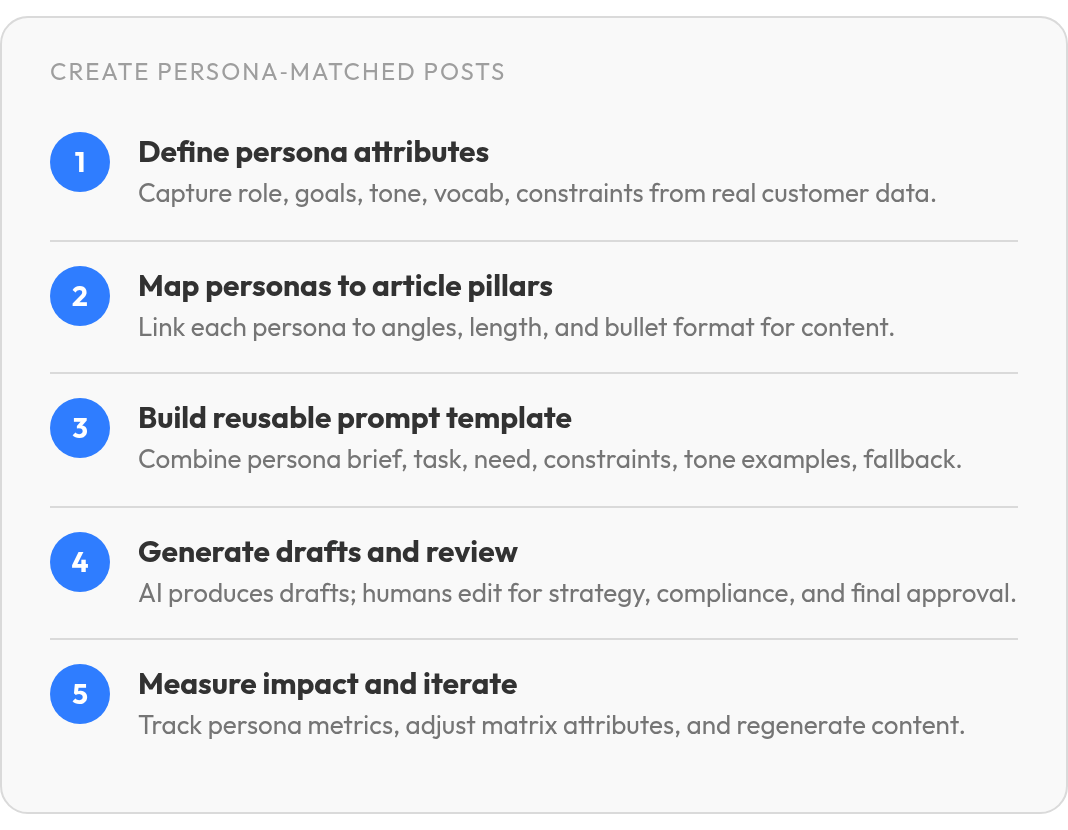
Start by building a structured persona baseline before you touch the source article. Define the buying situation, internal blockers, vocabulary, sophistication level, and decision criteria for each audience segment. The more operational detail you capture, the easier it becomes to tell the model which details belong in each version and which should be left out. The goal isn't to create long persona documents. It's to give the generation workflow enough direction to produce distinct narratives from the same source.
What Goes Into the Persona Sheet
Your persona sheet functions as a prompt scaffold. Include role, primary users, goals, tone, vocabulary to prefer, phrases to ban, context length, fallback behavior when uncertain, safety rules, and two to three example lines that sound like the persona. Skip comprehensive documentation. Keep it short and actionable.
Add brand lexicon, product names, feature terms, and specific angle slots tied to each persona's decision triggers. An enterprise buyer may need the article framed around risk reduction and handoff complexity. A founder may need the same idea translated into setup speed and resource tradeoffs. The source material doesn't change, but the narrative path through it does.
Building the Matrix
Map personas to content pillars from your source article—claims, examples, objections, calls to action. Each persona row gets its own angle slot, response length, and skimmable bullet format. This is the matrix that turns one article into five distinct drafts without manual rewrites.
Validation belongs outside the draft generator. Build your matrix from signals that come from actual buyer interactions—sales call patterns, support-ticket language, win-loss interviews, customer surveys, or qualified lead notes—then measure performance against business outcomes. If you let the same system invent the audience and grade the output, you risk optimizing for internal consistency instead of market response.
AI‑Powered Generation: No Manual Rewrites
Building the prompt infrastructure is where most teams stumble. Without clear instructions, you get five drafts that differ mainly in surface labels. The fix is a reusable prompt template that combines your source article, persona attributes from your matrix, the angle slot you're filling, and explicit output constraints.
What Goes Into a Persona-Matched Prompt?
Start with six components: persona brief, task definition, audience need, constraints, tone examples, and fallback behavior. The persona brief identifies who the draft is for and what they're trying to decide. The task definition names the source article and the specific transformation, such as turning a section into a LinkedIn post for a risk-sensitive buyer. Constraints set word count, required terms, banned claims, and structure.
Tone needs more than labels. A prompt that says "write for executives" or "make this technical" still leaves the model too much room to improvise. Feed it two or three sentences that sound like your target reader—language patterns pulled from real interactions or public conversations. A finance leader may respond to tradeoff language, while a product manager may need dependency and roadmap framing. These examples anchor the output far better than adjectives like "professional" or "technical."
For quality control, compare drafts against a reference set that didn't come from the same generation pass. That might include original customer phrasing, previously high-performing posts, sales enablement notes, or A/B test outcomes. The aim is to catch strategic drift: unsupported claims, mismatched vocabulary, or a CTA that asks the wrong next step for that audience.
Why Human Review Still Matters
Many teams skip evaluation entirely when using generative AI for persona work. That's how you end up publishing five posts that all cite features your product doesn't have or compliance standards your audience doesn't follow. We treat AI as the research and draft layer—it synthesizes persona inputs and produces structured outputs fast—but humans own the strategy, nuance edits, and final approval. That division keeps outputs from drifting into generic or unsupported territory while maintaining the speed and consistency that makes persona-matched content scalable.
Measuring Impact & Iterating the Persona Engine
Generation is only the first pass. Once the posts go live, the real question is whether each version reached the audience it was designed for. Performance should not be reviewed only at the campaign level. Aggregate reporting can hide the fact that one persona is responding strongly while another is ignoring the message entirely.
Measurement also tests whether the segmentation logic was right. If you built personas around company size brackets but the real differentiator is technical maturity, the content will keep addressing the wrong constraints. A SaaS provider found their "growth-stage" persona underperformed across channels because it conflated headcount with operating reality—teams at 75 employees with legacy infrastructure had completely different needs than 75-person startups built cloud-native from day one.
Track Persona Signals, Not Just Channel Averages
Platform KPIs like engagement rate, CTR, comments, saves, shares, and dwell time matter, but they only tell you if content performed—not which audience it resonated with. Compare performance across persona buckets and channels together. If your technical-buyer posts get high saves on LinkedIn but low shares, that's a signal about how that segment engages. If budget-conscious posts underperform across all channels, revisit whether your cost framing matched the actual decision pressure.
Newsletter clicks and lead captures can reveal persona match at the conversion end, but qualitative signals matter just as much. Look at comment themes, the questions people ask, and whether responses align with the persona attributes you modeled. If the replies consistently introduce concerns your matrix didn't account for, treat that as a prompt-design input rather than a random engagement artifact.
Adjust Attributes, Then Regenerate
When a persona bucket underperforms, identify the weak assumption—role, budget, compliance concern, tone, or content depth—and adjust it in the matrix before the next round. If executive-level posts aren't landing, maybe the issue is voice formality or the fact that executives delegate research to analysts. If posts for startups miss, check whether your budget ceiling was realistic or whether the real constraint is implementation speed. Teams relying on a single model family can also miss whether their instructions translate across different prompt architectures, so keep the matrix clear enough to survive tool changes.
Questions People Ask
What if I only have two or three distinct personas instead of five?
Start with the personas you can defend with evidence. Two carefully defined audience segments are more useful than five thin profiles created just to fill the matrix. You can expand later when a new segment shows different objections, research behavior, or buying criteria.
How do you validate persona attributes before building the matrix?
Look for repeated language in the places where buyers explain themselves: discovery calls, support conversations, closed-lost notes, onboarding questions, and renewal discussions. A useful attribute should appear often enough to shape messaging decisions, not just once in a memorable anecdote.
Can you reuse the same persona matrix across different source articles?
Yes, but treat the matrix as a stable audience layer rather than a fixed content plan. The core reader profile can stay the same, while the angle slots change with each article. One source piece might emphasize automation benefits; another might emphasize governance, speed, or implementation risk.
What's the minimum persona data needed to start if research is incomplete?
Begin with concrete inputs the model can act on: one decision blocker, one desired outcome, one vocabulary pattern, and one thing the draft should avoid saying. That gives you enough structure to create a usable first version while you continue gathering stronger evidence.