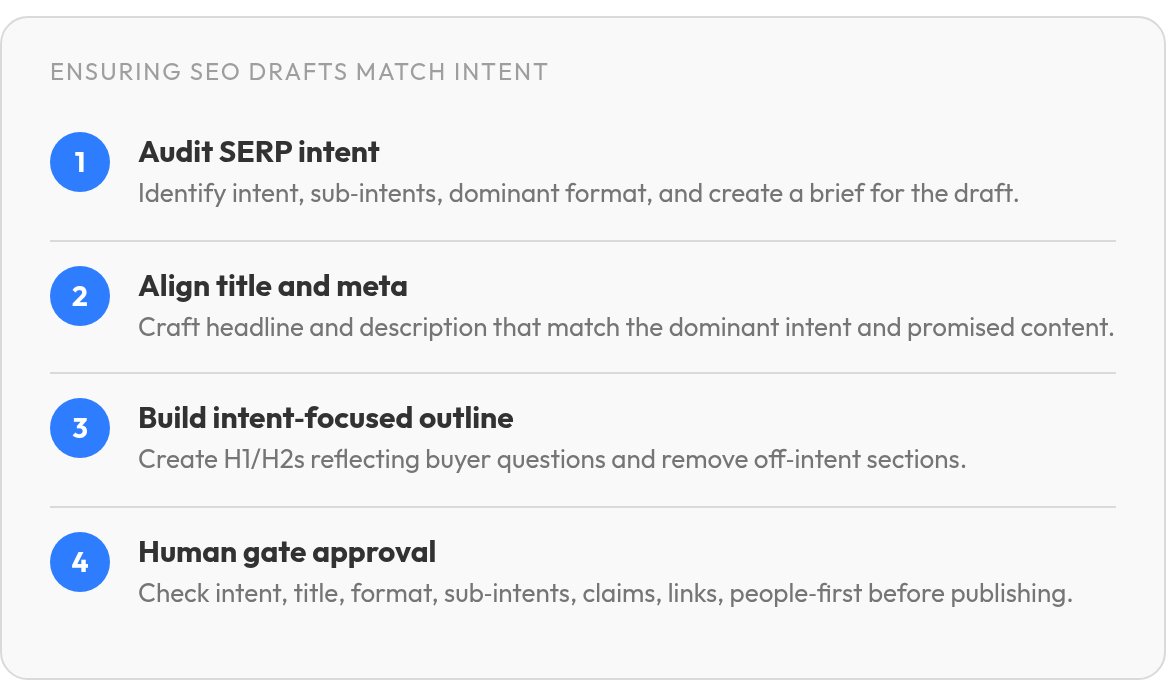
One-Click SEO Articles Skip Search Intent: What to Fix Before Publishing

Why one-click SEO articles miss search intent, and why links won't save them
One-click drafts rarely lose rankings because a machine wrote them. Google has said plainly that it judges content on quality and people-first purpose, not on how it was produced. What sinks a page from an AI SEO content generator is quieter than that. It answers a question the searcher never asked.
Google's quality raters score pages on a "Needs Met" scale that runs from "Fails to Meet" to "Fully Meets." A draft that misreads intent starts near the bottom, and backlinks tend not to rescue it. A strong post rewritten to match intent can often climb further than the same post with more links pointed at it. Authority amplifies an answer. It can't turn the wrong answer into the right one, which is why fixing the mismatch tends to pay off before link building does.
Commercial queries reward comparisons over definitions
A query like "AI SEO content generator" carries commercial-investigation intent. That's the research a buyer does before paying for something. The searcher is shortlisting tools, so the results page tends to fill with comparisons, reviews, alternatives, and buying criteria.
An accurate explainer on what these tools are can still rank nowhere, because it serves the wrong stage of the decision. The mismatch we flag most often looks harmless on the page: the draft covers the keyword but skips the searcher's actual goal. Every section is on topic, and none of it helps anyone choose.
Mixed-intent keywords need a different check, and the audit in Step 1 handles them by reading the SERP first.### Keep each audit step short and scoped An intent review can quietly swallow whole afternoons if every draft becomes an open-ended debate. You can keep it fast by noting, for each step, what the fix is and how much rewriting it needs. That stops the review from turning into a hidden tax on publishing.
A step tends to get harder as the SERP gets more ambiguous, as more sub-intents appear, and as the fix demands more rewriting. An easy step has one clear intent and needs only a title tweak. A hard step has a split SERP and needs a restructured body.
Step 1: Decode the SERP with a five-step intent audit
Keyword modifiers only give you clues. "AI SEO content generator" has no "best," no "buy," and no "how to," so you could read it as a definition query, a shopping query, or a hunt for a specific tool. The draft your generator produced already picked one of those readings without telling you. This audit makes that choice visible before the post goes live.
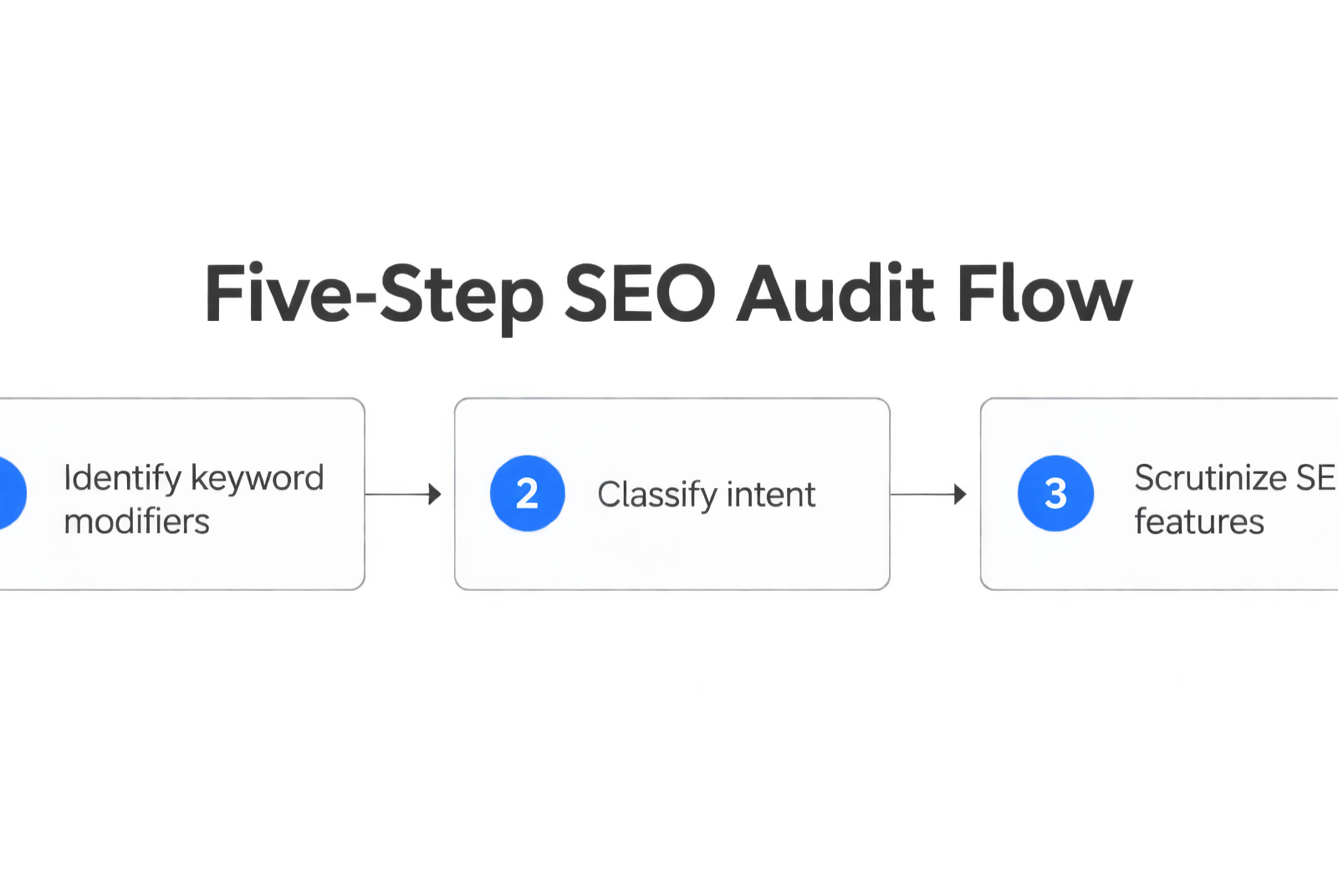
Run these five steps on every draft, using the target keyword itself as your test case. We won't tell you what the results show for this phrase today. Results shift, and the point is that you check them live.1. Label the intent. Informational, navigational, commercial, and transactional are the four main types of search intent in SEO, but one query can carry two labels. A search for an AI SEO content generator often sits between commercial and transactional. Reviews, comparisons, and buying guides tend to serve the commercial side.2. Read the SERP features. Note any featured snippet, People Also Ask box, and related searches. Write down the question each one implies. Those questions are the sub-intents your draft has to answer.3. Log the top 10. Paste each organic result into a spreadsheet with four columns: intent, format, angle, and depth. Ten rows can take twenty minutes, and they often save you a full rewrite later.4. Find the dominant format. If eight results are comparison lists, your how-to explainer is answering the wrong question. Mixed SERPs are the hard case. Some SEO guides advise covering every intent on one page, while others say that kind of hedging hurts rankings. Let the results settle it. A mixed SERP rewards a mixed page. A SERP that leans toward one page type punishes a page that tries to cover everything.5. Write the brief. Record the dominant intent, any secondary intents, the required format, and the questions from step 2. Keep it to a single page. Every later step measures your draft against this brief.
Step 2: Make the title and meta promise what searchers came for
The title is where a one-click draft makes its promise, and most generators promise the wrong thing. They tend to default to a definition template like "What Is an AI SEO Content Generator? A Complete Guide," because that formula fits any keyword. If your Step 1 audit labeled the query commercial investigation, that headline tells a shopper they're about to get a glossary entry.
Small modifiers change the job. People searching "backlink checker" want a tool. People searching "best backlink checker" want a comparison guide. Someone researching an AI SEO content generator before paying for one sits closer to the second group. They want options weighed against each other, not a concept explained.
The headline has to describe the body you actually wrote
| Generic one-click | Intent-aligned | |
|---|---|---|
| Title | What Is an AI Content Generator for SEO? Everything You Need to Know | AI Content Generators for SEO Compared: Features, Trade-offs, and Who Each Fits |
| Meta description | Learn what AI SEO tools are and how they work. | Compare five approaches on draft quality, refresh workflow, and local pages, and see the selection criteria we use. |
Our rule is strict. Use "Compared" only if the body contains the comparison. Use "Alternatives" only if the body names real options and the reasons to switch. If the draft can't support either word, add the comparison or keep the informational title and target a different keyword.
The tradeoff is real. A title that overpromises can win the click and still lose the visitor, which leaves the page worse off than an honest title would. You can see the full pattern in our side-by-side look at five AI SEO content generators.
The meta description follows the same logic. State the evaluation the reader gets, then invite them to compare options or view the criteria. Leave out click-rate promises you can't back up.
Secondary keywords should map to buyer questions
Replace filler secondaries like "benefits of AI writing" with the terms buyers actually research: features, use cases, trade-offs, alternatives, and selection criteria. Each term should earn a real heading with substance under it. If a term can't hold up its own heading, drop it.
Step 3: Build the outline around the buyer's questions
Most teams treat the outline as a formality, yet the outline is where an intent mismatch gets locked in or fixed. An AI SEO content generator builds headings from the keyword alone, so its skeleton tends to cover every possible reading at once.
Your Step 1 audit already chose the dominant intent and settled the mixed-intent question. The outline is where every heading has to follow that choice. On a SERP that leans toward one page type, a secondary intent earns a heading only when it helps the reader with the main job.
The H1 names the job and the H2s carry the buyer's questions
Put the dominant intent in the H1. Make each H2 a major evaluation question, and push supporting detail into H3s. Here's a commercial-investigation outline for this article's keyword:
- H1: Choosing an AI SEO Content Generator: What to Compare Before You Pay
- H2: Which tools fit which use case (scale, refreshes, local pages)
- H2: Features that move rankings versus features that only demo well
- H2: Where these tools fall short
- H2: Alternatives, including hiring writers
- H2: A selection checklist
Open each H2 with a direct answer in a short paragraph or list. Featured snippets often pull from those formats, though nothing shows that answer-first headings cause snippet placement. Write them for the reader who skims, and treat any snippet as a bonus.
Revision means cutting as much as adding
Compare the generated draft against your outline. Delete off-intent sections, such as a history of AI writing on a buyer's page. Add the evaluation questions the draft skipped, and rewrite any heading the body doesn't deliver on.
Then check your internal links:
- Link only to pages that answer a question this page raises.
- Use anchor text that says what the destination covers.
- Connect commercial and informational pages, such as a comparison of tools by use case, without pulling readers away from this page's main task.## How to gate your next AI draft before it goes live The stage teams automate first is the one we keep manual. An AI SEO content generator can draft, format, and schedule a post in minutes. In our experience, though, none of them can reliably judge whether that post answers the question searchers actually typed. So we treat the last step before publishing as a human gate, with a written yes or no for each check.
Google's guidance on AI-generated content draws the line in a clear place. It cares about why a page was made, not whether automation helped make it. Content produced mainly to game rankings, rather than to help people, falls on the wrong side. A reviewer can check that purpose directly by reading each section and asking who it was written for.
The workflow moves forward only when every check passes
SERP audit → Intent classification → Draft comparison → Revisions → Human approval → Publish
 ↑ │
 └────────── any "No" ──────────┘
A failed check sends the draft back to revision, not to a quick patch on the publish screen. Last-minute edits tend to fix the symptom, like a reworded title, and leave the mismatched body underneath it.
Seven questions belong in your SOP
Copy these into your publishing checklist. The reviewer answers each one with a yes or a no.
- Intent: Can you name the dominant intent in one phrase, and does it match what the live SERP rewards?
- Title: Does the headline promise the same page type that currently ranks?
- Format: Is the draft a comparison, guide, or tool page, matching what the audit called for?
- Sub-intents: Does the draft answer the priority follow-up questions you found in the SERP?
- Claims: Is every number and assertion supported, with nothing left vague?
- Internal links: Do the links send readers to the next step they actually need?
- People-first: Would every section stay if rankings didn't exist?The gate has limits, and that's deliberate. Skip it for minor typo fixes on posts that already rank. Rerun the full checklist whenever a revision changes the angle of a post. If you want more of the drafting work automated around this gate, see our walkthrough of a single workflow that drafts, repurposes, and publishes.