Programmatic SEO Templates vs. Editorial Automation: Which Captures Unranked Long-Tail Traffic?

What You Need to Know
- Programmatic SEO templates generate thousands of pages by swapping variables like city names, but risk Google's scaled content abuse penalties when underlying data is thin.
- Editorial automation produces genuinely distinct AI-written content supervised by editorial rules, trading lower volume for higher per-page ranking potential and voice fidelity.
- Programmatic templates require three conditions to succeed: proprietary data that changes per page, consistent high-volume search patterns, and pre-existing domain authority to rank pages.
- Research shows 94.74% of keywords receive fewer than ten searches monthly, making long-tail capture dependent on pages ranking competitively, not just generating impressions.
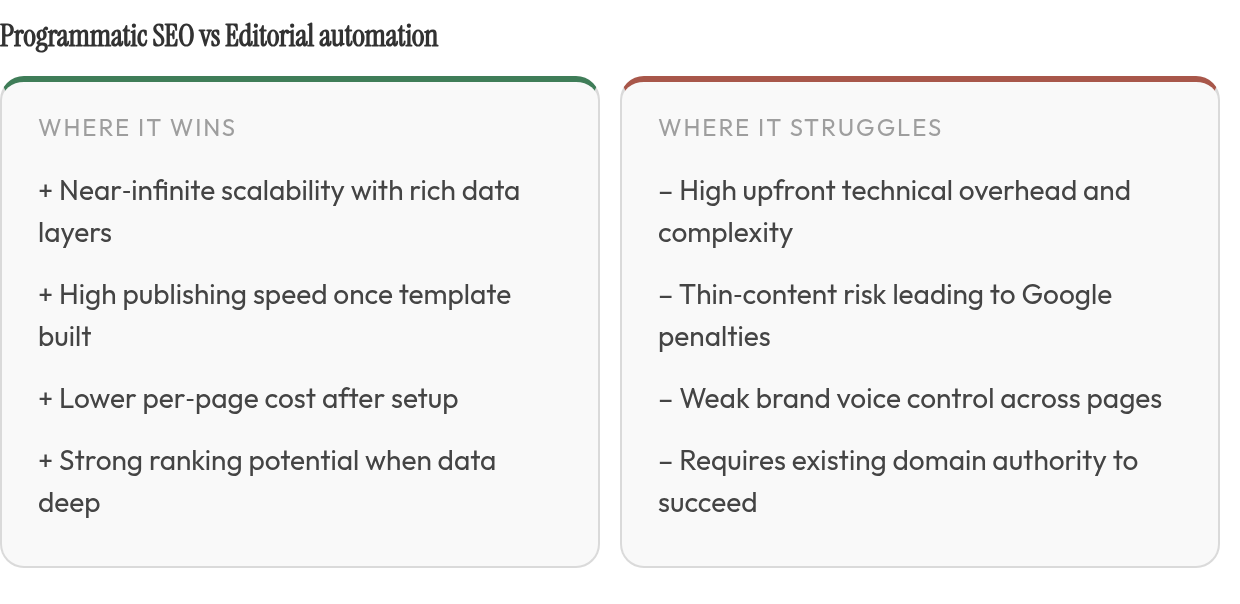
- Programmatic templates offer near-infinite scalability with high upfront technical overhead, while editorial automation provides stronger brand voice control at moderate volume with lower penalty risk.
Related Video
Watch: how to build a programmatic seo system that generates 10M impressions by SEO & AI Systems - Sayak Moulic
Our take on scaling long-tail traffic
Two playbooks dominate long-tail SEO, and both carry hidden downsides. Programmatic SEO templates generate thousands of pages by swapping variables: "best coffee shops in {{city}}" multiplied across 5,000 cities. Editorial automation uses AI to write distinct articles at volume while preserving your brand voice and editorial oversight. The difference isn't just technical. It's a choice between speed with structural risk and controlled scale with per-page value.
Programmatic templates excel at data-dense patterns where the underlying information changes meaningfully across pages. Property listings work when each page pulls unique MLS data: square footage, pricing history, neighborhood stats. When the data layer is thin, though, templates produce what Google now flags as scaled content abuse. Pages that swap one modifier while keeping everything else identical. Research shows that 94.74% of keywords get fewer than 10 searches per month. Capturing that long-tail volume requires pages that rank well enough to generate clicks, not just impressions.
Editorial automation solves a different problem. Instead of template rigidity, it generates genuinely distinct content for each query, informed by your existing voice and supervised by editorial rules. You're not building doorway pages. You're scaling the editorial process itself. The tradeoff is throughput. Editorial automation produces fewer pages per month than pure programmatic approaches, but each page can compete on substance rather than relying solely on domain authority to carry thin variations.
The operational differences shape which approach fits your needs:
| Dimension | Programmatic Templates | Editorial Automation |
|---|---|---|
| Speed | High volume once template and data layer are built | Moderate volume with quality controls in place |
| Control | Low—template locks structure; changes require rebuild | High—each piece can diverge from baseline while staying on-brand |
| Scalability | Near-infinite if data layer supports it | Bounded by editorial review capacity and generation infrastructure |
| Voice Fidelity | Weak—generic template prose repeats across all pages | Strong—trained on your existing content corpus |
| Technical Overhead | High upfront—database, CMS integration, indexing infrastructure | Medium—API setup, prompt engineering, QA workflows |
| Penalty Risk | Higher if data layer is thin or pages lack meaningful differentiation | Lower when quality thresholds are enforced |
| ROI Horizon | Faster if pages rank; minimal return if they stall below competitive positions | Longer initial ramp but more durable rankings over time |
When programmatic templates win
Programmatic templates capture unranked long-tail demand when three conditions align. First, you control proprietary data that changes meaningfully per page: real-time pricing, inventory levels, user reviews, location-specific metrics. Second, the search pattern is consistent and high-volume across modifiers. "Hotels near {{landmark}}" works because thousands of landmarks generate real searches. Third, your domain already carries authority. New sites attempting programmatic scale face a cost-authority paradox: you need the volume economics to justify building at scale, but you need pre-existing authority to make the pages rank.
Wise's currency converter pages illustrate the model. Each page targets a specific pair (USD to INR, EUR to GBP) and pulls live exchange rates, historical trends, and conversion tools. The data layer is rich enough that Google treats each page as solving a distinct user need. When programmatic works, it's because the database does the differentiation work, not because the template is clever.
When editorial automation captures what templates miss
Editorial automation shines when the long-tail demand requires expert synthesis rather than data display. B2B SaaS comparison pages ("HubSpot vs Salesforce for enterprise teams") don't benefit from templates because the value lies in analysis, not in swapping product names. Niche vertical content, local service guides, and use-case explainers all favor editorial approaches because readers expect original insight, not formatted database rows.
The technical shift matters. AI-generated editorial content under supervised constraints allows you to produce substantially more pages than manual writing while maintaining quality standards that pure template approaches cannot match. You're not writing articles by hand one at a time. You're supervising an AI system that writes them under constraints you define. The per-page investment rises compared to pure programmatic templates, but so does the ceiling for how high each page can rank.
Why the speed-vs-control tradeoff matters
Covering the full long-tail search market demands more pages than any team can write manually. Most keyword demand sits in specific, low-volume queries that are often high-intent but too small to justify commissioning traditional long-form editorial content one by one. A B2B SaaS team publishing a limited number of blog posts monthly will never capture the thousands of "best CRM for real estate agents in Austin" variations your potential customers actually search for.
Programmatic templates promise a way out: build one structure, multiply it across cities or categories, publish thousands of pages fast. Editorial automation offers a different path: use AI to write distinct articles at scale while your team maintains brand voice and oversight. Both methods automate content creation for SEO, but they solve the speed-vs-control tradeoff in opposite ways.

The hidden costs of staying manual
Manual production carries a cost most founders underestimate until the competitor starts ranking everywhere. Your content team writes a handful of pieces this month. Your competitor launches thousands of programmatic pages covering every city-service combination in your category. Even if only a small fraction of those pages rank, they still outnumber your entire site. Manual editorial production at typical agency rates makes capturing thousands of long-tail queries economically unfeasible for most businesses.
The alternative carries its own cost. Programmatic templates can dramatically reduce per-page costs, but front-load the risk into system design. Travel sites have built tens of thousands of destination pages by swapping city names across identical copy. Google often deindexes the majority within months. Local service directories using the same thin-content pattern have lost substantial organic traffic. Sites that lack meaningful differentiation between pages face the highest penalty risk.
When speed backfires
The position 15–30 trap reveals why impression volume is a vanity metric. Programmatic systems can generate thousands of pages that rank on page two, where searchers rarely visit. High impression counts mask the reality: the system generated visibility without value, wasting crawl budget and diluting the site's authority signals.
This isn't a flaw in automation itself but in the data layer behind it. Property and marketplace pages can work when each URL pulls materially different listing details, pricing context, local attributes, and user-relevant filters. When the underlying dataset is thin, templates produce near-duplicates that Google correctly treats as spam. The old playbook of variable injection without substance is why programmatic SEO developed a credibility problem between 2018 and 2022. Google's March 2024 policy update formalized the line: they now call it "scaled content abuse," defined by intent rather than method. They don't care how you created the content; they care whether you built it primarily to manipulate rankings rather than help users.
Programmatic SEO templates—mass-generate targeted pages
Template-driven workflows across programmatic pages rely on structured, repeatable data. The process starts with a validated keyword pattern (typically a structure like "best {{service}} in {{city}}" or "{{tool_A}} vs {{tool_B}}") then a structured dataset maps to that pattern. Each page pulls from the same template, but the content changes based on what's in the database: location lists, product catalogs, pricing feeds, user reviews, local statistics, or university datasets. The template defines the layout once; the data defines every individual page.
How the pipeline works in practice
Teams identify a repeatable search pattern first. The dataset feeds the template: property details, booking data, live pricing, feature comparisons, or review aggregations.
The speed advantage is real. Traditional SEO produces a manageable number of pages over several months through manual work. A programmatic system can publish thousands of pages far more quickly. But that speed creates risk. When the data layer is thin, such as a city name swapped into static copy, you produce doorway pages that Google's scaled content abuse filter will deindex.
What separates programs that rank from programs that stall
Data depth matters more than template design. Check a sample of dataset rows before publishing. If you can't tell pages apart when the modifier is removed, you have thin content. Each page needs substantial differentiation, pulled from multiple data sources. An online games catalog that wrote individual summaries for each title built meaningful traffic because each page provided genuine, differentiated value.
| Quality Check | Threshold | Why It Matters |
|---|---|---|
| Unique content ratio | Substantial | Differentiates pages beyond variable swaps |
| Data source diversity | Multiple sources | Prevents single-dimension templates |
| Word count floor | Context-dependent | Signals substantive content to crawlers |
| Schema validity | 100% | Ensures structured data parses correctly |
| Index coverage rate | Strong majority | Tracks whether Google accepts pages |
Common pitfalls and how teams mitigate them
Duplicate content happens when templates rely on a single variable. If every page changes only the city name, Google treats them as near-duplicates. Requiring multiple dynamic fields per page mitigates this: location-specific statistics, local weather patterns, regional pricing differences, neighborhood context, or user-generated reviews. Clean URL patterns matter too—use /hotels-chicago instead of /hotels?city=chicago. Parameterized URLs signal dynamically generated content to crawlers.
Keyword stuffing still trips up new implementations. Repeating "best coffee shops in Austin" twelve times across headings, body copy, and alt text triggers quality filters. Template copy should read naturally across all variations. If a sentence breaks when you swap modifiers, rewrite it. Progressive rollout catches these issues early: publish a test batch, monitor for a couple weeks, check Search Console coverage and click-through rates, then scale if metrics hold.
Internal linking structure becomes unwieldy fast. A large travel site struggled when each page linked to every other destination in its region. They rebuilt the taxonomy around hub pages that aggregated regions, reducing per-page links and recovering crawl budget. Flat link structures work for hundreds of pages; hierarchical taxonomy becomes necessary above a few thousand.
For content that requires brand voice, editorial oversight, or deeper expertise (where the value comes from perspective rather than data aggregation) programmatic templates hit a ceiling. That's where editorial automation takes over, using AI to generate distinct articles while preserving tone and quality control.
Editorial automation—AI-driven content with brand voice
Automating content creation for SEO through workflows that balance AI speed with brand voice consistency is different from template swaps. The distinction matters because Google now evaluates scaled publishing by usefulness and differentiation, not merely by whether a human or AI system produced the draft. We treat AI as a drafting partner within a controlled pipeline, not a publish button.
How the editorial automation workflow runs
The process starts with a content brief that defines structure, target keywords, required data sources, and brand voice parameters. The AI drafts a complete article pulling from those sources, optimizing for SEO while matching your established tone through our Persona Engine. The system generates content that integrates real data (your business knowledge library, uploaded PDFs and documents, and context-aware research) rather than relying on generic variable injection.

This workflow can scale content production significantly compared to manual processes. The efficiency gain comes from offloading research synthesis and first-draft structure to AI, then concentrating human effort on brand voice refinement and factual verification. Automation handles the structural and formatting work, but strategic decisions and final review remain with your team.
Quality control over speed claims
Our platform builds content around real differentiation: context-aware articles and headlines generated from your website's taxonomy, business persona, and knowledge library. The system performs automated SEO optimization, internal and external smart linking, and multi-platform publishing to ensure content serves both search engines and readers. Rather than chasing arbitrary quality scores, we focus on what actually drives results: SEO-optimized content that ranks, integrated analytics through Google Search Console and Google Analytics to track traffic and rankings, and real-time performance monitoring so you can verify the platform is driving measurable outcomes.
Skip editorial automation if your content demands deep subject matter expertise that AI cannot synthesize from available sources. A clinical protocol review or a financial compliance analysis still needs a domain expert writing from scratch. Where it works: comparison pages with feature matrices, location-based service descriptions pulling real operational data, use case breakdowns for SaaS products where the underlying facts exist but manual assembly is slow. The distinction isn't complexity—it's whether the required information already exists in structured or semi-structured form versus needing original expert synthesis.
AnyPost.ai—hybrid automation that marries templates and editorial control
Hybrid automation platforms are positioned as the solution to programmatic SEO's penalty risk, but the market lacks transparency about what these systems actually deliver. Before committing to any platform claiming to merge template efficiency with editorial quality, you need verification criteria that separate working implementations from rebranded template engines.
What a legitimate hybrid system must prove
A genuine hybrid platform requires three technical capabilities working together. First, data-feed integration that preserves uniqueness: the system must pull from multiple structured sources per page and combine them into content that differentiates each page meaningfully. Second, brand voice controls that extend beyond style guides: look for systems that learn from your existing content corpus rather than applying generic tone presets. Third, quality gates that block publication automatically: platforms should score each page against readability, source diversity, and schema validity before allowing it live.
Most vendor claims collapse under these criteria. A platform that generates 10,000 pages overnight without human review is running pure programmatic templates, not hybrid automation. One that promises "AI-powered content" without showing how it prevents the failure patterns (identical structure, thin differentiation, keyword stuffing) is selling risk in a new package.
The due-diligence checklist for hybrid platforms
Demand proof of three outcomes before evaluating features. First, ask for index coverage rates on existing client implementations. Healthy hybrid systems show strong index acceptance with meaningful time-on-site metrics, indicating Google accepts the pages as valuable. Second, request the platform's uniqueness scoring methodology. If the vendor cannot explain how they measure content differentiation between pages or what threshold triggers a quality failure, the system lacks the controls that prevent penalties. Third, verify progressive rollout support. Platforms that push you toward bulk publishing lack the risk management that successful implementations use: starting with a controlled initial batch, validating performance, then scaling only after proof.
The question is not whether a platform claims to solve programmatic SEO's traffic cliff problem. It is whether the platform's technical architecture, quality controls, and deployment workflow align with what works: differentiation requirements, multi-source data integration, and staged validation before scale.
Implementation blueprint—from first page to ongoing growth
Programmatic systems and editorial workflows are different architectures with different risk profiles, not variations of the same process. The mechanics overlap (dataset, template, quality gates, publication) but where you place manual checks changes everything. Here's how we structure both approaches to catch failure modes before they burn domain authority.
Validate demand before building structure
You need confirmed search volume for your modifier set before writing a single line of template code. Pull a sample of your target pattern variations into a keyword tool, then filter for modifiers that show documented monthly searches. If most of your sampled modifiers return no real demand, the pattern won't support a programmatic build. Teams often invest months engineering templates around patterns like "best {{tool}} for {{use_case}}" only to find that most of their use-case terms generate zero monthly queries. That dataset becomes thousands of unranked pages Google treats as indexing bloat.
For editorial automation, demand validation shifts earlier. Before configuring AI brief templates, audit which content types in your niche actually earn featured snippets, drive conversions, or get cited by AI answer engines. A city-guide template that ranks beyond the click-heavy positions across hundreds of cities wastes budget regardless of how good the prose reads, because AI answer engines and the position 15–30 trap both mean visibility without clicks doesn't scale. Test the pattern manually first: publish a handful of editorial pages for high-value modifiers, monitor performance for a few weeks, then automate only if rankings and engagement justify scale.
Prepare datasets that differentiate every page
Programmatic templates require multiple unique data fields per page beyond the modifier itself. A mortgage calculator targeting "Netherlands, €450,000, 35 years" works because it pulls country-specific interest rates, calculates amortization schedules, and displays local lending regulations—differentiated elements AI summaries cannot replace. The calculator becomes a tool, not a generic informational template competing with an answer box.
Editorial workflows need source lists and brand-voice parameters locked before the first draft generates. Define approved data sources per content type (industry reports, competitor analysis, user reviews, internal case studies), then require AI prompts to integrate citations from multiple sources per article. This creates genuine synthesis rather than reworded competitor content. Our Persona Engine maps tone, sentence structure, and domain terminology from your existing high-performing posts, so scaled output matches what already ranks.
Stage publishing and monitor coverage weekly
Never publish your full programmatic set at launch. Release a batch of pages, monitor Google Search Console's coverage report for several weeks, then expand only if you maintain strong index coverage. A sudden drop signals thin content—Google is selectively ignoring pages it considers duplicates. Programs can look successful in dashboards (millions of impressions) but generate near-zero clicks because pages stall outside the top positions.
For editorial automation, human approval gates belong at the start and end, not the middle. Our workflow requires editorial review of the first several AI-generated articles per content type to validate brand voice and factual accuracy, then shifts to spot-checking a portion of subsequent output plus mandatory review for any page targeting high-value keywords or sensitive topics. Run readability scores, uniqueness checks, and schema validation as automated gates before content reaches the publishing queue.
The ROI timeline splits by method: programmatic templates can show positive returns within several months if you have existing domain authority and rich datasets; editorial automation typically takes longer because it front-loads brand-voice training and quality-system design. Both beat the alternative of producing a handful of manual blog posts monthly while competitors capture thousands of long-tail searches you'll never cover editorially.
Quick Questions, Straight Answers
1. Can programmatic SEO templates and editorial automation work together on the same site?
Yes, and most successful implementations run both in parallel. Use programmatic templates where structured records make each URL meaningfully different. Reserve editorial automation for pages that need interpretation, positioning, and synthesis rather than a formatted database view.
2. What happens if I launch programmatic pages without enough proprietary data?
Google may ignore, deindex, or suppress those pages because they look like doorway content rather than useful landing pages. The practical damage is bigger than a few failed URLs: weak pages consume crawl budget, dilute internal linking, and make it harder for stronger pages on the domain to stand out.
3. How do I know if my keyword pattern has enough search volume to justify programmatic scale?
Pull a random sample of modifier variations into a keyword tool and check documented monthly searches. If most sampled modifiers return zero demand, the pattern won't support a programmatic build. You need a meaningful base of confirmed variations showing real search activity before investing in template engineering and database setup.
4. Why do some programmatic pages rank but never climb into meaningful traffic positions?
They earn surface-level visibility without enough page-level value to beat stronger competitors. Domain authority can help thin pages get discovered, but it usually cannot carry them into durable rankings if the content changes only by modifier and offers little distinct information.
5. What makes editorial automation less risky than programmatic templates under Google's current policies?
Editorial automation can create genuinely distinct content for each query rather than swapping variables across identical copy. The risk stays lower when the workflow enforces source quality, brand voice, factual review, and uniqueness checks before publication.