Programmatic SEO Templates vs. Editorial Automation: Which Scales Without Cannibalizing Rankings

What You Need to Know
Sites with limited crawl budgets often see a significant portion of programmatic pages never indexed by Google. Editorial automation platforms increasingly emphasize schema and extractable fact blocks to improve visibility in ChatGPT and Perplexity results. The hidden cost of DIY programmatic stacks surfaces over time through engineering hours spent managing broken integrations and republishing stale pages. Editorial automation typically publishes in smaller, more deliberate batches. Pages optimized only for traditional search often lack the structured markup AI models need to extract and cite content. Prospects increasingly use AI during pre-sales research, shifting some comparison activity away from Google.
The part most teams underestimate isn't writing the content
When you automate content creation for SEO at scale, you're choosing between two architectures: programmatic templates that generate thousands of pages from structured data, or editorial automation that wraps those templates in workflow governance and quality controls. The difference shows up in whether your pages compound into organic growth or pile up in Google's "discovered, not indexed" limbo.
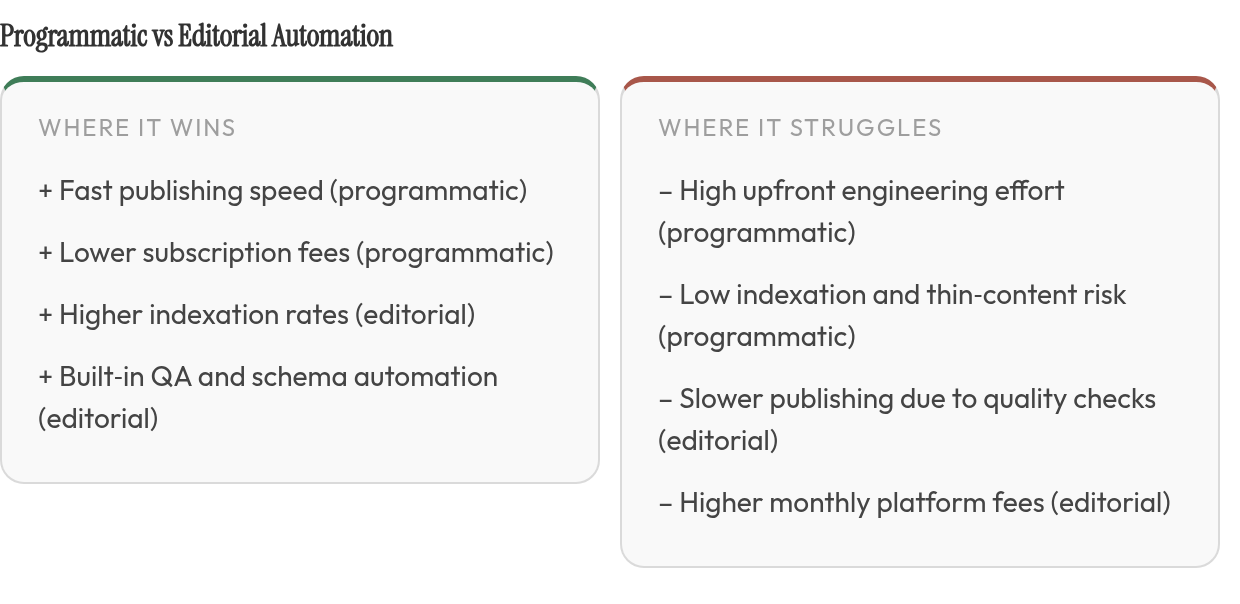
Teams often confuse volume with velocity. Programmatic SEO can publish location pages rapidly, but a large inventory has little value if it doesn't earn impressions or clicks. Editorial automation layers search-demand validation, schema markup, internal linking logic, and refresh workflows on top of generation—turning a page printer into a content engine that actually ranks.
Publishing speed vs. indexation reality
Template-based platforms can generate pages quickly once you configure the data source and template structure. The velocity is real, and production speed can spike significantly when the infrastructure is in place.
Editorial automation tools tend to publish more slowly because they front-load quality checks before pages go live. Platforms in this category validate keyword intent, inject structured data, and build internal link clusters as part of the publishing step. The tradeoff is a smaller initial release with more deliberate selection of pages for publication.
Google doesn't penalize templates simply because they're templates. The risk appears when a page changes only a city name while offering no location-specific evidence or utility. A system that enforces data-depth requirements is more likely to produce pages with a reason to exist than one that merely multiplies boilerplate.
Cost structure: subscription vs. total ownership
| Dimension | Programmatic Templates | Editorial Automation |
|---|---|---|
| Typical monthly cost | Lower subscription fees for generators; minimal for DIY stacks | Higher platform fees for governed systems |
| Engineering time | High upfront (template build, CMS integration) | Lower (pre-built CMS connectors, managed workflows) |
| QA overhead | Manual review or none | Built-in approval gates, brand-safety checks |
| Refresh effort | Fully manual; pages go stale | Automated refresh pipelines detect outdated data |
| Cost per indexed page | Can be higher when indexation rates are low | Can fall when more pages earn indexation and clicks |
The apparent savings of a DIY stack can narrow as the system ages. Spreadsheet databases, automation tools, and CMS connections require maintenance when an integration breaks or source data changes. Ongoing QA and content updates belong in the cost model alongside the monthly subscription.
AI search visibility: the new selection criterion
Programmatic pages built for traditional search—often around keyword density and backlinks—can lack the structured markup AI models need to extract and cite content. ChatGPT and Perplexity pull from pages with entity-rich schema, verifiable data sources, and extractable fact blocks.
Editorial automation platforms increasingly automate schema injection, including FAQPage, HowTo, and Product markup, at the template level and structure content into discrete, citeable fact blocks. The goal is to make pages easier for AI assistants to extract and cite without changing the underlying data.
A strong Google ranking doesn't guarantee inclusion in an AI-generated recommendation. Schema, clear entities, and evidence that can be lifted without interpretation give a page a better chance of being used in that setting.
Why this decision determines your maintenance burden
Programmatic pages can address thousands of specific, repeatable searches—"best accounting software for dental practices," "Slack + Asana integration," "hotels near JFK Terminal 4"—while editorial workflows typically publish 4-8 pieces monthly. That velocity gap looks compelling until you hit the operational wall: QA backlogs, indexation problems, and thin content that Google discovers but never ranks.
What programmatic publishing velocity actually looks like
Zapier built category-defining organic traffic by generating pages for tens of thousands of unique integration combinations from a single template structure. That's the ceiling. Most teams land somewhere between hundreds and low thousands of pages, constrained not by generation capacity but by data depth—the unique, verifiable information each page needs to avoid thin-content problems. Cost-per-page can drop when the system replaces manual workflows, but only if the template embeds sufficient differentiation. Swap a city name into identical boilerplate and you've built a spam factory, not a ranking asset.
Editorial automation adds governance to the generation process: demand validation before publishing, schema markup, internal linking logic, and refresh workflows. Those controls matter more as prospects increasingly use AI during pre-sales research. Pages that provide structured, extractable information are more useful to both readers and the systems summarizing them.
The operational pain points that emerge at scale
Publishing velocity creates three downstream bottlenecks. QA becomes the chokepoint: reviewing thousands of AI-generated pages by hand eats the time saved on drafting. Indexation management turns into a recurring diagnostic task because submitted URLs don't all enter the index. Optimization at scale requires separating pages that need substantive enrichment from those that only need clearer targeting or stronger internal links.
The teams that scale successfully treat template design as the architectural decision that determines both economics and ranking risk. When templates fail to embed distinct intent and sufficient data depth, the pipeline produces variations that compete against each other. A comparison page and a "best for X" page targeting the same software pair aren't a useful content cluster if both answer the same buyer question; they divide authority and make page selection less clear.
Not every keyword overlap signals a problem. Targeting a keyword on multiple pages works when each page answers a distinct search intent—an informational guide versus a transactional comparison versus a technical integration walkthrough. Intent is what separates a planned cluster from a ranking problem. Editorial workflows naturally encourage this separation because humans begin with a specific reader question. Programmatic systems need an equivalent rule in their template logic.
We approach this by validating search demand and intent alignment before pages publish, ensuring that each template variation targets verifiable keywords and serves a purpose no other page already covers. Volume without that validation creates unnecessary maintenance and weakens the information architecture.
Programmatic SEO templates: foundations and scale
Automating content creation for SEO through programmatic templates means building a structured system where repeatable keyword patterns meet differentiated data at scale. The foundation lies in identifying which search intents can support thousands of variations without collapsing into duplicate content, then validating that the dataset can genuinely distinguish each page from the next.
Which keyword patterns actually scale
Start by finding head terms with viable modifier sets—the patterns where one template produces genuinely different pages. Location-based searches work when you have location-specific data: "hotels near [landmark]" only succeeds if each landmark page pulls unique reviews, pricing, and availability. Integration queries scale when each pairing delivers functional value: Zapier's "[App A] + [App B] integration" pages tend to work because each page describes a distinct automation workflow, not just swapped product names.
Before building, run a modifier viability check: sample a batch of variations from your pattern and confirm that search demand exists for each. If most of the sample has no documented demand, abandon the pattern before investing in the build. If the confirmed modifier set is too small to justify the engineering effort, reject the pattern before building.
The data depth test separates thin templates from rankable ones: remove all modifier names from three generated pages and see if you can tell which is which from the remaining content. If they're indistinguishable, your template lacks the structured data required to make each page useful.
Publishing in stages instead of bulk
Launch in staged batches rather than flooding your site with thousands of pages at once. Publish an initial tranche, monitor Search Console performance, then iterate on template depth before scaling. A controlled release gives you a chance to identify weak fields, broken links, and poor page types while the affected inventory is still manageable.
Then watch which pages rank below the first page after a few weeks; these tend to signal insufficient content depth. Case studies on templated launches often show an early traffic spike that traces back to the small fraction of pages that accumulated backlinks—not the bulk inventory. Enriching underperforming pages before adding new ones compounds authority rather than diluting it across an expanding index of weak pages.
Track weekly indexation metrics and prioritize crawl budget by applying noindex to data-sparse pages rather than indexing everything. A smaller, high-quality inventory is easier to maintain and gives internal links more focused destinations.
AnyPost.ai: the integrated platform that marries templates and automation
Automating content creation for SEO using programmatic templates, the editorial layer—brand voice grounding, workflow QA, and publishing governance—is what separates systems that rank from systems that get filtered. We built our platform to solve the operational gap most teams hit after they generate their first thousand pages: how do you keep them on-brand, maintain quality at scale, and actually get them published without manual bottlenecks?

Brand voice as the foundation
Most programmatic tools treat voice as a post-generation problem. You generate pages, then review them individually to see if they sound like your brand. That approach collapses the moment you publish more than fifty pages monthly. We use a Persona Engine that analyzes your existing content and matches tone across everything we generate. The system crawls your website to understand your messaging, terminology, and audience patterns, then applies that voice consistently across every variation.
Some customer experience research is cited to argue that every programmatic page represents a brand touchpoint that either reinforces trust or signals automation. When prospects evaluate your content before reaching out, inconsistent voice signals low editorial standards and damages conversion rates before the first conversation starts.
When Zapier generates tens of thousands of integration pages, they're not reviewing each page individually for voice consistency—they built the voice into their content engine. Scaling programmatic SEO without losing brand coherence is the operational challenge every growth team faces once volume exceeds manual review capacity.
| Component | Traditional Programmatic Tools | Editorial Automation Platforms |
|---|---|---|
| Voice control | Post-generation review | Persona-driven tone matching |
| QA workflow | Manual spot-checking | Automated generation + spot review |
| Publishing | Bulk export or manual CMS paste | Direct WordPress integration |
| Refresh logic | None (one-time generation) | Scheduled content updates |
| Distribution | SEO-only focus | Multi-channel (SEO, social, newsletters) |
The workflow layer that actually scales
Publishing friction is where many programmatic strategies stall. Manual copy-paste between generation tools and a CMS swallows hours and introduces errors. We integrate directly with WordPress so content moves from generation to live URL without a developer touching the pipeline. You maintain editorial control—review what needs review, auto-publish what meets your standards—while the system handles the distribution mechanics.
The operational difference is velocity without quality collapse. Everything we generate includes semantic HTML structure and relevant internal links by default. That foundation gives large inventories a consistent technical baseline.
We also turn your articles into social media carousels and publish automatically to LinkedIn, X, Instagram, TikTok, and YouTube. Most teams stop at blog publication, then watch their content sit unused while competitors distribute the same topics across every channel their audience monitors.
Playbook: launching a scalable, non-cannibalizing content engine
The gap between generating pages and getting them indexed separates programs that compound from programs that stall. When automating content creation for SEO, the rollout sequence determines whether you catch cannibalization signals early or find them after publishing thousands of competing pages. Teams that rush to full deployment often spend months diagnosing weak performance across a large inventory.
The four-week controlled launch sequence
Week 1: Keyword clustering and intent mapping. Run your full modifier list through a clustering tool to group semantically similar queries. Flag any clusters where multiple pages would target near-identical intent—those are your cannibalization traps. Document the primary keyword, URL pattern, and template ID for each planned page in a keyword-to-page schema spreadsheet. Confirm that the planned variations have enough demand to justify the build.
Week 2: Template build and data depth audit. Design your template so every variation carries useful information beyond its modifier. Review three sample pages side by side and identify the fields that make each one different. Embed internal linking logic, canonical tags, and schema markup into the template itself—treating these as post-generation tasks collapses under volume.
Week 3: Pilot batch. Publish your first controlled batch to a staging subfolder, then submit the sitemap segment to Search Console. Monitor the Coverage report closely in the initial period. Pages ranking poorly after an initial indexation window indicate thin content or weak intent alignment; enrich those pages before expanding the program.
Week 4 and beyond: Staged expansion with weekly QA. If your pilot batch shows strong indexation and a meaningful portion of indexed pages earn impressions within the first few weeks, proceed with staged rollouts. Track these KPIs in a single dashboard: indexed page percentage, average ranking position for indexed pages, organic traffic per indexed page, and the ratio of indexed pages earning clicks. Pages stuck in "crawled, not indexed" status need data enrichment or noindex tags. Keep expansion tied to the quality of the pilot rather than to a fixed page quota.
FAQ
Can programmatic pages rank if most of them never get indexed by Google?
No, an unindexed page cannot receive organic rankings. The practical response is to treat indexation as a release metric: begin with a representative batch, review how Google processes it, and use the findings to decide whether the next group is ready. That keeps weak page types from expanding unnoticed.
What happens when two programmatic pages target the same keyword but different modifiers?
Different modifiers do not automatically create different opportunities. The pages should have separate primary questions, conversion paths, or supporting evidence. A comparison page, for example, should not duplicate the buyer guidance of a separate "best for X" page merely because the URL modifiers differ.
Why would a page rank on Google but never get cited by ChatGPT or Perplexity?
Search visibility and citation eligibility are separate outcomes. A page may satisfy conventional ranking signals while presenting its facts in a format that is difficult for an assistant to identify or verify. Clear entities, source references, and discrete answer blocks make the page easier to interpret when an AI system constructs a response.