Why Most AI Content Tools Ship Copy That Tanks Before Google Crawls It

Why This Matters
When you automate content for SEO, you assume every published page gets treated the same. It doesn't. Your AI copy might index fast, rank briefly, then fade—not necessarily because Google spotted AI, but because the page failed signals you didn't know were being evaluated.
The difference often comes down to domain context. On a trusted domain with existing authority and strong internal links, AI-assisted pages may get enough support to be indexed and retained. On a new domain, the same page may face a freshness cliff: an early crawl and temporary visibility, followed by declining recrawls unless engagement, authority, and architecture justify the cost.
Google doesn't penalize AI content. It penalizes content that wastes crawl resources.
Google's public guidance says AI-generated content can be fine. What matters is whether the page serves users or just manipulates rankings. The tool matters less than whether your page earns the crawl budget, indexing resources, and ranking consideration Google allocates.
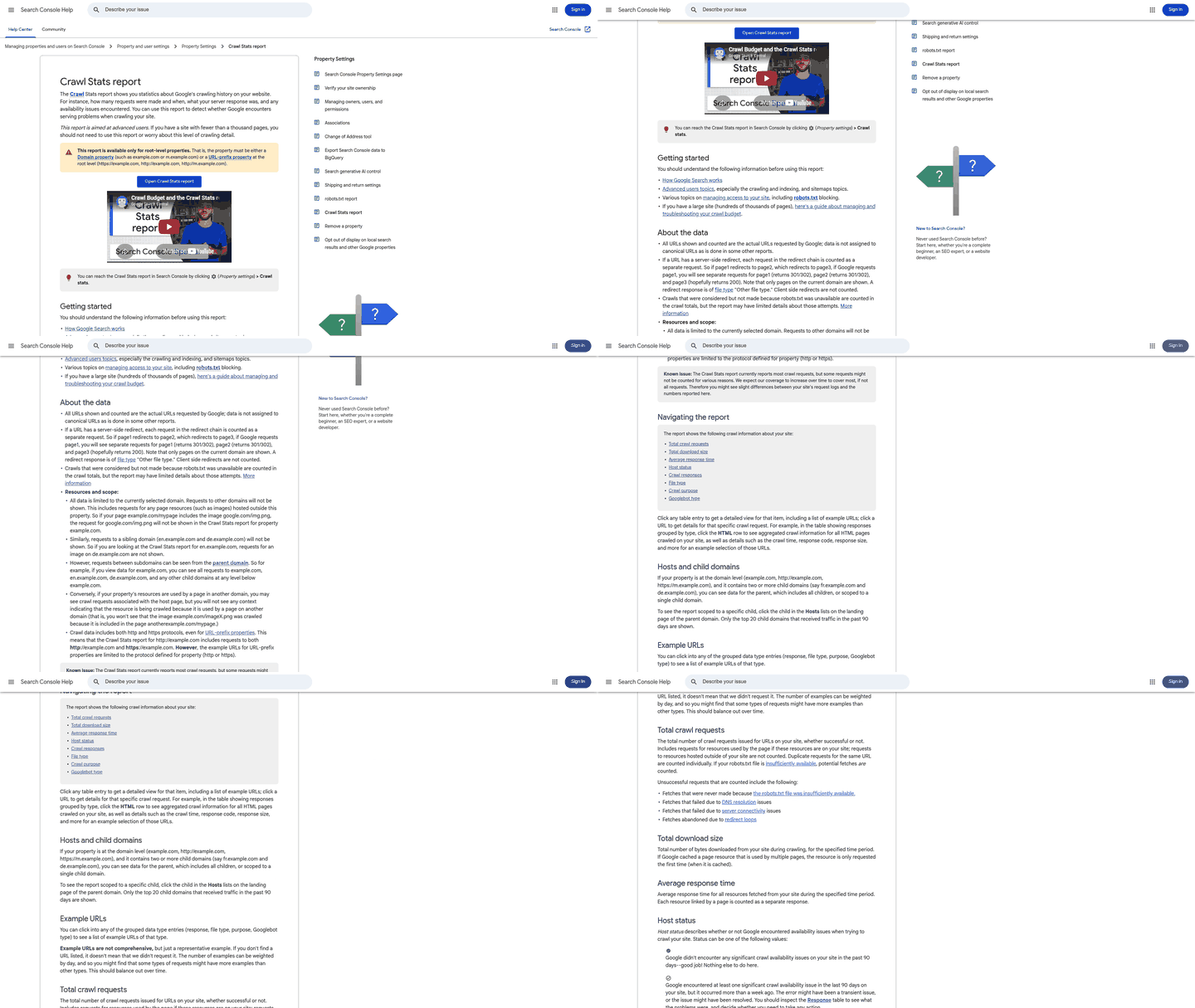
Here's what catches teams: crawling, rendering, and indexing pages consume finite resources. When you suddenly publish many AI-generated URLs, search engines weigh factors such as perceived inventory, demand, and domain authority to decide how often to spend resources recrawling your site. Sites that publish many thin or repetitive pages can see reduced crawl attention. An initial burst of crawl activity may not last if the domain's authority and engagement signals don't justify the scale.
Some site owners observe a pattern with AI articles on new domains: pages may index within the first month and generate early impressions, but many lose visibility after the freshness window closes. The content may not have become low-quality. It may have lost the temporary freshness signal and failed to accumulate engagement signals such as clicks, dwell time, or external validation. When search engines reduce crawl frequency to low-performing sections, pages that are not recrawled regularly become harder to keep indexed. For aggressive programmatic AI content, that window can be narrow.
Pre-crawl quality issues compound faster when you publish at scale
Publishing AI content without editorial review can expose you to several failure modes that hurt indexation and impressions before you realize anything is wrong:
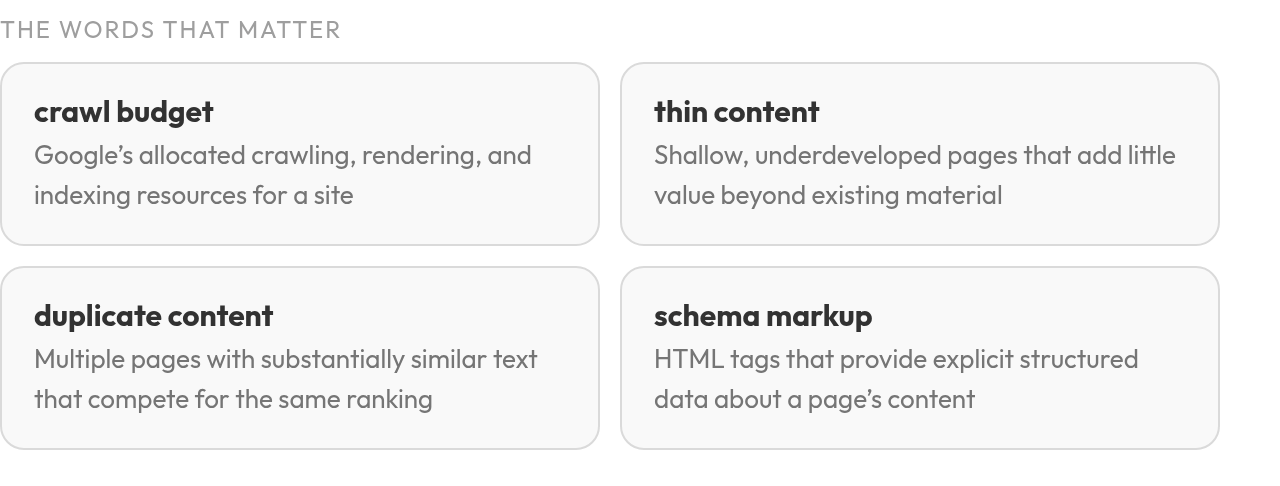
Thin or underdeveloped copy. AI tools can generate structurally correct but shallow content—paragraphs that restate the same idea in different words or skip details users need. Search engines evaluate depth and originality. Pages that do not add value beyond what competitors already publish often struggle to rank even when indexed.
Duplicate content across pages. When you generate many pages from templates, subtle duplication can creep in: repeated boilerplate, similar product descriptions that swap only a few variables, or location pages that differ by city name alone. Search engines often group similar pages and choose one to represent them in search results. The rest may lose visibility. Duplicate content does not necessarily trigger a penalty, but it can fragment ranking potential across URLs that compete instead of consolidating authority.
Poor readability. AI writing tools can produce unnecessarily complex syntax and long sentences that hurt engagement. Pages can pass automated SEO checks but still fail human engagement signals. Low dwell time and high bounce rates may signal to search engines that users did not find what they needed, which can suppress rankings over time.
Weak metadata and title-tag problems. AI copy can produce generic title tags that either get truncated or fail to differentiate pages from competitors. Missing or thin meta descriptions may reduce click-through rates from search results. When search engines must infer a page's topic because metadata is absent or unhelpful, they may index more cautiously.
Isolated pages with weak internal-link context. Scaled AI content can be published without proper integration into your site's existing architecture. Pages that lack strong internal links from authoritative sections may struggle to accumulate crawl priority and link signals. Search engines use link context to understand topical relationships; isolated pages can appear less important and receive less frequent crawling.
Manual fixes for these issues are difficult to scale. Reviewing hundreds of AI pages for duplication or readability problems can consume the time automation was supposed to save. Automated workflows can help when they are configured to audit readability, detect near-duplicate content, validate metadata completeness, and map internal-link gaps before publication. Workflows that integrate these checks may improve long-term performance compared with publish-first-fix-later approaches.
Lower indexation and weaker impressions are the measurable costs
Some analyses of AI content performance suggest indexation gaps between pages with a high share of AI-generated content and pages with more human review. Even when high-AI pages index, they may receive fewer organic impressions than pages with stronger editorial input. The difference may not be binary—AI versus human—but gradual: as the share of unedited AI content rises, engagement metrics can decline, which can suppress visibility over time.
Another pattern can appear in AI Overview inclusion. Structured, connected content with clear entity definitions may perform better in AI-generated answers. Some case studies suggest that entity linking—connecting on-page entities to internally defined terms or authoritative external knowledge bases such as Wikipedia—can improve AI Overview visibility, but the impact varies by site and query. AI systems may prioritize content that disambiguates meaning and demonstrates topical relationships. Pages that lack these semantic signals may be overlooked when AI models pull sources for generated responses.
The question isn't whether you use AI to automate content creation for SEO. It's whether your automation includes the pre-crawl quality checks that prevent wasted production effort, indexation failures, and ranking volatility before users ever see your pages.
What you need to know:
- Crawl attention can be throttled when sites publish many thin or repetitive pages, and previously indexed content can lose visibility.
- AI articles on new domains may index early but can lose visibility after freshness effects fade unless engagement and authority justify continued recrawling.
- Crawl allocation may be influenced by perceived inventory, demand, and domain authority.
- Pages with a high share of unedited AI content may receive fewer organic impressions than pages with stronger human review, even when indexed.
- Duplicate content across AI pages can fragment ranking potential because search engines may group similar URLs and show only one in search results.
- Poor readability can reduce dwell time and increase bounce rates, signaling lower engagement and suppressing rankings over time.
The Pre‑Crawl Pitfalls Most Teams Miss
When you automate content creation for SEO, many platforms hand you a polished draft and call it ready. That draft may not be ready. AI copy can fail technical and semantic checks before a crawler sees it, and those failures may not show up in your editor—they show up later when visibility softens and traffic slides.
AI output often arrives underdeveloped or unreadable
Some early-generation AI tools produced shorter outputs than requested and required multiple prompts to reach target length. The bigger problem is not always length; it is clarity. Many AI content generators optimize for keyword coverage and semantic relevance while letting sentence structure become stiff, repetitive, or too abstract for the audience.
Readability matters because users make quality judgments quickly. If a page feels like a search-engine summary instead of a useful answer, visitors leave. That behavior weakens the engagement patterns your content needs after it has been crawled and indexed.
Duplicate content wastes crawl budget you can't afford to lose
When you publish AI articles in isolation, you risk creating near-duplicates across your own site—especially if you use templates or bulk-generation workflows that swap out a few variables but leave structure intact. Search engines may cluster similar pages and choose one to represent them all. The rest may be filtered out, not penalized, but effectively invisible.
Run a scan with Siteliner or use Screaming Frog to catch duplicate title tags, meta descriptions, and body content before you publish. Check canonical tags and URL parameters. If your CMS adds sorting parameters for filters, those can spawn duplicate URLs that spend crawl budget on pages that add no value. Pages that show low engagement can face longer recrawl intervals and higher deindexing risk.
Title tags get truncated or ignored when AI generates them
AI tools can generate titles that either overpack keywords or underdeliver on specificity. Titles that are too long may be truncated in search results, cutting off your message. Titles that are too short may waste an opportunity to pull users in.
Audit every title tag before you publish. Search engines can rewrite titles based on their understanding of page content, but manual title tag creation gives you more control over the first impression users see. For your most important pages, that control matters.
Missing schema and entity markup costs you AI Overview visibility
Entity linking helps AI systems disambiguate meaning and understand how concepts relate within a broader knowledge ecosystem. Structured data gives search engines explicit signals about what your content means, not just what it says. When search engines can parse entities, relationships, and context through markup, they may be more likely to surface that content in rich results or AI-generated answers.
AI content rarely ships with entity markup or schema unless you build it into your workflow. When you skip this step, you may publish copy that search engines can crawl but not fully understand. That can mean fewer AI Overview citations, fewer featured snippets, and less visibility in environments where users get answers without clicking through. Some industry analyses report that structured data can improve click-through rates in enhanced search results, but outcomes vary by page and query.
Internal linking gaps leave articles isolated at publication
When you publish articles in isolation, search engines have less context for how they fit into your site's topical structure. Internal links signal crawl priority and topical relevance. AI tools may not automatically generate those links; they often write standalone drafts. If you automate content creation for SEO without a linking strategy, each new page may appear as an island with no supporting architecture.
Build a linking protocol before you scale. Every new article should link to at least two existing pillar pages, and every pillar page should link back to relevant new content. That creates crawl paths and signals topical authority.
Core Technical Gaps in Most AI Content Platforms
When you use AI content creation for SEO, the platform you choose can ship copy that fails before Google ever crawls it. The issue is not that AI wrote the text; it is that some AI content generators produce output with technical and quality gaps that hurt SEO before publication.

AI output can be too difficult to read
Many AI tools generate copy that looks comprehensive at a glance but feels dense once a reader starts moving through it. The paragraphs may include the right terms, related entities, and topic coverage, yet still require too much effort to parse.
That trade-off matters. Search engines can process text, but people decide whether the page is worth reading. If the language drifts academic, generic, or overloaded, the page may earn a crawl without earning sustained attention.
Length inconsistency wastes editorial time
Some AI generators produce shorter outputs than requested. Early tools may have required multiple attempts to hit a target word count, forcing editors to repeatedly prompt or manually pad the copy. When you automate content at scale, that inconsistency can consume significant editorial time. The hidden tax is not just the prompt engineering; it is the back-and-forth to coax the tool into delivering the target length without generating filler.
Title tags arrive broken or missing
Title tags often need tighter handling than AI systems provide by default. Some drafts produce a decent headline for the page body but fail to translate that idea into a search result title. Others skip the field entirely, leaving your CMS or search engine to improvise.
That creates an avoidable click-through problem. The title tag is not just a ranking element; it is the user's first reason to choose your result over the next one. If it is missing, vague, or mismatched to intent, the page enters search at a disadvantage.
Duplicate content risk goes unmonitored
AI content generators do not necessarily flag when output overlaps with existing pages on your site or across the web. You might publish multiple variations of the same article without realizing it, creating duplicate content that confuses search engines about which page to index and rank. Search engines may not penalize you for duplicates, but they may pick one version to represent in search results and filter the rest, diluting traffic across URLs you thought were distinct.
Duplicate content can affect AI-generated answers differently than traditional search. When an AI system generates an answer, it may select one page to ground that response in. Your duplicate pages may not appear at all; they can be filtered before the answer is constructed. That can make duplication less forgiving in AI Overviews than in organic listings, where near-matches may still appear in some form.
Schema markup and entity signals are absent
Most AI writing tools produce plain text without structured data. If you publish that copy directly, you may miss the schema markup that helps search engines understand entities, relationships, and content type. Without structured data, search engines may treat your content as untagged prose, forcing algorithms to infer context rather than read explicit signals about what each section means.
Some studies of featured snippets suggest that pages with FAQ or HowTo schema may be more likely to appear in position zero than pages without markup, but results vary by query and site. The structured layer can give search engines confidence about format and intent, which may affect placement in rich results. When your AI tool outputs bare HTML, you may be competing without the metadata that can help improve visibility in enhanced search features.
Building Crawl‑Ready Copy with AnyPost.ai
For AI content creation for SEO, the workflow should enforce quality gates before publication—not after Google has already decided your pages are not worth revisiting. Many platforms hand you a draft and assume you will catch technical flaws manually. That assumption can break at scale.
Metadata generation should flag truncation risk
Automated title-tag generation should aim to enforce reasonable display limits. Search result titles that run long can be cut off before the useful part of the message appears. Meta descriptions have a similar practical problem across desktop and mobile layouts. If your workflow does not flag risky metadata before publish, searchers may see an incomplete pitch.
Google's documentation on title-link generation notes that excessively long titles can be rewritten automatically. When this happens, you lose some control over the message. Automated systems may reduce this by flagging titles and descriptions that are likely to be truncated. Manual review at scale does not catch these consistently; the check is more useful at generation time.
Persona inputs should target comprehension, not just keywords
Many AI tools chase keyword density and semantic relevance while leaving audience comprehension underspecified. Some platforms offer persona-based generation that captures brand voice from existing content and briefing inputs, helping drafts match the tone, complexity, and structure the audience expects.
Briefing inputs should include audience, use case, proof points, and readability targets during generation. If your workflow accepts "write 1,500 words on X" without specifying who will read it or what action they need to take, you may get technically correct copy that no one finishes. Readability checks should run before publish, flagging dense sentences and overly long paragraphs. These are not polish tasks; they are structural requirements.
The crawl-ready pipeline needs sequential quality checks
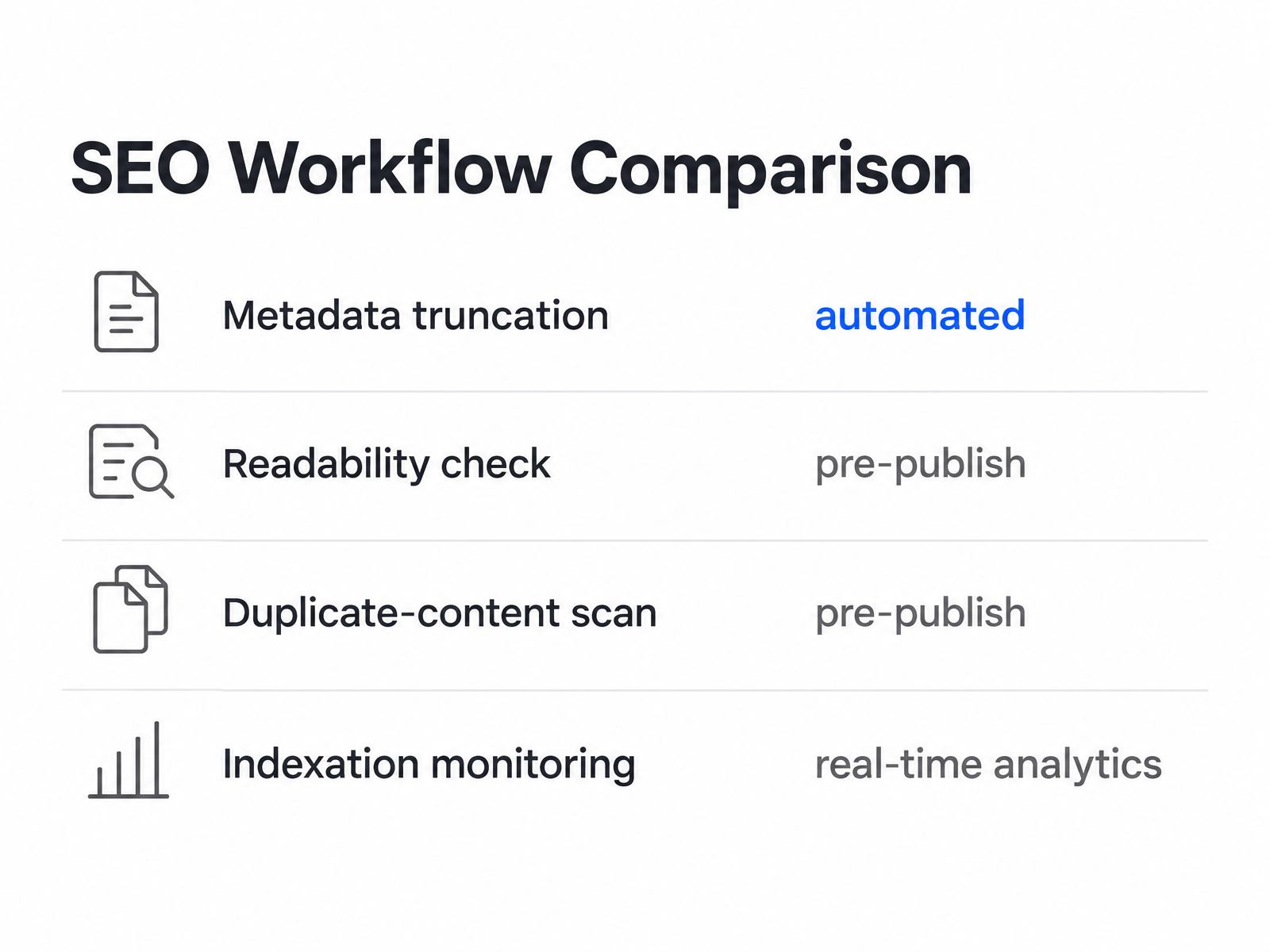
Draft generation is step one. The pipeline should then enforce:
- Readability check: flag overly complex sentences, dense paragraphs, and passive voice.
- Duplicate-content scan: compare new drafts against existing indexed pages to catch internal cannibalization before search engines do.
- Metadata check: verify title-tag and meta-description length, and ensure each page has a unique set.
- Schema and entity check: confirm structured data validates, entity references resolve to known identifiers, and relationships are explicit.
- Internal-link check: ensure the new page connects to related existing pages and that those pages link back, creating crawl paths search engines can follow.
Only after those checks pass should the content move to publish. The final step is indexation and visibility monitoring: track when search engines first crawl the page, whether it enters the index, and how it performs in search results over time. A fast drop after launch may point to a structural issue rather than an algorithm shift.
Workflows can fail when they treat these checks as optional polish rather than mandatory gates. Some long-running SEO observations suggest that many pages may index initially but lose visibility within weeks unless structure, links, and semantic disambiguation justify continued crawling.
What to Check Before You Hit Publish
For AI content creation for SEO, the real work begins after the draft arrives. Many AI drafts ship with technical and quality gaps that can hurt rankings before search engines finish their first pass. The checklist below covers the pre-crawl audit gates that separate content that ranks from content that disappears.
Run a pre-crawl quality scorecard
Start with metadata. Look for title tags and descriptions that will be unclear, incomplete, or too generic in search results. Tools like Screaming Frog can surface these issues during review instead of after performance has already stalled.
Next, scan for duplicate content. If your AI tool generated copy that already exists on another domain—or if it recycled blocks from your own site—you may be spending crawl attention on pages search engines may cluster and filter. Run a site search with site:yourdomain.com plus a long-tail keyword to spot internal overlap quickly. For broader checks, use a crawler or duplication scanner before the page goes live.
Readability deserves its own pass. Look for sentences that bury the main point, paragraphs that stack abstractions, and sections that repeat the same claim without adding a new detail. Hemingway Editor or WebSite Auditor can help flag passages that need human revision before they lose reader attention.
Check schema and entity signals. Entity linking to authoritative knowledge bases—Wikipedia, Wikidata, your own internal entity definitions—may help AI systems disambiguate meaning. Instead of treating structured data as a final technical add-on, make it part of the publishing workflow so each page leaves clear clues about people, products, concepts, and relationships.
Review internal linking. AI drafts often arrive as isolated pages with no connection to your site's existing taxonomy. Map each new article into your topical clusters before publishing. Orphaned pages struggle to pass authority signals and may be deprioritized when crawl demand tightens.
Set up post-publication monitoring
Track indexation rate in the early launch period. If search engines indexed most of your pages quickly, the content cleared the first crawl gate. If only a small fraction made it in, you may be hitting quality thresholds or crawl budget limits.
Watch for delayed visibility loss. Pages that attracted no meaningful engagement at launch can lose recrawl priority through resource starvation rather than a formal penalty. Monitor impressions and clicks weekly through Google Search Console. If a page has not been recrawled in months, review it before it disappears from the index entirely.
Run the scorecard on your next AI draft before you hit publish. If you use a platform like AnyPost, check whether it can be configured to flag title-tag truncation risks, duplicate-content overlap, readability issues, and schema gaps before publishing.
Quick Questions, Straight Answers
1. Does Google penalize AI-generated content differently than human-written content?
No. Google evaluates the usefulness and intent of the page, not the identity of the writer or the software used to create it. AI content gets into trouble when it is shallow, repetitive, disconnected from the site architecture, or produced in volumes the domain cannot support. In those cases, the outcome often looks like a penalty because visibility falls, but the underlying issue is usually quality, relevance, and crawl prioritization.
2. Why do AI-generated articles lose visibility after the first month even when nothing changed?
A new page can get an early test in search, but that attention is not permanent. Once Google has enough evidence about how users respond, weak pages stop earning the same visibility. AI-generated pages are especially vulnerable when they summarize existing results without adding original structure, examples, expertise, or clear internal context. The page may be technically indexed, but it no longer looks worth revisiting or promoting.
3. How do I know if my AI content is creating duplicate content problems across my site?
Look for repeated titles, similar snippets, and pages that answer the same query with only minor wording changes. A manual Google search using your domain plus a distinctive phrase from the draft can reveal overlap quickly, and crawler tools can compare titles, descriptions, and body copy across your site. The key warning sign is a set of URLs that appear different to your CMS but interchangeable to a search engine.