Publish on Your Blog First, Social Second: Indexed Pages Outlast Feed Posts
Quick Answers
- Research analyzing 5.6 million social posts across 11 platforms shows blog content maintains engagement for years while feed posts concentrate engagement within hours or days.
- Social platform engagement half-lives range from under one hour to approximately one day, forcing high-frequency iteration over depth.
- Blog posts continue attracting organic search traffic for months or years, so blog-first makes more sense for evergreen or search-intent topics than for urgent or experimental ones.
- Indexed blog pages serve as long-term assets that feeds can point back to, reversing the typical content distribution sequence most teams follow.
- Reposting the same blog excerpt with different wording across several weeks outperforms single polished shares when engagement windows close within hours.
- Skip blog-first sequencing for time-sensitive announcements or untested angles where social feedback arrives within hours before committing production effort.
- Exact engagement timeframes vary across studies measuring different metrics, but the directional ranking holds: feeds decay in hours, blogs stretch across months.
Most Teams Get the Order Wrong
The mistake isn't in the writing. It's in the sequence. Publish a thought to Instagram first and you get a spike, then it's gone. Write it as a blog post first and that same idea can keep pulling people in months later. That choice sits underneath every decision about how you distribute content.
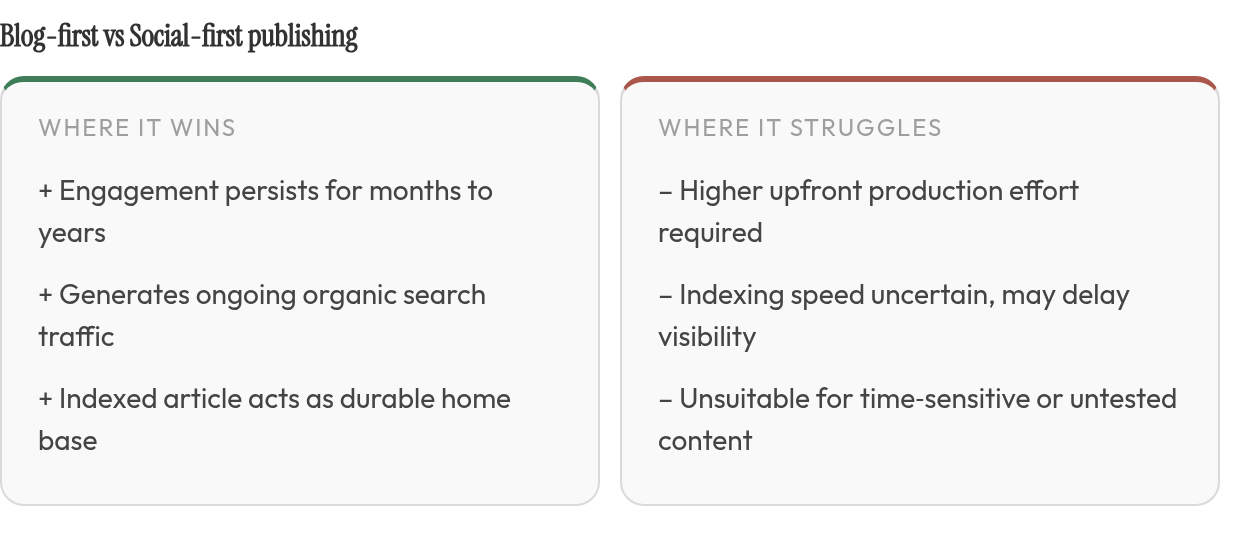
The gap is real. A social post creates a short distribution window—feed half-lives in the research range from under one hour to about a day—while a useful blog page keeps earning search visits for months or years. That is the difference between promoting an idea and owning the destination.
| Workflow | Publishing sequence | Engagement window | Longevity | Distribution role | Upfront effort | Measurement focus |
|---|---|---|---|---|---|---|
| Blog-first | Indexed article, then social cuts | Extended engagement over time | Search keeps surfacing it | Home base that feeds point back to | Often higher; varies by team | Indexing status, organic visits over months |
| Social-first | Feed post, blog later or never | Concentrated early engagement | Fades once the feed moves on | Spark that tests and amplifies | Often lower per post; varies | Early reactions within hours |
Studies Disagree on Timeframes, Not Direction
The exact numbers shift because each study measures different metrics and observation windows, so treat them as directional rather than universal. The consistent finding is that feeds concentrate attention early, while search distributes attention long after publication.
Blog-First Has Real Costs
We generate and publish content to your website first, then distribute it to social platforms. The indexed page becomes your long-term asset. It costs more upfront, and you need to confirm the page actually gets indexed. Indexing speed, production effort, and ROI vary from team to team.
Use blog-first when the topic is evergreen or search-intent and you want a durable asset that can rank. Use social-first for time-sensitive announcements or when you're still testing an angle. Social gives you feedback quickly, so use the feed to find out which message works before investing in the long version. If a platform offers a longer discovery half-life, treat it as the home base and point fast feeds back to it.
Why the Blog Outlasts the Feed
A feed gives an idea an opening burst. A search result can keep introducing it to people with an active need. In the research above, social activity drops rapidly on many platforms, while a blog page can remain discoverable when it continues to rank. That changes the article's role: it's not just a longer version of a post, but a durable destination for the campaign.

Engagement half-life measures the point where a post has collected half of all the interaction it will ever receive. The research range—under one hour to about a day for many social feeds—shows why the clock matters. Some social feeds decay almost immediately unless a post goes viral. Other platforms support longer discovery windows. The platform you choose sets the clock on how long your content can keep working. That clock should decide how much production depth the idea deserves.
Short Half-Lives Reward Speed, Long Half-Lives Reward Depth
When attention disappears quickly, you need a high-frequency rhythm. Batch-produce variations of the same idea, test different hooks, and publish while the audience is active. A single update won't reach every follower, so the same underlying message may need several genuinely different entry points.
Longer-lived content lets you invest time differently. A blog post that generates traffic over an extended period can support deeper research, fuller explanations, and evergreen packaging. You write it once, refresh it occasionally with updated data or new examples, and it continues pulling people in long after publication. Feeds are useful for discovery and response, but their short lifespan makes them a poor substitute for the underlying resource.
When to Publish vs When to Promote
Blog-first doesn't mean waiting for search traffic before promoting the article. It means establishing the durable destination before sending short-lived distribution toward it. Social posts can create an early pulse, while the article remains available for people who discover it later through search, links, or direct sharing.
Fast-Decaying Platforms Need Batch Production
Platforms with brief engagement windows need batch production rather than perfectionism. Research indicates that reposting an article excerpt with a changed hook or framing over several weeks can outperform one highly polished share. The reason is practical: individual updates reach only part of an audience, and many followers will never encounter the first version.
Instagram and LinkedIn provide somewhat more breathing room than the fastest-moving feeds, but they still work best as discovery channels. Use them to spark interest and direct traffic to the indexed article. The immediate reactions are useful for learning which framing attracts attention. The site remains the place where the complete explanation can keep working.
Treat Indexing and Social as Separate Checks
Google states clearly that submitting a URL for indexing is a request, not a guarantee, and that repeated submissions don't change queue position. Indexing can take anywhere from hours to weeks depending on your site's authority and update frequency. That uncertainty makes publishing the article first sensible: the indexing process can begin while you prepare distribution.
Once the page is live, verify indexing separately from your social schedule. Use Search Console's live URL test to confirm Google can access the page, then request indexing if the page isn't already in the index. Social amplification happens in parallel. Schedule platform-specific versions over the following weeks, using each one to direct readers to the same owned destination rather than treating social publication as a prerequisite for the article.
How We Automate the Full Sequence
After every post goes live, we work through a pre-promotion checklist: verify the URL loads, check that the page is crawlable through Search Console, and confirm the sitemap includes the new entry. Then we wait for Google's crawl process to do its work. A submission can prompt discovery, but it can't guarantee when a page will appear in results.
Automation is most useful for removing small operational gaps. A checklist can catch a broken URL, missing metadata, or an unchanged sitemap before the promotional schedule begins. It also keeps publication and distribution visible as two connected workflows instead of making one dependent on the other.
Check Indexing Before You Amplify
Once the post is live, run a quick site:yoururl.com/new-post-slug search in Google. If it shows up, you're indexed. If not, open Google Search Console, paste the full URL into the inspection tool at the top, and run a live test. A green "URL is available to Google" result means the page is crawlable and ready. It just hasn't been added to the index yet. At that point, hit "REQUEST INDEXING" once and move on.
While the index catches up, prepare your social adaptations. Give each version a distinct lead, example, or question, while keeping the article as the destination. That approach lets social do its job—creating immediate awareness—without turning a temporary feed update into the only home for the idea. The article can continue collecting search visibility independently.
How to Measure Durability Against Feed Decay
We track blog outcomes in organic sessions, lead conversions, keyword positions, and inbound links—categories that measure durability, not just yesterday's likes. Social engagement is still useful, particularly for judging hooks and audience response, but it shouldn't be the only evidence you use to evaluate an article that's designed to work over time.
The research above found that platform lifespans vary widely. Feed half-lives run from under one hour to about a day. Search-led traffic follows a different pattern—it may begin slowly, then continue for months or years as the page becomes discoverable for relevant queries. Comparing the two requires more than placing their launch-day totals side by side.
Half-Life as a Practical Measurement
Calculate half-life by tracking when your content accumulates 50 percent of the total engagement you observe over a chosen window. Report the observation period and platform separately because the same idea published on a fast-moving network and as a blog article will show different decay patterns.
One workflow is to evaluate social posts over a short monitoring period and blog posts over a substantially longer one, then compare the point at which each reaches the midpoint of observed engagement. The purpose isn't to force identical measurement conditions. It's to show whether a format continues contributing after the initial promotional cycle has ended.
When you measure by half-life instead of peak engagement, you see which formats keep delivering after the initial push. A page that brings someone to your site long after publication is doing more than a post that peaks and disappears. Use that evidence to allocate effort: rapid batch production for fast feeds, deeper research and refreshes for the pages that keep earning. Track the half-life, note the platform, and state the observation window so you can compare results fairly across your distribution strategy.
Questions People Ask
1. How many times can I repost the same blog content to social media without annoying my audience?
There is no universal posting limit. Reuse the article when the audience, timing, or entry point changes, and stop when the updates begin to feel interchangeable. A practical variation might lead with a lesson, a different one with a question, and another with a specific section of the article. Keep the destination consistent, but make the reason to click distinct.
2. Should I wait for my blog post to get indexed before I start sharing it on social media?
No—begin social distribution after publishing rather than making it dependent on the indexing result. Use Search Console to inspect the page and submit it once if needed, then continue preparing social variations while Google processes the URL. Early promotion can bring readers and feedback, while the article remains available for later discovery.
3. When does it make sense to post to social media first instead of writing a blog post?
Skip blog-first sequencing for time-sensitive announcements or when you're testing an angle you haven't validated yet. Social gives you feedback quickly, so use the feed to find out which message resonates before investing production effort in a long-form article. Once the angle is clear, expand it into an indexed post that can support future discovery.
4. How do I know if my content repurposing strategy is actually working over time?
Track organic sessions, keyword positions, conversions, and inbound links alongside early social reactions. Review the results over a period long enough to capture search behavior rather than judging the article by launch-day activity alone. Half-life can add another useful view: record when each format reaches the midpoint of its observed engagement, identify the platform, and document the observation window.