SEO Content Generation Checklist: 5 Guardrails Before You Automate

In short: Google’s content systems began rewarding quality about a decade ago as mass-produced publishing grew. That shift did not penalize AI authorship itself. Google’s helpful content system prioritizes material created primarily for people, while ranking manipulation based on automation falls outside its spam policies. The five guardrails are: 1) brand controls before drafting, 2) topic validation through keyword and search-intent research, 3) E-E-A-T and quality standards before automation, 4) metadata, structured-data, and internal-link review, and 5) workflow checks and monitoring. Each gate moves human review toward judgment-heavy checks instead of repairing weak drafts. Content briefs cover seven fields: target query, related subjects, longer variations, intended reader, editorial perspective, opportunities to connect with existing pages, and voice guidance. Human reviewers then check factual accuracy, originality, audience fit, and brand voice before publication.
The Work Starts Before the First Draft
Guardrail 1: Set brand controls before drafting. The part teams routinely underestimate is not the drafting. It is the time spent repairing generic phrasing, inconsistent tone, and unsupported claims after automation has already produced a full draft.
What Google’s approach means for AI-assisted content
Authorship is the wrong test for an automated draft. The better question is whether the page addresses a genuine audience need and offers information worth publishing.
That distinction changes the workflow. Instead of treating compliance as a final inspection, teams can build audience purpose, evidence requirements, and editorial accountability into the process. Guardrails then shape the draft from the start rather than adding a cosmetic layer at publication time.
Which guardrails prevent the most rework?
The most effective controls explain how the business should sound before the model writes a word. Without clear creative boundaries, you often get polished copy that could have come from any company with a content form.
-
Give the model a defined assignment: name the reader, the need, and the action the page should help them complete.
-
Turn brand voice into reusable instructions: preferred vocabulary, formality, sentence rhythm, recurring terminology, and language the team avoids.
-
Supply examples of successful published work; require a pass/fail voice check against those samples before the draft moves forward.
-
Assign a named editor to inspect claims, examples, transitions, and shifts in perspective; fluent output can still be unreliable or tonally wrong.
-
Compare the finished article with its original brief; fail it on missing sections, terminology drift, or departure from the agreed editorial angle.
You do not need an elaborate voice system for a routine announcement with low risk. It becomes more useful for search-led articles, service pages, and thought leadership, where readers meet the brand through work published at different times.
Sequence matters as much as the individual checks. Set the creative constraints, generate within them, and reserve editorial attention for decisions that need context. That beats letting a weak draft swallow half an afternoon of line-by-line repair.
Guardrail 2: Validate Topics Through Keyword and Search Intent Research
A strong SEO content generation workflow does not begin with a prompt. It begins by deciding which question deserves an answer, who is asking it, and whether your business has a useful perspective to add.
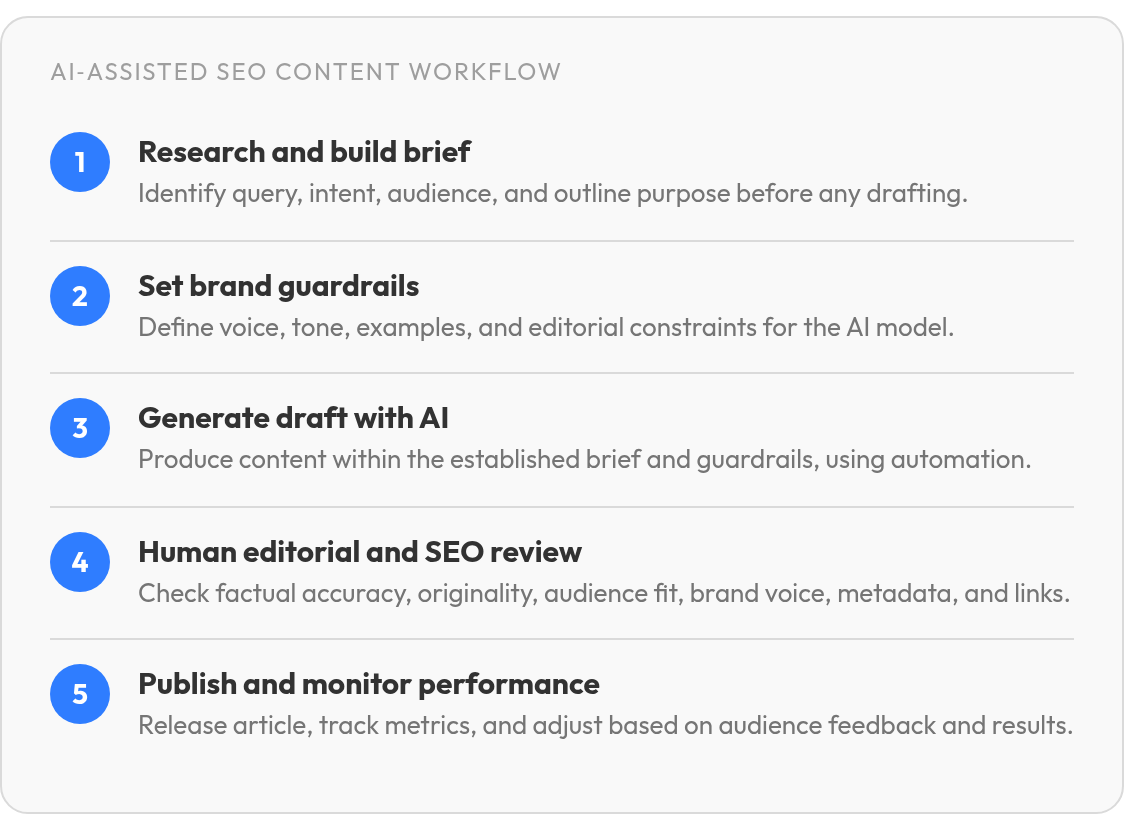
For unfamiliar subjects, research should come before substantial writing. Otherwise, your team can spend hours refining an article built on a premise the search data never supported. A straightforward update with a settled audience and purpose can move through a lighter process.
Match search intent to the content you plan to write
Test whether the target phrase and proposed page solve the same problem. Someone preparing for wet weather needs different information from someone choosing a campground, even though both searches fall under the broader camping category. Confirm the reader, question, and expected format before asking AI for prose.
- Check the primary phrase against the reader’s actual problem instead of relying only on search demand
- Decide whether the response should be guidance, a comparison, a checklist, or a local option
- Stop production when the proposed article and the likely need point in different directions
Research for “camping in the rain” may support several narrower questions rather than one oversized page. Organizing those questions into connected pieces gives each article a specific job while preserving continuity across the broader subject.
Build the brief before the draft
A content brief turns research into production instructions in seven fields. Adding personality after generation usually means rewriting, not editing.
- Target query and defined purpose
- Related subjects
- Longer variations
- Intended reader
- Editorial perspective
- Opportunities to connect with existing pages
- Voice guidance
With that map in place, writers, editors, and automation work toward the same destination. The final review can then ask whether the page fulfilled its assigned role instead of checking whether a tool produced enough words.
Guardrail 3: Enforce E-E-A-T and Quality Standards Before Automation
Automation can produce convincing language without knowing whether the underlying claim is correct, useful, or distinctive. Editorial standards need to define what qualifies for publication before the system starts creating pages at scale.
This guardrail is not about detecting machine-written sentences. It establishes accountability. A person should be able to explain why the article exists, where its information came from, and how it serves the reader and the business.
What should a human review before publication?
Editors should focus on weaknesses that fluent generation can conceal, including thin reasoning, unverifiable details, generic advice, and abrupt changes in perspective.
- Verify that the response follows the briefed need instead of drifting toward an adjacent subject; fail it if the target reader would not recognize the answer.
- Trace quotations, data, and factual assertions to their original material; delete anything that cannot be substantiated.
- Test the article’s practical value: the reader should leave with an answer, an actionable next step, or a perspective worth remembering.
- Read the draft beside established brand content; revise false familiarity, stock phrasing, and language that feels disconnected from the business.
- Connect the page to an intended result—qualified visits, leads, or sales—and kill it if no defined role exists.
- Preserve the editorial instructions with the assignment so they remain visible during review.
Document these checks instead of relying on memory. A visible record makes recurring weaknesses easier to identify across drafts, which means you can adjust the process that created them.
Is the draft ready to publish?
A publication decision should reflect the article as a whole, not a single optimization score or an impression that the prose “sounds good.”
- Record the review outcome and name the unresolved weaknesses; surface polish should not conceal a sourcing or positioning problem.
- Let a named reviewer approve the article only when its claims are defensible, its contribution is useful, and its presentation suits the intended reader.
- Return weak work for targeted revision; specify whether the problem concerns evidence, depth, organization, or style.
- Confirm that the page has an appropriate destination and a clear reason to exist within the site.
Guardrail 4: Apply SEO Optimization Checklist for Metadata, Structured Data, and Internal Links
The final on-page review should connect discoverability with editorial intent. Metadata, structured data, and links influence how a page is presented and navigated, so they should reinforce the article rather than act as technical decorations added by default.
SEO metadata must preserve your positioning
A title tag and meta description introduce the page before a visitor reaches it. Both should represent the article accurately, communicate its value in the company’s language, and avoid promises the body cannot fulfill.
- Make the title tag clear about the core subject without duplicating the on-page headline word for word.
- Give the description a concrete reason to continue instead of relying on generic promises about secrets, tips, or expertise.
- Compare the metadata, headings, and introduction for terminology conflicts that make the page feel assembled from unrelated prompts.
- Inspect the rendered result for forced keyword placement and revise any phrase that no longer sounds natural.
If the existing metadata already represents the article and its positioning clearly, an accuracy pass may be enough. Rewriting every field because a tool offers another version can flatten language that was already working.
Structured data and internal links need editorial judgment
Markup should describe material readers can actually see, while links should support movement through the site. Mechanical implementation can surround a useful article with irrelevant destinations or inaccurate labels.
- Select a structured-data type only when it corresponds to the page’s real format. A step-by-step article, for instance, should contain the elements required by the procedure it represents.
- Match every marked-up detail to visible information on the page and remove properties that cannot be confirmed there.
- Inspect each link’s destination, context, and anchor wording instead of inserting it merely because a related phrase appears.
- Position links where a reader may need more context or want to continue the task.
A SaaS content writing checklist, for example, can lead naturally to a broader guide about repeatable editorial systems. The relationship should be clear without requiring knowledge of the underlying content plan. Reviewing titles, snippets, labels, and anchors together also keeps optimization language from competing with the article’s message.
Guardrail 5: Implement an Automated Workflow With Built-In Quality Checks and Monitoring
Workflow failures often happen during handoffs. Research may not reach the person building the outline, or a technically correct edit may strip the language that distinguished the original draft. A controlled pipeline protects those decisions as the article moves from planning to publication.
A repeatable process can cover research, clustering, outlining, generation, visuals, editing, on-page optimization, and promotion. Planning limits unfocused coverage; visual review checks that images add meaning; editing catches language that works grammatically but not editorially.
What should a repeatable content pipeline include?
Turn the approved brief into an outline before generating complete prose. The outline should show what each section must accomplish, which source material supports it, and where visual or navigational elements belong.
- Create a research brief that identifies the audience’s problem and the page’s place within the wider subject.
- Develop an original structure that assigns a purpose to every section and carries the agreed editorial constraints into generation.
- Produce the initial draft, then select visuals that clarify or support the explanation instead of decorating generic copy.
- Edit in separate passes for clarity, sourcing, style, and relevance. Mark recurring language, unsupported assertions, and passages that could belong to any competitor.
Defined handoffs also make ownership visible. One person should approve the brief, another named reviewer should evaluate the draft, and publication should happen only after outstanding issues are resolved.
What should you monitor after publication?
Publication starts the feedback stage. Performance tracking shows whether the page is reaching the audience it was designed for and where revisions may improve its usefulness. More visits can still mask a mismatch if readers quickly discover that the article does not deliver what the search result promised.
- Compare post-publication indicators with the baseline selected during planning, focusing on measures tied to the intended query and reader.
- Examine search previews and audience comments for wording that conflicts with the company’s positioning or creates the wrong expectation.
- Improve an existing page before adding a replacement to the queue. A revised opening, clearer framing, or stronger connection to another resource may solve the problem without creating overlapping content.
Automate stable mechanics such as routing, formatting, and distribution, but keep final accountability with a person. Software can speed movement through the system. It cannot decide which editorial choices make your company recognizable.
Quick Questions, Straight Answers
Does using AI to speed up content production automatically count as spam?
No. Evaluate the finished page and the workflow behind it rather than treating the tool as the deciding factor. A responsible process begins with a legitimate reader need, keeps evidence traceable, and gives a named editor authority to reject weak output. Volume should never bypass those controls.
Can published examples replace a rigid brand voice manual?
They can serve as a practical starting point, but they should not become an excuse for copying familiar sentences. Choose samples that represent different formats, annotate what makes them successful, and periodically replace outdated material. A short set of explicit non-negotiables can cover cases the examples do not show.
Does high search volume mean a new article is worth publishing?
No. Demand is one input in the decision, not permission to create another page. Before approving production, check whether your site already addresses the subject, whether the proposed contribution is distinct, and whether the business has enough relevant material to answer it well. This avoids cannibalizing existing work or publishing a thin variation.
When do internal links and structured data add noise instead of value?
Use the editorial review in Guardrail 4 as the decision point. If an element requires awkward wording, interrupts the reading experience, or exists only to satisfy an automated recommendation, reconsider it. Optimization should clarify the page’s role, not make the implementation visible to the reader.