Why Most SEO Automation Fails: Missing the Editorial Layer

Before we get into it:
Most SEO automation falls apart when you start generating content at scale. The failures often look the same: crawl jobs step on API calls, partial runs have no restart point, and something ships live without anyone checking whether it makes sense. The editorial layer, the human checkpoint between generation and publish, catches tone drift, factual problems, and duplicate pages that automation misses. Staged workflows let you rerun a failed crawl or fix a single brief without reprocessing everything. Split crawl and generation into separate modules so API rate limits hit one stage, not the whole system. Teams automate the scaffolding — internal linking, intent mapping, and schema validation still need a human call.
The Hidden Tax of DIY SEO Automation
The part most teams underestimate isn't getting the automation running. The real cost shows up weeks later, when a poorly coordinated run silently breaks work you thought was done.
At scale, automation creates a coordination problem. Large crawl jobs and content generation workflows need to run without colliding, or you hit rate limits, silent failures, and no clean recovery path.
Why Does Scale Break Your SEO Automation?
The answer is in workflow design. Most teams build their first SEO automation as a single batch: trigger it, wait, collect results. That holds at low volume but collapses in production, where crawl jobs and API calls compete for the same resources.
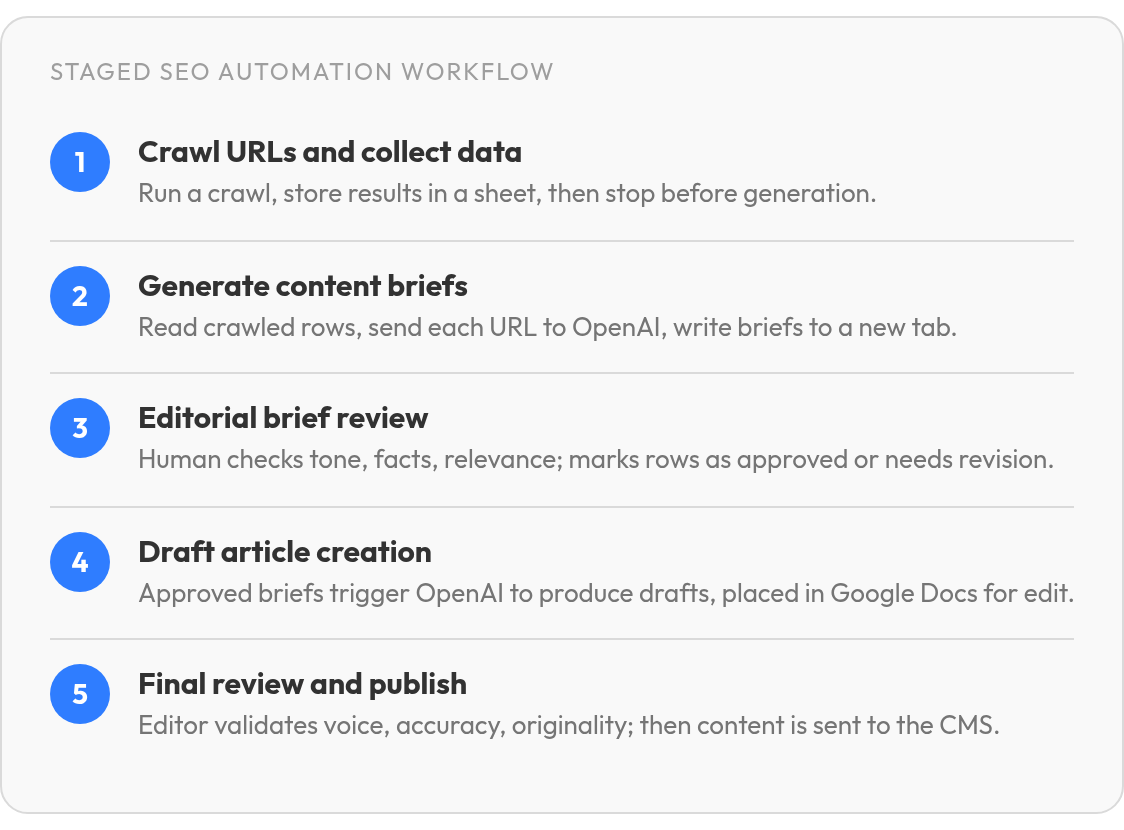
A staged process solves that. Each operation runs in isolation and can be retried on its own. A crawl finishes and saves its results before content generation starts, giving the system a stable hand-off between tasks. We cover that five-stage design in more detail here.
The work automation should remove is the scaffolding, not editorial judgment. Internal linking, intent calls, and schema decisions stay human. Once the machinery is dependable, the editorial layer has room to do its job.
When Automation Meets the Editorial Gap
Teams automate content creation for SEO and assume the hard part is over. The crawl runs, briefs populate, and drafts land in a review step. Then a strategist opens one and finds a meta description that repeats the H1 verbatim, a factual claim that contradicts the product roadmap.
That gap between technical execution and editorial judgment is where most SEO automation breaks down. But if no one checks the output before publication, the system can ship material that quietly erodes trust instead of building it.
What the Editorial Layer Actually Catches
The editorial layer is the checkpoint between generation and publication. It asks questions automation cannot reliably answer: Does the draft match the brand voice? Are its factual claims current and defensible? Is the keyword targeting aligned with what the product team shipped last quarter? Does the piece duplicate something already published?
Those questions expose several distinct failure modes. A model may invent a statistic or rely on a deprecated API. A prompt with too little audience or product context may produce a generic tone. A high-volume publishing process may create a near-copy of an existing page because no one compared the draft with the current URL set.
These are not merely cosmetic defects. A technically successful workflow can still produce content aimed at the wrong intent, make claims the business cannot support, or dilute the site's topical structure. Editorial review evaluates those consequences together.
Staging the Workflow So Each Step Can Fail Cleanly
A staged workflow separates crawling, generation, and publication into distinct steps. You can trigger a large crawl overnight, write the results to a staging file, and run a second workflow the next day that reads those rows and sends them to the generation step individually. Keeping the crawl away from live completion calls reduces competition for API capacity and gives each stage a clear boundary.
If the crawl stops midway, it can be rerun without disturbing the content work. If one brief returns an error, that row can be addressed without rebuilding the dataset. The editorial review point sits between meaningful stages rather than arriving after every item has already been pushed live.
Building an Editorial Layer Without Hiring a Team
When teams first automate content creation for SEO, they often assume the challenge is building the workflow. The more consequential test comes after the first drafts arrive: can someone identify which outputs need attention without reading every line from scratch?
A workable editorial layer doesn't require a large department. It requires visible review criteria, a consistent hand-off, and a way to distinguish routine output from material that needs expert judgment. A strategist can scan for patterns while automation handles collection, formatting, and routing.
Staging Triggers to Prevent Collisions
The operational design starts by separating the crawl from the per-page completion call. Operationally, that means dividing the process into discrete modules, with each module waiting for the previous one to finish before starting.
The crawl module pulls URLs, normalizes them into a shared staging area, and stops there. A separate scenario reads that area, sends each URL to the generation step for a brief, and writes the result to a visible review state. A later module can use approved briefs to create drafts and send them to the CMS. These hand-offs make the state of the work visible: a row can be new, under review, approved, or marked for another attempt.
This arrangement also clarifies ownership. Operations staff can monitor failed requests and incomplete rows, while a strategist decides whether a proposed topic deserves a brief in the first place. A throttled request affects the relevant module rather than forcing the entire process back to the beginning.
Three Editorial Dimensions That Scale
Three review dimensions provide a practical starting point: tone, fact-checking, and relevance. Tone catches generic listicle language or a voice that conflicts with brand guidelines. Fact-checking flags claims that contradict the product roadmap or misstate a technical detail. Relevance catches a draft that responds to a neighboring question instead of the one implied by the keyword.
These checks can be applied in batches. A strategist can look for recurring voice problems, confusing intent patterns, or unsupported claims instead of line-editing every draft. Claim validation can also compare generated text against a knowledge base or style guide stored in a shared reference, using a text-matching module before the draft reaches the CMS.
The human role remains important because a match is not the same as a judgment. A sentence may use approved terminology while still making an inappropriate promise, and a draft may target the correct keyword while failing to help the intended reader. Automation can surface candidates; an editor decides what the signal means. Automate comparisons and rule-based flags; keep judgment and sign-off human.
From Idea to Ready‑to‑Rank
The mechanics are not the finish line. A scenario can pull keywords, produce a brief, and place content in a CMS while leaving unresolved questions about audience, evidence, and differentiation.
A ready-to-rank process is a sequence of controlled hand-offs. Each operation completes before the next begins, and a person checks the output at the points where context matters most.
Structuring the Workflow as Discrete Stages
Start by separating research, brief generation, drafting, and publishing into distinct modules. The research module gathers search-volume and SERP data through an HTTP request. That information feeds an OpenAI completion call that proposes keyword intent, a target persona, and source URLs. The brief then lands in a shared review queue for sign-off.
Approval should be an explicit state rather than an assumption. Once a strategist marks the row as approved, the drafting stage can begin. A second generation pass turns the approved brief into an article, and the draft lands in a review document where an editor checks voice, accuracy, and originality.
Only after that review does the final stage send the content to the CMS and schedule related social posts. The structure keeps research decisions separate from writing decisions, so a weak keyword selection can be rejected before it becomes an expensive draft.
Scheduled hand-offs also make capacity easier to manage. Instead of firing every request at once, the workflow spreads operations across planned runs. If a service becomes unavailable, the affected stage can wait while completed research and approved briefs remain intact.
Where the Editorial Layer Intervenes
The gates between stages are where editorial judgment sits. After brief generation, the process pauses until a human marks the row "approved." That approval becomes the condition for drafting. After drafting, the document remains in review until an editor confirms that it's suitable for publication.
This separation gives reviewers a place to resolve questions that a prompt cannot settle. They can merge a proposed topic with an existing page, request a stronger source, change the intended reader, or reject an angle that no longer fits the product.
Technical maintenance can continue alongside those decisions. A scheduled audit can surface broken canonicals, while the editorial workflow handles the content questions. Internal linking, schema validation, and redirect hygiene are operational tasks that automation can flag or route, but the appropriate response still depends on site context.
Measuring the Impact: KPIs That Prove the Editorial Layer Works
The metrics that prove an editorial layer works aren't limited to traffic lift or engagement. Those outcomes arrive later and are affected by many variables. Upstream measures reveal whether the process is preventing avoidable failures before they reach users or search engines.
Useful measures include the number of technical issues caught before Google's next crawl, the proportion of drafts that pass review without substantial rework, and the time required to recover from a failed operation. Together, they show whether the workflow is both careful and usable.
Technical Detection Before Crawlers Arrive
When you automate content creation for SEO at scale, one operational KPI is whether broken canonicals, redirect chains, or missing schema are flagged before the next crawl. Scheduled scenarios can surface these issues in staging, allowing the team to decide whether a developer should fix them or whether the risk is acceptable.
This is a technical hygiene checkpoint rather than a content-quality score. The editorial layer surfaces the problem, and a person determines its priority.

Treat the screenshot as an illustrative metrics panel, not a specific client result. The value shows up as avoided damage. A canonical pointing to a missing page can waste crawl budget and confuse indexing. Finding it during an internal audit gives the team an opportunity to correct the issue before it compounds. Track the proportion of technical problems discovered in staging compared with those that reach production. A healthier process should identify more issues earlier, not merely produce more reports.
Isolation and Retryability Under Load
Another useful measure is recovery behavior. When a content-generation operation fails, the team should be able to identify the affected records, understand what happened, and resume that stage without disturbing completed research or approved work.
Track failed operations, recovery time, and the number of records requiring manual reconstruction. A decline in recovery effort suggests that the hand-offs are clear and the workflow state is being preserved. If staff repeatedly rebuild spreadsheets or restart completed modules, the automation may be running, but it isn't yet dependable.
Review the nature of each failure as well. A temporary service issue calls for a retry path; a bad prompt or invalid source requires editorial correction. Treating both as the same technical error hides the reason the process broke and makes future runs harder to improve.
Quick Questions, Straight Answers
1. What happens if my OpenAI call fails halfway through a batch?
The workflow should preserve completed rows and identify the records that did not finish. That lets an operator inspect the failed inputs, correct a malformed request if necessary, and send only those records through the relevant module. The important design choice is storing progress outside the live request rather than relying on one uninterrupted run.
2. Can I automate fact-checking, or does someone need to read every draft?
You can automate an initial comparison against a knowledge base or style guide stored in a shared reference. The system can flag language that does not match the approved reference material, while a strategist reviews the exceptions. Human review remains necessary when a claim is technically consistent with the reference but misleading in its surrounding context.
3. How do I know if my crawl and generation triggers are actually separated?
Look at the workflow history and confirm that each stage has a visible completion state before the next begins. Also review failed runs to see whether a crawl interruption leaves generation untouched. A clean separation is evident when operators can identify the affected stage without reconstructing the entire run.
4. What editorial checks matter most when reviewing many briefs at once?
Start with intent, audience, and overlap with existing content. A brief can be well written and still target a question the site has already answered or attract readers the business cannot serve. Grouping similar problems allows a strategist to correct the underlying prompt or selection rule rather than treating every brief as an isolated edit.
5. Why would a meta description repeat the H1 if the prompt seems clear?
The model may not have enough examples of the desired format, or the available context may not distinguish the page's search snippet from its headline. An editorial gate exposes the pattern before publication. The team can then improve the prompt with representative samples and preserve a review rule for future output.
