Write the LinkedIn Carousel, X Thread, Newsletter, and YouTube Short First to Skip Rewrites

TL;DR
- About 51% of marketers already use AI tools for repurposing, yet 49% of content marketers say they still don't repurpose enough.
- A $20,000 whitepaper published only as a PDF can drop to a few hundred dollars per asset once it's split into 30 derivative pieces.
- People use close to seven social platforms a month, so one idea often reaches the same person in multiple formats.
- In our editorial ratings, 30–60 second videos take the most effort and skill, while X threads take the least.
Plan for every channel before you write the long piece
Most teams treat repurposing as cleanup. The long post ships, and only then does someone ask how to turn it into a carousel, a thread, and a clip. In our experience, this is the stage most content repurposing strategies skip, and it causes most of the rework.
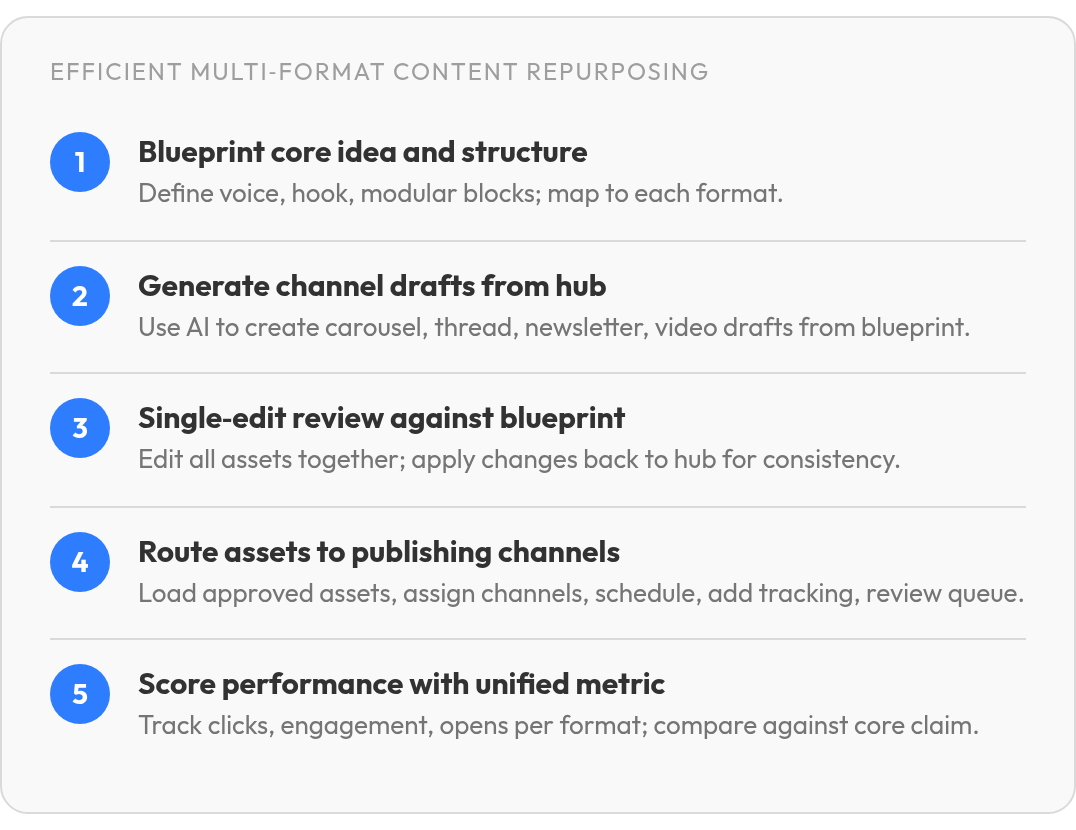
The tools are usually in place. The workflow often isn't. Plenty of teams have AI-assisted repurposing on hand and still leave good source material sitting unused, which points to planning as the bottleneck. AI can speed up production, but it can't rescue a source piece that was never built to split.
Rewrite-first workflows charge a hidden tax
When you write the long piece first and adapt it later, every channel starts from zero. You rebuild the hook for X, the slide logic for LinkedIn, the CTA for the newsletter, and the visuals for the short video. That duplicated work can swallow whole afternoons. The message also tends to drift a little with each pass.
Your audience notices the drift. The same buyer may run into your idea in a feed, an inbox, and a video app during one buying journey. Those versions only reinforce each other when they come from the same core.
- Rewrite-first: draft the piece, then adapt, edit, and format each channel separately.
- Multi-format-first: define the core idea, hook, proof points, and CTA once, then adapt each output on purpose.
Our recommendation is the second one for anything substantial enough to carry it.
One blueprint lowers the cost of every asset
Planning the outputs up front makes each piece cheaper. A big research asset is expensive when it sits alone as a single download. Split it into a planned set of smaller pieces and the original spend works across more channels. We walk through a similar breakdown in turning one blog post into 25 pieces.
We use the ratings below as a planning aid. They're our judgement, not an industry benchmark.
| Output | Effort | Skill | Reuse value |
|---|---|---|---|
| LinkedIn carousel | Medium | Medium | High |
| X thread | Low | Medium | Medium |
| Newsletter | Medium | Low | High |
| Short video (30–60 sec) | High | High | Medium |
Skip the full four-format plan for thin or time-sensitive posts. A quick product announcement rarely has enough proof to fill a carousel, so pick only the formats your source can actually support.
Blueprint the core idea: voice, hook, and structure
One idea has to hold up across several formats without sounding like four unrelated campaigns. The blueprint is the planning doc that makes that work, and it's usually the piece missing from a repurposing workflow.
The simplest model is a hub-and-spoke map. The core idea sits in the center. Four spokes point out to the LinkedIn carousel, the X thread, the newsletter, and the short video. Every spoke pulls from the hub, so the message stays fixed while the format changes.
What goes into the hub?
Start with a voice checklist you reuse for every idea, so tone decisions get made once instead of per channel.
Then outline the idea in modular blocks: problem, insight, steps, proof, example, objection, CTA. Each block should stand on its own. That way you can lift the proof block into a carousel slide, or the objection block into a thread post, without rebuilding the logic around it.
How does one hook become four?
Write one core hook, then adapt it per channel:
- The carousel opener makes a promise the slides keep.
- The first X post states the tension in one line.
- The newsletter subject line earns the open, and the first paragraph restates the promise.
- The short video's spoken hook lands right away, paired with a visual cue.
Next, map blocks to spokes. A carousel can run promise, insight, steps, proof, CTA, roughly one block per slide. A thread follows the same order. The newsletter carries the full set and links out to the other assets. Short clips tend to work best when they stay tight: pick one block, script the hook, show it, close on the CTA.
If an idea has no proof or example block, skip the carousel. It will read as filler. AI tools can draft channel variants fast once the hub is solid. They'll also copy a weak hub's problems into every variant, just as fast.
Polish once, publish everywhere: the single-edit cycle
Editing four assets separately feels thorough. In practice it often produces four slightly different arguments. Each review pass adds small changes, like a softened claim in the thread or a new CTA in the newsletter, and by launch the formats no longer agree with each other.
We fix this by editing once, against the blueprint, before anything ships. You review all four outputs side by side in one sitting, and every correction goes back to the hub first. In our experience, this cycle decides whether a content repurposing strategy holds together or splinters.
One checklist covers all four formats
Run each asset through the same six checks:
- Core claim: It states the hub's idea at the same strength.
- Hook: It fits the format but promises the same payoff.
- Proof point: It uses the same evidence, with no swapped-in stat.
- Tone: It matches your voice checklist.
- CTA: It points to the same next step.
- Visual requirement: The asset has what its format needs, from carousel slides to captions on the clip.
The short video is a useful stress test. Its compressed format strips the idea down to a hook and one supporting point, so it shows quickly whether the concept is clear enough to travel.
Treat CTA alignment as an editorial rule. If the thread asks readers to subscribe and the carousel asks them to book a demo, you've split their attention. We pick one next step per idea and repeat it everywhere.
Rights and claims get checked once, not four times
Compliance tends to slip when each channel gets reviewed on its own. Check the whole set together:
- Disclosures for sponsored content, affiliate links, or AI-generated media
- Rights to every image, font, and music track, especially audio added to the clip
- Substantiation for every claim, so the newsletter never promises what the thread hedges
The cycle has two limits. It takes setup time, and the payoff depends on how carefully you run it. If a piece has no visual story, drop the carousel instead of forcing slides. For help matching ideas to formats, see our content repurposing plays that turn blogs into traffic.
The bottom line on repurposing: automate the routing, score the idea
Most teams grade the wrong thing. They check carousel likes, thread reposts, and newsletter opens in four separate dashboards, and nobody asks how the idea itself performed. If you planned one blueprint, you need one scorecard to match it.
Automation is where the planning pays off. Once the hub is approved and the single edit is done, distribution should be the boring part of the week. You aren't rewriting or swapping hooks anymore. You're routing finished assets to the right channels at the right times.
Confirm every destination before you schedule
Start by checking where each asset can actually go. List every destination in the blueprint (LinkedIn, X, your newsletter, short video) and confirm your publishing setup supports each one before you build a calendar around it. We publish to LinkedIn, X, Instagram, TikTok, and YouTube, and we create and send newsletters. If a format you need falls outside that list, plan to post it by hand so the gap doesn't surprise you on launch day.
Then run the setup in this order:
- Load approved assets. Upload or paste only the versions that passed the single edit, so no draft slips into the queue.
- Assign channels. Map each asset to its destination using the blueprint's spokes.
- Schedule publish times. Space the formats so the same audience meets the idea more than once without getting all of it on one day.
- Add tracking links. Tag every CTA by format so clicks and leads trace back to the asset that earned them.
- Review the queue. Read the full lineup once before anything goes live.
Every format gets a different metric
Judge each format by the number that fits how people use it:
- LinkedIn and X: engagement, meaning comments, reposts, and saves.
- Newsletter: open rate and click-through rate.
- Short video: views, watch time, and retention.
- Every format: clicks and leads from your tracked CTAs.
Then compare the formats side by side. Every asset carries the same core claim, so a gap between them tends to reflect format fit rather than message quality. If the thread drives more clicks than the carousel, that tells you something about where your audience acts on this kind of idea.
Don't read too much into the first few launches. Hold off on these comparisons until you've run enough ideas through the blueprint to see patterns, because early results can be noisy when timing, topic, or distribution strength varies from one launch to the next. Start with your next substantial piece: blueprint it, edit it once, route it, and give the scorecard a few cycles before you change the plan.
Frequently Asked Questions
Can AI tools replace the blueprint step if they already rewrite content quickly?
No. AI is most useful after the strategic choices are made: the promise, the supporting evidence, the audience angle, and the CTA. Without those decisions, it can produce polished variants that still feel scattered. The blueprint gives the tool a clear source of truth instead of asking it to invent structure after the fact.
Do short or time-sensitive posts need all four formats?
Usually not. Match the format to the amount of substance in the source. If the update is simple, publish it where brevity is a strength instead of stretching it into slides, emails, and video. The goal is reusable clarity, not maximum output at any cost.