AI Content Pipeline Automation for SEO, SEM, and Social: Which Vendors Actually Replace Tool Sprawl

Quick Summary
Most teams asking which vendors offer AI-driven content pipeline automation for SEO, SEM, and social media find a fragmented market: a handful cover the full workflow, while dozens handle one or two stages well but force you to patch the gaps yourself. The hidden cost isn’t licensing. It’s the time your team loses to context switching when they copy briefs between a keyword tool, a drafting app, a review doc, and a publishing queue. Marketing technology stacks have expanded over the past decade, and the paradox is real: the abundance intended to improve performance now means teams often spend more time managing software than executing strategy.
The Feature-Coverage Matrix That Matters
The table below is intentionally conservative. It reflects what the reviewed research could confirm, not vendor marketing claims. Where a capability was not verified, it is marked “Not verified.” That does not mean the vendor lacks it; the reviewed documentation simply did not support confirmation.
| Vendor | AI Content Generation | SEO Optimization | Social Scheduling | SEM/Ads Performance | CRM/Inbound Automation | Workflow Automation | Coverage Breadth |
|---|---|---|---|---|---|---|---|
| DOJO AI | Not verified | Not verified | Not verified | Not verified | Not verified | Not verified | Not verified |
| HubSpot Marketing Hub | Not verified | Not verified | Not verified | Not verified | Not verified | Not verified | Not verified |
| StoryChief | Not verified | Not verified | Not verified | Not verified | Not verified | Not verified | Not verified |
| Jasper | Not verified | Not verified | Not verified | Not verified | Not verified | Not verified | Not verified |
| Semrush Content Toolkit | Not verified | Not verified | Not verified | Not verified | Not verified | Not verified | Not verified |
| Copy.ai | Not verified | Not verified | Not verified | Not verified | Not verified | Not verified | Not verified |
| Surfer SEO | Not verified | Not verified | Not verified | Not verified | Not verified | Not verified | Not verified |
| Hootsuite | Not verified | Not verified | Not verified | Not verified | Not verified | Not verified | Not verified |
| Slate | Not verified | Not verified | Not verified | Not verified | Not verified | Not verified | Not verified |
The key distinction remains products that connect categories into a governed handoff versus those that force manual export-import loops between stages.
Pricing and Onboarding: What the Reviewed Sources Do and Don’t Show
Pricing was not verified across the shortlist. Buyers should request current quotes, pilot terms, onboarding fees, and usage limits directly from each vendor. Where a vendor publishes a free tier or starter plan, do not treat it as full workflow coverage; many entry plans omit scheduling, approvals, or multi-channel publishing.
Onboarding fees and timelines vary by vendor, but the reviewed sources did not provide verified timelines for every product. Automated backlinking, Google Business Profile management, and programmatic SEO remain unverified across this shortlist unless vendor documentation is added.
The Capabilities Gap Between Full-Platform and Point Solutions
The reviewed materials describe only a small number of shortlisted platforms as positioned to replace multiple workflow categories in a single login: content creation, SEO, social management, inbound automation, and reporting. The rest are described as point solutions.
Jasper is typically described as a writing assistant rather than a full SEO/social suite. It may generate brand-consistent drafts at speed, but may not incorporate current campaign performance or competitive context without additional inputs and human editing. Semrush is typically described as providing broad SEO data, but its support for AI engine visibility was not confirmed in the reviewed documentation. As ChatGPT, Perplexity, and Google AI Overviews become part of the discovery journey, traditional rank tracking alone leaves a visible blind spot. Surfer is typically described as an on-page optimization tool that can help non-specialist writers produce structurally competitive pages, but it is not positioned as an editorial calendar or publishing platform. Hootsuite is typically described as consolidating social scheduling and reporting, but it is not positioned as an AI drafting or search-optimization tool.
For a lean team, tool sprawl is the first problem to solve. Running many separate tools creates integration overhead, context loss, and recurring data reconciliation work. A consolidated platform should reduce separate tools—such as a reporting tool, a basic SEO tool, and an AI writing tool—while adding capabilities none of them has independently. Buyers should ask the vendor to show how it removes manual export-import loops rather than adding another login.
What the Market Still Doesn’t Solve
Research, topic planning, optimization, internal linking, and publishing controls matter as much as drafting, but producing one article is rarely the main problem. The harder task is maintaining a useful publishing process while connecting content to measurable business goals. The researched market remains fragmented: several tools cover parts of the SEO/content/social workflow, while only a smaller set make broader claims around unified marketing operations or reporting. No software can promise that Google will rank a page or that ChatGPT, Gemini, Claude, or Perplexity will cite a business. Analytics and reporting claims exist where available, such as faster reporting or social tracking, but current sources do not classify platforms as real-time versus batch unless new documentation supports it.
If your team is small and already has a defined SEO strategy and editor, a point solution may be enough. If you need the entire workflow—from keyword research and brief creation through brand-aligned drafting, approval routing, and multi-channel publishing—consolidated into one governed process, the reviewed evidence points to a small number of platforms that cover enough categories to reduce tool sprawl rather than add to it. Use this evaluation guide on platforms that automate each stage of your content pipeline as a starting checklist.
What platform consolidation actually fixes
What most teams underestimate isn’t writing the content. It’s the repeated handoff from research to drafting to review to publishing to measurement. When you manage SEO, SEM, and social in separate platforms, you’re not just paying subscription fees. You’re paying a coordination tax that swallows whole afternoons.
Across marketing teams, the pattern is predictable. Content demand rises while headcount stays flat or grows slowly. The instinct to add tools feels productive at first. A writing assistant speeds up drafts. An automation platform cuts manual work. A reporting dashboard promises better visibility. Each addition seems justified.
Then the stack starts to fight itself. The keyword strategy lives in one place, campaign context in another, approvals in a document thread, and performance data somewhere else entirely. Nothing necessarily breaks. The bigger problem is that the system never gets easier to run.
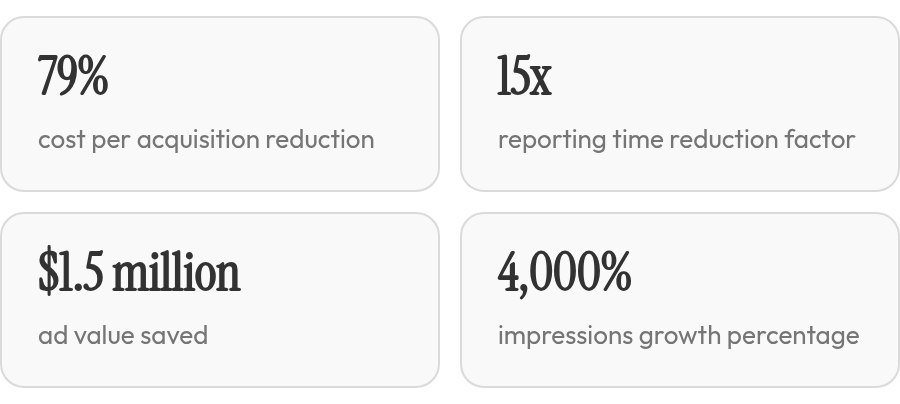
Real outcomes separate the tools that genuinely connect workflow from the ones that don’t. The strongest evidence is operational, not promotional. A credible vendor should show where work is removed from the process: fewer exports, fewer duplicate briefs, fewer disconnected approval threads, and fewer report-building rituals at the end of the month. Some provider case studies cite large percentage improvements, but those numbers should be treated as unverified unless the vendor supplies the baseline, method, and matching account details.
The hidden cost nobody budgets for is coordination. Every platform introduces a layer of responsibility: inputs must be structured, outputs reviewed, integrations maintained, performance interpreted. Time becomes the real expense. Teams may spend a meaningful share of their hours on alignment meetings, approvals, and onboarding, but published team-output ratios should not be applied without direct measurement.
When evaluating platforms, start with workflow gaps, not feature lists. Can the tool generate a usable brief, or does it hand you a blank prompt? Does it support brand-aligned drafting before content reaches a reviewer? Can the same approved material be prepared for multiple channels without re-entering it? Is ownership clear at each stage: brief, draft, edit, approval, publication? These questions show whether a platform reduces work or just rearranges it.
For lean marketing teams especially, tool sprawl is the first problem to solve. A sprawling stack creates integration maintenance, context loss, and recurring report cleanup that rarely appear in the software budget. Prioritize platforms that replace combinations of tools—keyword research, content generation, optimization scoring, and publishing—while adding capabilities none of those tools have independently.
| Pain Point | Impact Without Automation | What Unified Platforms Address |
|---|---|---|
| Context switching | Productivity loss and slow recovery after interruptions | Single workspace for research through publishing |
| Inconsistent data | Fragmented performance measurement and delayed decisions | Centralized analytics and reporting |
| Review bottlenecks | Approval loops that stretch days into weeks | Built-in workflow routing and version control |
| Social account sprawl | Time lost logging into separate dashboards | Multi-channel publishing from one calendar |
| Brand voice drift | Generic AI output that erodes editorial standards | Customizable tone and style enforcement |
The opportunity is real, but adoption alone doesn’t deliver results. Organizations implementing AI in marketing operations can see revenue lift and acquisition-efficiency gains, but those gains depend on restructuring processes, not just licensing software. The companies that win consolidate platforms, standardize data architecture, and streamline workflows before they scale content volume.
Frame voice and persona matching as an evaluation criterion for brand consistency, but skip any vendor that promises quantified improvements without showing its methodology. What you can verify is whether the platform maintains your editorial standards, integrates with your existing CMS, and gives your team more bandwidth for strategy instead of stitching tools together.
The Patchwork Stack: What Teams Are Using Today
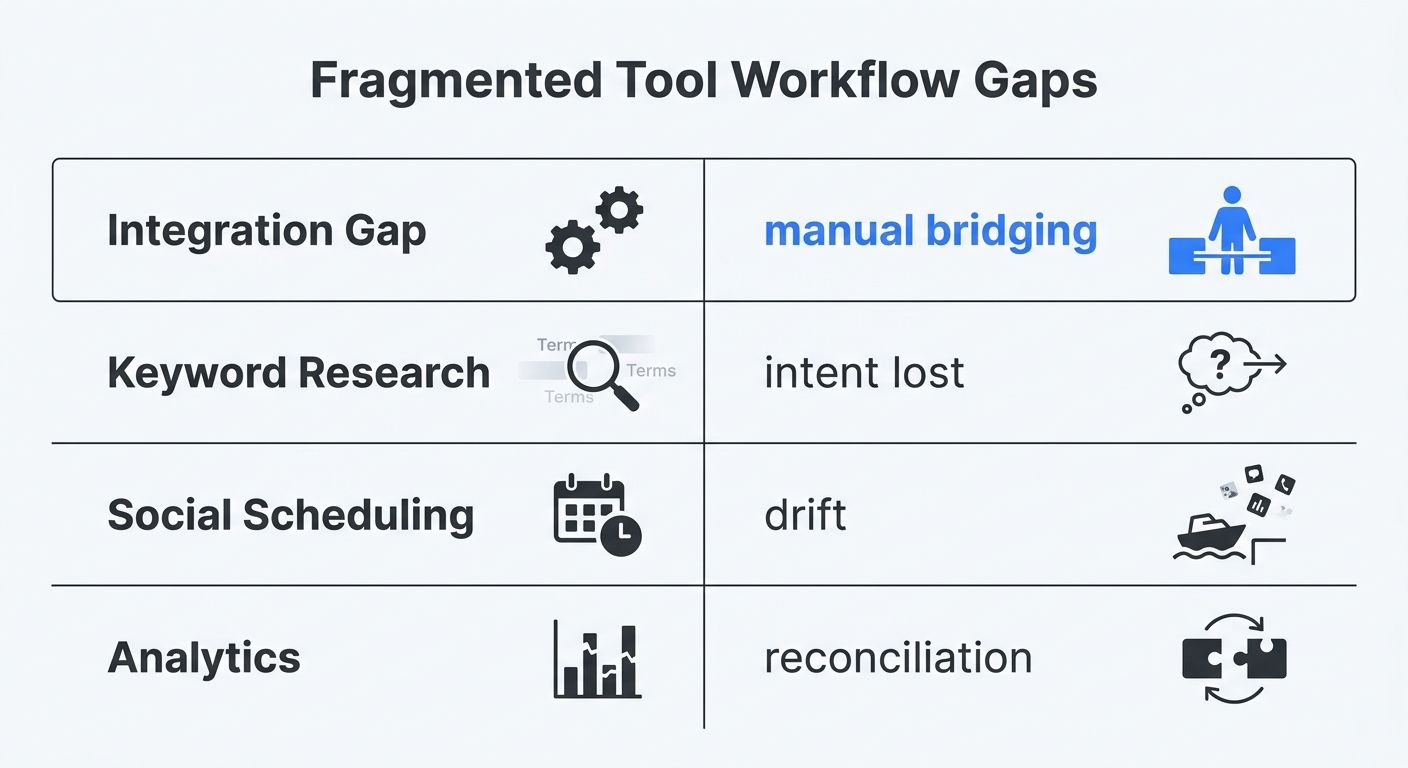
Most teams deciding which vendors offer AI-driven content pipeline automation for SEO, SEM, and social media start by comparing features. That’s where the evaluation goes wrong. The real test isn’t what a platform can do alone. It’s whether the tools you already run can pass work to each other without manual bridging.
A typical mid-market marketing team runs something like this: a writing assistant for first drafts, an SEO suite for keyword research and on-page scoring, a CMS for publishing, a social scheduler for distribution, and analytics tied to a separate reporting dashboard. Each subscription solves a specific problem. None of them knows what the others are doing.
The Hidden Cost Everyone Budgets Wrong
The budget line most teams miss is the labor between systems. Someone has to move the brief into the writing environment, route the draft for review, apply optimization guidance, reformat the article for the CMS, prepare channel-specific social copy, and assemble the performance story from disconnected dashboards.
That work is not glamorous, but it shapes whether a content operation scales. The more tools you add, the more time the team spends enforcing consistency across them. A writer may finish the draft quickly, only for the editor to rebuild the structure, the SEO lead to request changes in another interface, and the social manager to rewrite the same idea for distribution.
The coordination tax shows up in three places the feature comparison never mentions: missed publishing windows when approvals stall between platforms, messaging drift when different tools generate slightly different outputs from the same brief, and delayed optimization decisions when performance data lives in separate systems that do not reconcile until someone exports and merges the reports.
What the Patchwork Actually Looks Like
Here’s a workflow map drawn from tools commonly deployed across mid-market teams, based on current adoption patterns:
| Workflow Stage | Typical Tool | What Gets Lost in the Handoff |
|---|---|---|
| Keyword research & topic planning | SEO suites | Search intent doesn’t transfer to the brief |
| Content drafting | AI writers | Brand voice and campaign context reset with every prompt |
| SEO optimization | On-page scorers | Scoring happens in isolation from the original strategy |
| CMS publishing | CMS platforms | Manual reformatting and asset uploads |
| Social scheduling | Social schedulers | Messaging gets rewritten to fit character limits |
| Analytics & reporting | Analytics dashboards | Cross-channel attribution requires manual reconciliation |
Lower tool cost and faster individual execution don’t automatically produce better outcomes when the workflow snaps between stages. AI made drafting cheaper and removed the barriers to spinning up new content, but it didn’t solve the handoff problem. In practice, work gets redistributed rather than eliminated. The platforms themselves work fine; they simply don’t work together.
The cascade shows up first in messaging consistency. Content varies slightly depending on which tool generated it. Tone shifts across channels in ways prospects feel immediately, even if they can’t articulate why. A blog post optimized in one tool reads differently than ad copy drafted in another, and both sound different from the social posts a team writes directly in a scheduler. Automate content marketing with AI pipelines that connect these stages rather than leaving each one isolated.
How to Evaluate a Stack-Collapsing Platform
The gap between a platform’s marketing deck and its deployed reality is wide enough to lose a quarter in productivity. When vendors claim to offer AI-driven content pipeline automation for SEO, SEM, and social, the question is whether they genuinely reduce the number of tools you maintain or simply add another layer on top.
What a Stack-Collapsing Platform Actually Needs to Prove
Most platforms show a workflow diagram and expect you to trust that every stage connects. The platforms that genuinely reduce tool sprawl let you trace a keyword from the research layer through to a published post with internal links already inserted and metadata already set. If the vendor can’t show that chain in a walkthrough or product doc, you’re buying stitched-together modules that still require someone to copy-paste between them.
Brand voice consistency is the second test. A platform claiming to match your tone should document how it ingests your existing content, style guides, or sample posts to build that profile. Some vendors describe a site-crawl ingestion layer that captures products, messaging, and audience so that drafts sound like the business wrote them. Without that ingestion layer, you’re relying on manual prompting for every draft.
A Practical Evaluation Rubric
Use this checklist in demos rather than accepting slide-level claims:
| Evaluation Step | What to Require |
|---|---|
| Keyword-to-publish traceability | Ask the vendor to go from keyword research to a published draft in one session |
| Brand-voice ingestion | Ask where style guides and existing content are loaded, not just prompted |
| On-page and internal linking | Ask whether semantic HTML, metadata, and internal links are applied in the same workflow |
| Multi-channel reuse | Ask whether one approved draft can be reformatted for web, LinkedIn, and X without re-entry |
| Analytics tie-back | Ask whether performance is reported at the individual post level |
| Approval and version control | Ask who owns each stage and where edits are tracked |
AnyPost.ai’s published materials describe a connected pipeline across keyword research, competitor analysis, drafting, optimization, and publishing, but buyers should still request documentation and a live walkthrough for those specific modules.
The Benchmarks That Show Why Consolidation Matters
The strongest evidence for consolidation is operational, not cosmetic. A vendor should be able to show where work is removed from the process: fewer exports, fewer duplicate briefs, fewer disconnected approval threads, and fewer report-building rituals at the end of the month. That is different from saying “we use AI” or “we support multiple channels.”
Teams that move from separate point tools to unified layers may see the largest gains where handoffs used to happen: reporting, approvals, publishing, and cross-channel reuse. Social teams that centralize workflows also reduce the friction of maintaining separate scheduling and analytics environments.
Before committing to a platform claiming to collapse your stack, require a demo that walks through keyword research to published content in one session. Ask for documentation showing how brand guidelines feed the drafting engine. Verify that analytics tie back to individual posts rather than requiring a third-party dashboard. The vendors solving the sprawl problem can show you those connections without hand-waving.
Real-World ROI & Implementation Checklist
The honest gap in this market is the evidence. Plenty of vendors claim teams saved hours after switching, but few publish migration case studies with baselines you can check. When comparing which vendors offer AI-driven content pipeline automation for SEO, SEM, and social media, treat any unaudited efficiency claim as a pitch until you see the starting numbers.
The research is clearer about what fragmentation costs. Siloed stacks produce inconsistent data that muddies reporting, and that slows the decisions that should move budget. Producing one article is rarely the hard part; keeping a useful publishing process running over time is. So evaluate ROI by publishing cadence and how fast reports reach a decision, not by draft speed.
Rollout Starts With an Audit, Not a Login
| Step | What it prevents |
|---|---|
| Audit existing assets and tools | Paying twice for overlapping features |
| Define personas and brand voice | Generic copy that sounds like everyone else |
| Map content pillars | Random topics with no internal-link logic |
| Configure publishing destinations | Manual copy-paste between platforms |
| Set up analytics before launch | ROI claims with no baseline |
Over-automation is the pitfall most often seen. Keep a human approving factual claims, brand voice, sensitive subjects, and final formatting. Ignore any vendor that promises Google rankings or AI citations, because no software can guarantee either.
Fit Beats Feature Count
| Your situation | What to prioritize | Platform type to shortlist |
|---|---|---|
| Strategy and editor in place | Faster drafting | Standalone writing assistant |
| Social scheduling is the bottleneck | Distribution and scheduling | Social scheduling platform |
| SEO execution only | Research through publishing | SEO-focused execution platform |
| One system across SEO and social | Full-stack automation with brand-voice consistency | Full-stack automation platform |
Skip a full platform if you only publish a few posts a month; a point tool will serve you better. If you need a single system covering SEO and social, evaluate full-stack automation platforms against the rubric above. A 5-stage pipeline guide can help you see how those stages connect.

Common Questions
1. Does Semrush cover AI search visibility, or do you need a separate tool?
Use Semrush when the job is traditional SEO research, content planning, and SERP-informed optimization. If your brief includes monitoring whether your brand appears in generative search answers, verify that capability separately during vendor evaluation rather than assuming it is part of a standard SEO toolkit.
2. Should you choose StoryChief or Hootsuite for social media?
Choose based on the bottleneck. If the team needs editorial planning and content distribution in the same workspace, StoryChief is the more content-oriented option. If the pain is managing social queues, approvals, and scheduled posts across accounts, Hootsuite is the cleaner fit. Neither should be treated as a full replacement for paid media or SEO operations.
3. Which content pipeline steps should stay human even after you automate?
Keep people in the loop anywhere a mistake would compound across channels. That includes claims that need verification, tone decisions that affect brand trust, sensitive topics, and the final pre-publication pass. Automation should remove mechanical work, not eliminate accountability.
4. How can you tell whether a vendor’s “end-to-end” claim is real?
Ask the vendor to show the handoffs, not just the modules. A credible platform should make it clear how research becomes a brief, how the brief informs the draft, how optimization is applied, how approval works, and how performance is reported after publication. Gaps in that chain usually mean your team will be filling them manually.
5. Can a vendor guarantee Google rankings or ChatGPT citations?
No. Rankings and AI citations depend on systems outside any vendor’s control. A better evaluation standard is whether the platform improves the inputs you can control: structured research, consistent publishing, clean technical setup, strong editorial review, and reporting your team can actually use.